

Are Drop Down Menus Bad for SEO
The Reputation and the Reality
Drop down menus have a bad reputation in SEO circles, and it is not entirely undeserved. Plenty of sites have been held back by navigation that search engines could not crawl, that buried important pages behind hover states, or that dumped four hundred links onto every single page. But the menu pattern itself is not the culprit. A drop down built with server-rendered anchor links, a sensible number of items, and a structure that mirrors how users actually think about the site is perfectly SEO-friendly. The question is never whether to use a drop down. It is whether your navigation is crawlable, focused, and architecturally honest.
How We Can Help With SEO at AAMAX.CO
At AAMAX.CO, navigation is one of the first things we examine when a site with good content is underperforming, because information architecture quietly determines how authority flows through every page you publish. We map your existing structure, identify pages orphaned or diluted by bloated menus, rebuild the hierarchy around real user intent and search demand, and implement it as crawlable server-rendered markup with proper internal linking and breadcrumbs. We are a full service digital marketing company delivering web development, digital marketing and SEO services worldwide, so we can redesign the navigation, build it in your codebase, and measure the ranking impact afterwards. If your site has grown organically into a sprawling menu nobody can defend, our SEO services start by fixing that foundation.
When Drop Down Menus Genuinely Hurt
There are specific failure modes worth knowing. The most serious is a menu rendered entirely by client-side JavaScript that only builds its links after a user interaction. If the anchor elements do not exist in the initial HTML, crawlers may never discover the destinations, and any page not linked elsewhere becomes effectively invisible. A second failure is link bloat: mega menus that expose every category, subcategory, and filter combination on every page, spreading internal authority so thinly that no page receives a meaningful signal about its importance. A third is depth confusion, where menus flatten a site so aggressively that search engines cannot tell which pages are hubs and which are leaves. A fourth is mobile behaviour, where a desktop menu becomes an unusable nested accordion, harming engagement metrics that indirectly influence performance.
Crawlability Is the Non-Negotiable Part
Whatever visual pattern you choose, the links must exist as real anchor elements with real href attributes in the server-rendered HTML. Crawlers do execute JavaScript, but rendering is slower, less reliable, and less complete than parsing static markup, and depending on it for your primary navigation is an unnecessary risk. Hover and click behaviour should be a presentation layer over links that are already present in the document. A quick way to verify this is to view the raw page source, disable JavaScript, or fetch the page with a plain HTTP request and confirm every navigation destination is still there.
Link Volume and Authority Distribution
Every internal link on a page divides the authority that page can pass along. A menu with thirty carefully chosen links sends a much stronger signal about what matters than a menu with three hundred. There is no magic threshold, but a useful discipline is to ask what percentage of visitors would ever click each item. Links that serve fewer than a fraction of a percent of users usually belong on a category page, a sitemap page, or a footer resource index rather than in the primary navigation. Pruning a bloated menu is one of the few SEO changes that regularly produces measurable improvement without adding a single word of new content.
Architecture Matters More Than Menu Style
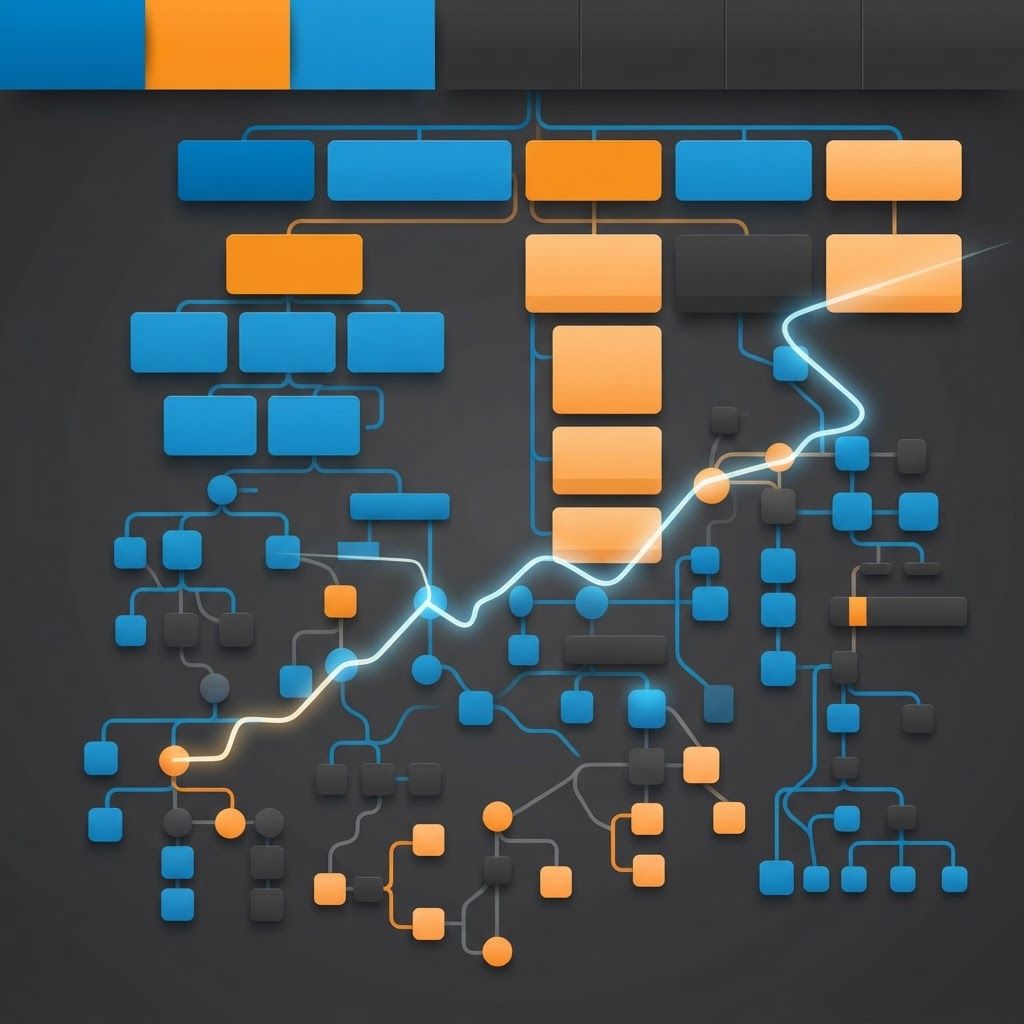
The deeper issue behind most navigation problems is that the menu is being used to paper over an incoherent site structure. Good architecture groups content into a small number of clear top-level topics, each with a genuine hub page that ranks for the broad term and links down to specific pages beneath it. The menu should then reflect that hierarchy rather than replace it. When the underlying structure is sound, the navigation can be simple, because most discovery happens through hub pages, contextual internal links, and breadcrumbs. When the structure is a flat pile of pages, the menu inevitably swells to compensate.
Building a Drop Down That Works
A well-implemented drop down has a handful of characteristics. Top-level items are themselves linkable hub pages, not dead toggles. Sub-items are limited to genuinely important destinations. The markup uses a navigation landmark, real lists, and real anchors. Keyboard and screen reader access work correctly with appropriate expanded-state attributes. Mobile uses a pattern designed for touch rather than a shrunken desktop menu. Descriptive anchor text tells both users and crawlers what the destination covers. Breadcrumbs reinforce the hierarchy on every page. And contextual links within body content carry a meaningful share of the internal linking load.
Signals That Your Navigation Is Hurting You
Watch for a few diagnostic patterns. Important pages that receive very few internal links according to your crawl tools. Category pages that fail to rank for their obvious head term while individual product or article pages rank instead. Crawl statistics showing search engines spending most of their budget on low-value URLs. High exit rates from category pages. Large numbers of discovered-but-not-indexed URLs. Each of these often traces back to how the menu is distributing attention.
The Verdict
Drop down menus are not bad for SEO. Uncrawlable menus, bloated menus, and menus that substitute for real architecture are bad for SEO. If your drop down is server-rendered with genuine anchor links, restrained in the number of destinations it exposes, accessible on every device, and built on top of a clear topical hierarchy supported by hub pages and breadcrumbs, it will help both users and search engines navigate your site. Fix the architecture first, keep the markup semantic and crawlable, and the menu style becomes a design decision rather than an SEO liability.
Want to publish a guest post on aamax.co?
Place an order for a guest post or link insertion today.
Place an Order