


10 Best Contract Management Software Platforms for UK Businesses in 2026
A UK buyer's comparison of the best contract management software in 2026, with CLM platforms and contract management system picks judged on Procurement Act readiness
The best contract management software for a UK business in 2026 has a harder job than it did three years ago. It still needs to store every signed agreement in one searchable place and warn you before a renewal fires. On top of that, UK rules now ask your contract records to prove things. Public contracts over £5m carry published KPIs that authorities assess at least every 12 months. Section 73 of the Procurement Act 2023 pushes 30-day payment terms down every public sub-contract in the chain. Large companies report their payment behaviour twice a year, and failure to report is a criminal offence for the business and for every director. A spreadsheet doesn't answer any of that; a good contract management system does.
The ten platforms below cover the full spread a UK buyer meets: a unified vendor-and-contract platform built in the UK, browser-first CLM tools from London and Manchester, European platforms with published prices in euros, a construction specialist for NEC and JCT work, and the American enterprise suites that dominate global shortlists. Rather than scoring them on feature counts, the reviews walk through where each one earns its place and what it costs when a price exists in public, with the capability gaps spelled out rather than smoothed over. Treat it as advice from someone who has read the vendor pages, the security documentation and the user reviews so you don't have to open forty tabs.
One honest note before the detail: every platform here now claims AI. The useful question isn't whether a vendor has AI; it's what records that AI can see. An assistant that reads contracts alone answers contract questions. An assistant that also sees the supplier's risk profile and the spend behind the agreement can answer the questions a UK compliance deadline asks.
Key takeaways
- UK compliance has become a buying criterion. Procurement Act 2023 duties, payment practices reporting and published KPI assessments all generate evidence work that your contract records either support or don't.
- The market splits four ways for UK buyers: unified vendor-and-contract platforms, legal-led CLM tools (Juro, Summize), European repository and automation platforms (Zefort, Precisely, Oneflow, M-Files) and enterprise suites (Ironclad, DocuSign), with Sypro sitting apart from all four as the construction specialist.
- Pricing transparency is rare. One platform here publishes pound pricing and two publish euro pricing; the rest quote. Budget for the quote process itself.
- AI is table stakes; data scope is the differentiator. Extraction and review ship with almost everyone, so judge what the AI can see: the contract alone, or the vendor and spend record behind it.
- Adoption beats feature depth. A platform your procurement, finance, legal and operations people open without training wins over a heavier system that stays inside one team.
Contract management software for smaller UK businesses
Match the tool to your size and your paperwork, because the right answer changes fast as headcount grows.
- Under about 100 contracts with one careful owner: a dated folder structure and a tracker still work. Buy software when the second person starts signing agreements, since that's when filing discipline breaks.
- A small team that drafts and signs more than it files: the browser-first tools fit best. Oneflow lists an entry Business tier from around €50 a month on its G2 page, and Juro quotes in pounds for UK teams.
- A compliance-driven team that inherits contracts rather than drafting them: a repository-first platform such as Zefort, with published pricing from €995 a month for 20 users, covers storage and deadline alerts without workflow sprawl.
- A team that answers for suppliers as well as contracts: once payment practices reporting or supplier due diligence lands on your desk, a unified platform earns its investment, because the vendor record and the contract record stop living in different tools.
The dividing line is less company size than whether anyone outside your team will ever audit what your contracts say, and in the UK of 2026 that answer trends toward yes. Payment practices reports, KPI assessments, insurance renewals and notice periods all arrive with dates attached, and the platforms below exist so those dates stop depending on one person's calendar.
What contract management software enables, and what UK buyers should expect
Contract management software gives an organisation one secure place to create, store, track and retrieve its agreements. It automates reminders, powers full-text and AI search, controls who sees what, and keeps an audit trail of every change and approval. The fuller platforms, which the market calls contract lifecycle management or CLM, add the work before it’s signed (drafting, negotiation, e-signature, approvals) and the work after it (obligation tracking and renewal reporting). The two terms have blurred; most tools now do some of both.
At a minimum, expect five crucial functions from any serious contract management system in 2026:
- Central storage: one repository replacing shared drives, inboxes, desktop folders and the filing habits of whoever left last year.
- Search that survives scanned paper: OCR plus AI search, so a ten-year-old scanned lease answers questions as well as a fresh PDF.
- Date and obligation tracking: alerts for renewals, notice periods, insurance expiries and price-rise triggers, with lead times you control.
- Access control with an audit trail: permissions based on role with a log of every view and edit, which matters the day an auditor or regulator asks.
- Workflow: intake forms and approval routing that move an agreement along without anyone chasing it by email.
A sixth job has joined the list for UK buyers: structured data you can report from. KPI evidence, payment-term fields and change-notice thresholds all assume your contracts exist as data, which a drive full of PDFs can't deliver.
Which contract management system handles renewal and expiry tracking best?
The renewal job has three parts: extract the renewal and notice dates when a contract arrives, let you set a reminder on any date with your own lead time, and show every upcoming expiry in one view. Among the ten platforms here, the capture-focused tools (Zefort, M-Files) extract dates on ingestion and remind on schedule; the workflow platforms (Juro, Ironclad, DocuSign) track dates inside broader lifecycle machinery; Oneflow reminds well but, per its own reviewers, asks you to configure reminders per document. Unified vendor-and-contract platforms go a step further by timing renewal decisions against spend data, so the alert arrives with the numbers that decide whether to renegotiate or walk.
Does contract management software help with Procurement Act compliance?
It helps with the record-keeping half, which is the half that burns time. The Act asks suppliers and authorities for evidence: KPI performance on larger contracts, payment-term compliance down the chain, published notices before modifications. Software can't make a decision for you, but it can hold payment-term fields you can query, link KPI evidence to the contract it serves and flag when a proposed change approaches the thresholds that trigger a notice. Teams that run those duties from a spreadsheet spend their quarter chasing documents; teams with structured contract data answer in an afternoon.
How UK rules shape a 2026 shortlist
Most comparisons of this category read as if every buyer sits in California. A UK shortlist looks different, because several regimes now pull contract data into the open.
Procurement Act 2023 duties turned supplier performance into published data
The main regime commenced on 24 February 2025. Contracts over £5m must carry at least three KPIs, and authorities assess and publish performance against them at least every 12 months. Section 73 flows 30-day payment terms down every public sub-contract through the chain, and overriding terms are void. Section 75 requires a published change notice before modification, with exceptions at 10% or less of value for goods and services and 15% or less for works, plus an anti-splitting rule. If you supply the public sector, your performance, your modifications and your payment behaviour now appear on a central platform. Software that extracts payment terms, tracks KPI evidence and tests a proposed change against the 10% and 15% thresholds turns those duties into routine admin. For planning, note the moving deadline: SI 2026/746 pushed the Contracts Finder switch-off to the central digital platform back to 1 May 2027, so suppliers live with both systems through most of 2026.
Payment practices reporting carries criminal exposure
Large UK companies and LLPs, meaning those meeting two of three thresholds (£54m turnover, £27m balance sheet, 250 employees), report their payment practices every six months and publish within 30 days of the period end. The metrics include average days to pay and the share of invoices settled in 30 or fewer days. Failure to report is a criminal offence by the business and by every director. You can't produce those numbers twice a year from memory; you produce them from contract and invoice data that lives somewhere queryable.
The late-payment overhaul remains a proposal, not law
A bill introduced in Parliament on 19 May 2026 would cap payment terms at 60 days (30 for public authorities) and make 8%-over-base statutory interest non-waivable. None of that has passed as of October 2026, so treat it as weather on the horizon rather than a current obligation. The direction of travel still matters when you sign multi-year software contracts: payment-term visibility across your agreements is about to get more valuable, not less. The government's own figures explain why Parliament cares: late payments cost the UK economy almost £11bn a year and close 38 businesses a day.
Construction contracts play by their own rules
NEC and JCT contracts run on notices and compensation events with tight clocks, which is a different job from managing a SaaS renewal. A general contract management system stores an NEC contract; it doesn't administer one. That's why a construction specialist appears at position eight below, and why a main contractor may run two tools without that being a failure.
The matchups UK buyers run
Most shortlists end as a pair, not a list of ten. These are the pairings that come up, and the honest way to split them.
Juro or Summize. Both are UK-grown and legal-led, with deployment measured in weeks. Juro wins if you want contracts born in its browser editor; Summize wins if your lawyers refuse to leave Word and Teams, because it embeds there instead of replacing them.
Zefort or Precisely. Both are Nordic and EU-hosted, priced for mid-sized teams. Zefort is the stronger pure archive with published pricing; Precisely is the stronger template-automation engine when you draft high volumes of your own paper.
Oneflow or DocuSign eSignature. The small-team signing decision. DocuSign brings the brand your counterparties never question and published pound pricing; Oneflow brings interactive documents that carry the negotiation as well as the signature, at a published euro entry price. If most of your agreements arrive ready to sign, DocuSign's familiarity wins; if your team drafts and haggles before anyone signs, Oneflow does more of the job in one place.
Ironclad or DocuSign. The classic enterprise bake-off. Ironclad takes workflow design and negotiation; DocuSign takes signature ubiquity and the broader agreement estate. UK buyers should weigh hosting in both cases, since Ironclad's own security page describes US-hosted infrastructure and DocuSign's data-residency page lists five regions without a UK option.
Unified vendor-and-contract platforms or a pure CLM. This one is a scope question, not a quality question. If the job ends at the contract, several tools below do it well. If the same small team also answers for supplier due diligence, payment-practice evidence and renewal spend, a one-record model removes the integration project the pure CLM route creates.
How to choose a contract management system in the UK
Feature lists converge; buying mistakes repeat. Six checks sort the market faster than any demo script.
Step 1: start from the jobs your team does every week
A paralegal hunting a renewal clause before a call, a finance manager checking payment terms against the payment-practices report, an ops lead filing a signed order: those moments decide whether the tool becomes a go-to or is shelved. Provide each vendor with a scanned, misaligned document from your own records during the presentation to test its clause-extraction capabilities. If a solution struggles with physical paperwork despite handling digital files smoothly, it will likely fail when processing your legacy repository.
Step 2: weigh up the risks of adoption over the scale of features
Most failed contract projects die of empty logins, not missing features. A platform most of the company opens beats a deeper system only legal touches. Check how each vendor prices extra users, because per-seat plans cap adoption without anyone deciding to cap it: the moment a sales manager needs one renewal date, someone has to buy a licence or forward a PDF. Unlimited-user models cost more on day one and tend to win by month six.
Step 3: read pricing behaviour as a character reference
Of these ten platforms, DocuSign publishes pound pricing for eSignature, and Zefort and Oneflow publish euro pricing. Everyone else quotes. Quote-based isn't a scandal at the enterprise tier, but it has a cost: expect weeks of calls before you see a figure, and remember your negotiating position is weakest when you’re renewing, once your contracts are in the system. Request that quote-based vendors commit to future pricing for years two and three in writing during initial discussions; their response will give you valuable insight.
Step 4: check UK and European hosting claims against the vendor's own pages
Hosting marketing and hosting documentation sometimes differ. Among the vendors here that state locations in public, Juro hosts customer data on AWS servers in Ireland, Zefort states that all data stays within the EU on European infrastructure, and Precisely names Google Cloud in Frankfurt with backups in Finland and signed documents archived in Dublin. Ironclad's security page describes US-hosted infrastructure, and DocuSign's residency page lists five regions with no UK region among them.
Gatekeeper publicly identifies AWS as its data-hosting provider in Exhibit C of its DPA, listing the USA, Ireland, Australia, and Canada as hosting locations. Buyers should confirm which region applies to their deployment. Where a vendor publishes no region at all, write "does not publish a hosting region" on your evaluation sheet rather than guessing in its favour.
Step 5: factor in implementation costs alongside licensing
Deploying an enterprise CLM can incur professional services fees that rival subscription costs. Mid-market providers frequently include onboarding within their standard package. Before committing, secure a written scope covering key integrations like single sign-on, electronic signatures, CRM, and financial software. Never rely on informal assurances regarding setup support.
Step 6: ask what happens to an obligation after signature
Receiving automated renewal notifications is only part of the equation. What truly matters is whether the platform can turn reporting mandates, insurance conditions, and KPI milestones into actionable, trackable tasks assigned to specific owners, all directly tied to their source clauses. For UK public-sector suppliers, this capability is essential given the strict schedules governing mandatory KPI reviews. During vendor demonstrations, ask to see a live walkthrough of an obligation moving seamlessly from raw text to a completed task.
How we compared these 10 platforms
The comparison below rests on each vendor's own published pages (product, pricing, security and trust documentation), review data from G2 and other public review platforms with ratings and review counts as of October 2026, and UK legislation and guidance on legislation.gov.uk and gov.uk. Pricing appears where a vendor publishes it; where none exists, the entry says so rather than inventing a figure. No claims rest on private testing. Platforms that handle e-signature alone fell outside the brief, and every entry follows the same structure so you can compare like with like.
Full reviews: the best contract management software for UK businesses
1. Gatekeeper
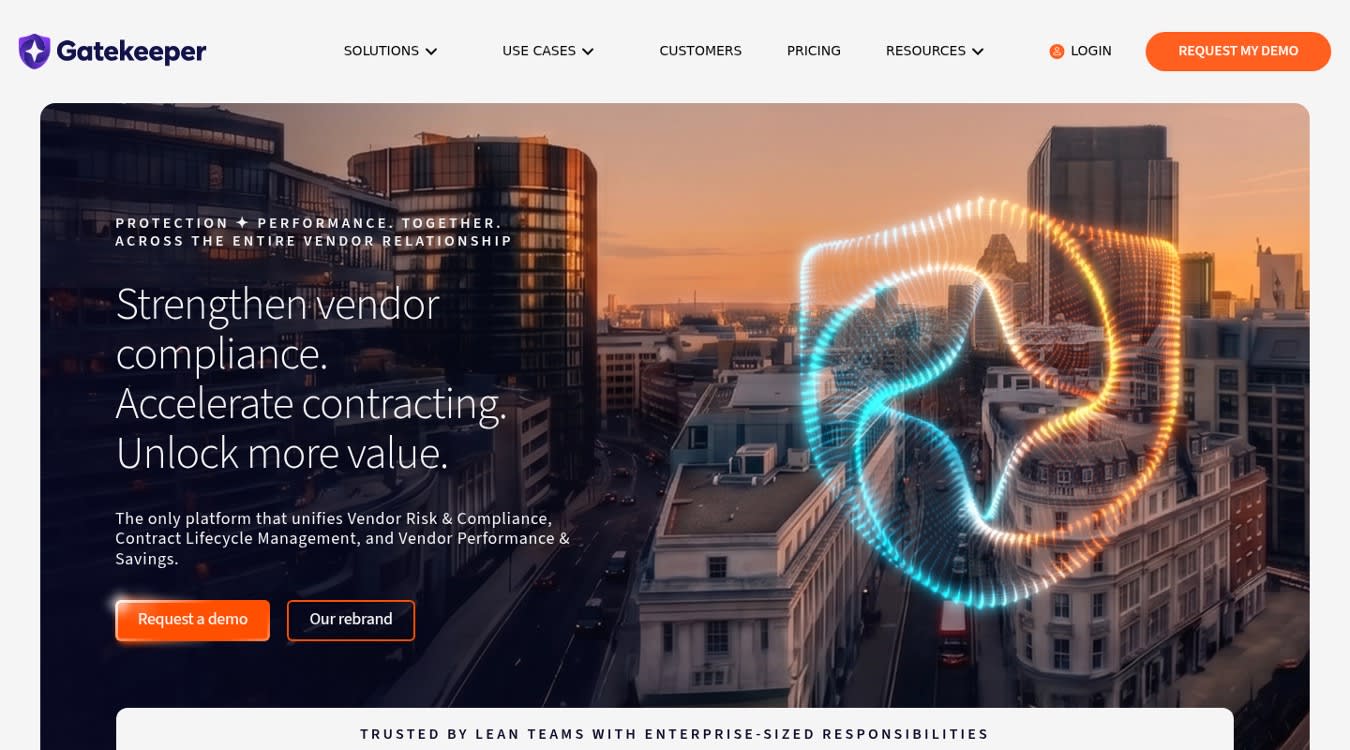
At a glance: Gatekeeper is a UK-registered platform that treats the contract and the supplier behind it as one record. It describes itself as the only unified platform for contracting and for managing third-party compliance and spend, powered by AI, and that unified-record design is the point: due diligence done before signature stays attached to the agreement, and the agreement stays attached to obligations, renewals, performance and spend for the life of the relationship.
For UK teams facing supplier-facing rules such as payment practices reporting and public-contract KPIs, that one-record model helps support evidence gathering and compliance workflows when a deadline demands answers. Gatekeeper also resolves redline bottlenecks and review speed issues, which previously caused every non-standard contract to land on the General Counsel's desk. Commercial teams can safely self-serve using guard-railed templates and an approved clause library. Over 300 organisations across 23 countries run on it, and its UK customer page names Pets at Home, DAC Beachcroft, Auto Trader, FNZ and SumUp.
Price range: Quote-based, tiered by how many third parties you manage rather than by seats. Users and eSign come unlimited.
What you'll get with Gatekeeper:
- One record for vendor, contract and spend: every agreement, obligation, renewal, performance review and line of spend hangs off the same record, so a renewal decision starts with full context rather than a search across systems.
- Pre-contract screening with nonstop monitoring: the platform screens suppliers before signature, then watches them around the clock for financial and cyber risk through the MarketIQ module, which flags trouble between review cycles instead of at the next audit.
- Built-in AI agents: All 50+ AI agents are included on every plan, with no separate AI charge, handling work such as due diligence review, contract review, obligation extraction and evidence collection, inside your permissions and your audit trail.
- Kanban Workflow Engine: no-code workflows with ready templates for third-party onboarding, renewal review, ESG due diligence and touchless NDAs, shown as boards where anyone can see which step owns the delay.
- Vendor Portal onboarding: suppliers register through a branded portal and maintain their own records, which takes the document chase out of the first weeks of every relationship.
- Spend control: actual spend tracks against contracted spend, surfacing duplicates and forgotten subscriptions before a renewal locks them in for another year.
- Published security posture: its trust centre sets out ISO 27001:2022 with SOC 2 Type II, a SOC 1 Type II attestation and ISO 9001:2015 beside them, and names DORA among the frameworks it supports.
- 1,700+ integrations: the Interconnect layer links finance, CRM, identity and e-signature tools, with Gatekeeper's own team building and managing connections.
Customer feedback highlights rapid value, though reviewers note an initial learning curve and configuration setup complexity for advanced workflow permissions. The platform holds 4.5/5 on G2 across 94 reviews, with 69% at five stars and none below three. Public G2 data shows an average implementation timeline of around four months, and the UK businesses running it include Auto Trader and SumUp, names most readers will have dealt with as customers themselves. The procurement team at law firm DAC Beachcroft puts the product view plainest:
"Gatekeeper is, from a product perspective, fantastic. It's well-built, lean in its design and incredibly easy to grasp and use.", Luke Stagg, Procurement Specialist, DAC Beachcroft LLP, on Gatekeeper's customer page
Pros
- One record carries contract terms, supplier risk, performance and spend together, so the questions UK reporting duties ask get an answer from a single query
- AI agents come included in the platform rather than sold as a separate tier, so the automation you saw in the demo is the automation you get
- Unlimited users and unlimited eSign remove the per-seat arithmetic that caps adoption on rival platforms
- A public trust centre carrying the full ISO and SOC report set gives security teams their evidence without a chase
- UK roots and UK-recognisable customers mean the product grew up with the compliance culture its British buyers work in
Cons
- You won't find a figure on the pricing page, so budgeting starts with a conversation rather than a calculator
- Tiers follow your third-party count, which means you'll want a reasonable tally of your suppliers before the sizing discussion gets precise
- The platform carries an initial learning curve and configuration setup time for complex workflow and granular permission rules
2. Juro
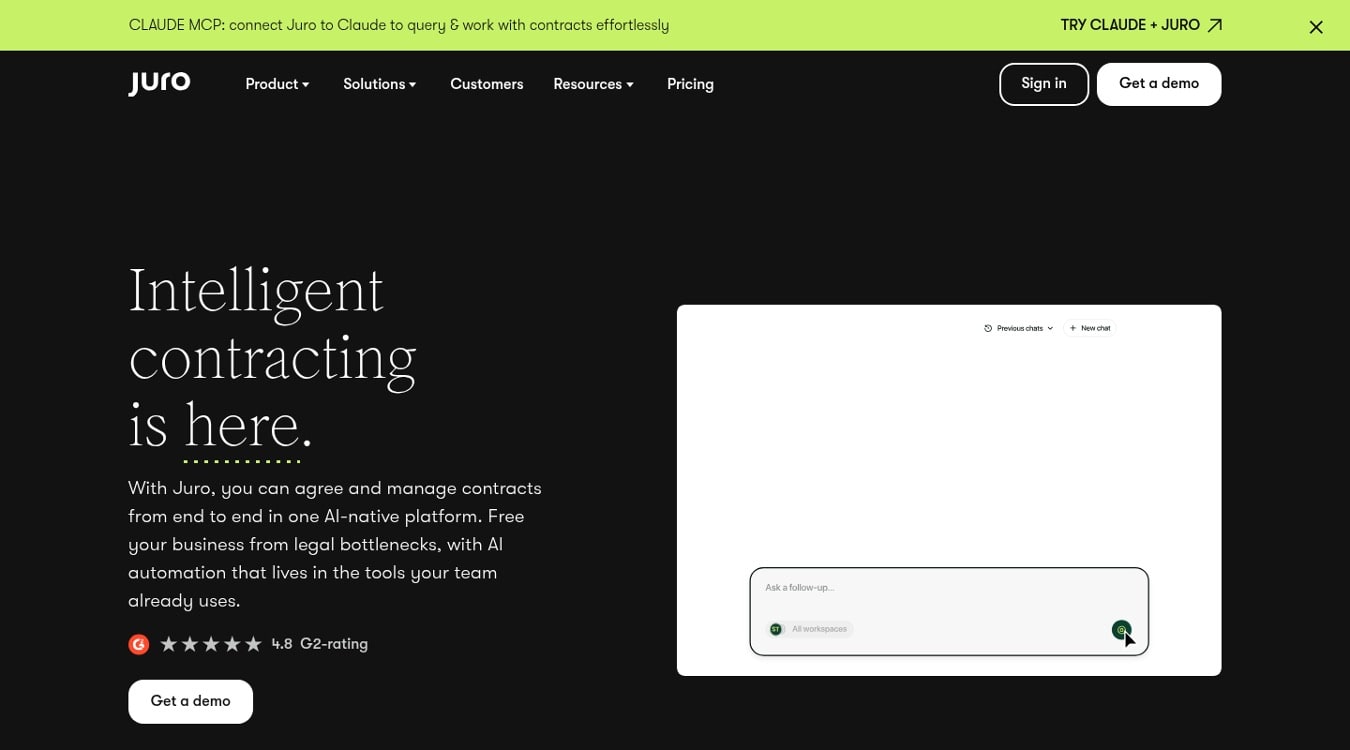
At a glance: Juro is a London-founded contract automation platform built around a browser-native editor, so agreements live as collaborative web documents rather than Word files passed by email. Legal teams keep control through templates with built-in logic while sales and HR self-serve routine paper, and an AI assistant handles extraction, drafting help and review. Review platforms rate it near the top of the category for speed of implementation, and its published security documentation includes SOC 2 Type II and Cyber Essentials.
Price range: Quote-based; Juro states it can quote an equivalent amount in USD, GBP or EUR, which makes it one of the few here that talks to UK buyers in pounds, even without a published figure.
What you'll get with Juro:
- Browser-native drafting: contracts behave like modern web documents, with comments, approvals, negotiation and signing in one place.
- Self-serve templates with logic: legal locks the language; commercial teams generate their own routine agreements against it.
- Integrated e-signature: signing happens in the same flow, without a separate tool.
- AI assistant: extraction, drafting suggestions and review support inside the editor.
- Structured repository: searchable storage with access controls once contracts reach signature.
Reviewers across platforms praise onboarding speed and the editor's ease, with a 4.8/5 rating on Capterra and top marks on G2 for implementation speed. The friction appears at scale: user feedback mentions limits in search and tagging, plus performance complaints on long or complex agreements. One more note for UK buyers: Juro's own application-security page states that customer data lives on AWS servers in Ireland, which is EU hosting rather than UK-soil residency; fine for most UK GDPR postures, worth logging for the strictest ones.
Pros
- The editor makes contract collaboration feel like ordinary document work, which drives the adoption most CLM projects miss
- Implementation speed ranks among the best on public review platforms, so time to first value stays short
- A London headquarters and GBP quoting make the commercial conversation easier for UK teams than with US-priced rivals
- SOC 2 Type II and Cyber Essentials sit in its published security documentation for your vendor-review file
Cons
- The platform stops at the contract, with no fraud monitoring, supplier risk scoring, SLA tracking or spend analytics, so vendor oversight needs a second system
- Its AI reads agreements without context from a supplier record
- Search and tagging draw criticism from reviewers as portfolios grow, and long agreements can slow the editor
- Pricing stays quote-based, so budgeting needs the sales cycle
3. Summize

At a glance: Summize, founded in Manchester, takes the opposite bet to every platform here: instead of moving your people into a new system, it embeds contract review and workflow inside Word, Teams, Slack and Salesforce. Lawyers review paper where they already work, business teams raise requests from the chat tool they already have open, and the CLM machinery hums underneath. Implementation runs in sprints, with the first use case live in around four weeks, and a recent $50M investment signals momentum behind the approach.
Price range: Quote-based and demo-led, with no published tiers.
What you'll get with Summize:
- Embedded contract review: AI summaries and clause analysis delivered inside Word and Teams rather than in a separate interface.
- Workflow from chat: intake and approvals triggered where your teams message each other.
- Central repository: a searchable store underneath the embedded experience.
- Sprint implementation: a use-case-first rollout measured in weeks.
The embedded model earns its keep in firms where a new login dies on arrival. The flip side is that research for this comparison found no published rating on the main review platforms to cite, so ask Summize for reference customers at your size and sector and weigh their answers the way you'd weigh a review score.
Pros
- Living inside Word, Teams and Slack removes the adoption cliff that kills most contract systems outside the legal team
- A four-week first use case keeps the project honest and the payback early
- Manchester roots mean UK-hours support and a vendor fluent in UK contracting norms
- Fresh funding reduces the platform-longevity risk that haunts smaller CLM vendors
Cons
- The product serves the legal workflow and stops there, with no supplier risk management, audit management, SLA tracking or spend analytics behind the contract
- Its AI summarises text but does not evaluate third-party risk
- No published pricing and no citable public review score mean your evaluation leans on references the vendor selects
- A compliance team that answers for suppliers as well as agreements will outgrow the scope
4. Zefort
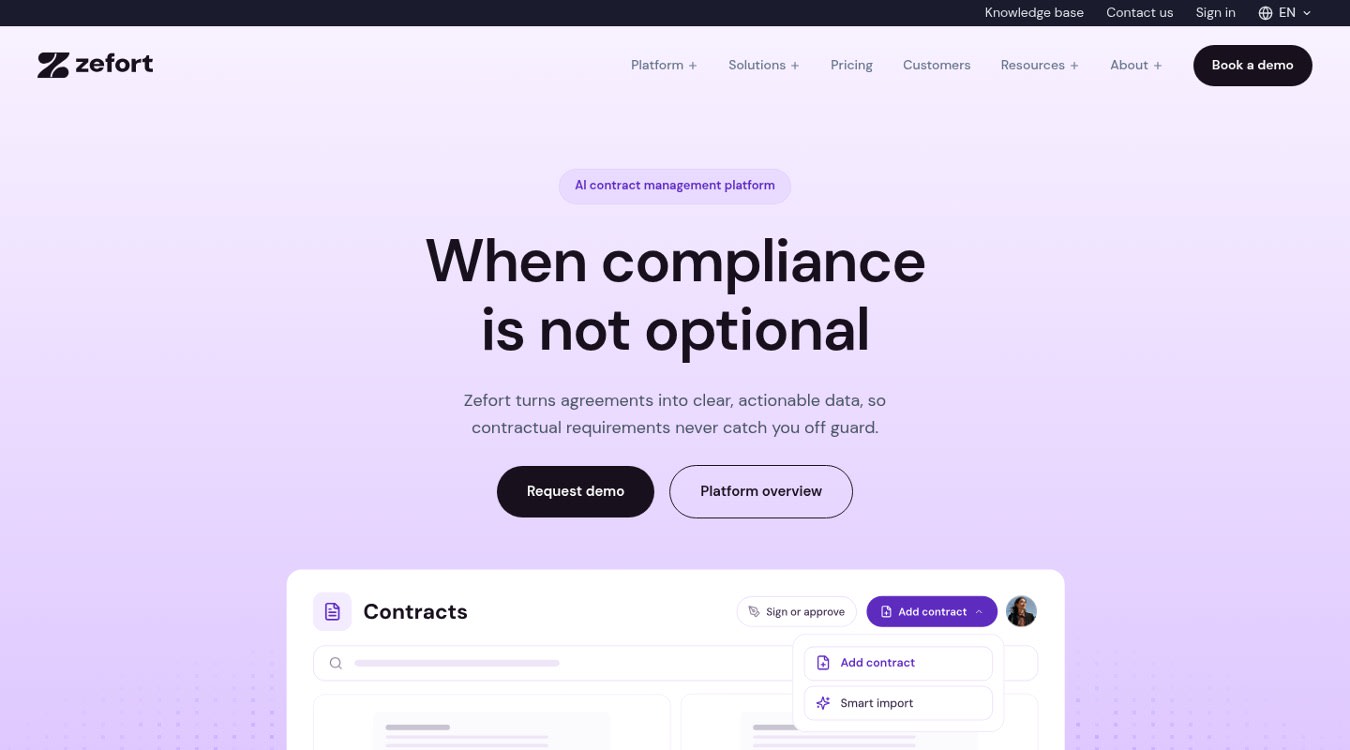
At a glance: Zefort is a Finnish platform, founded in 2017, that aims at compliance-driven teams who inherit contracts more than they draft them. You feed it signed agreements by upload, email or integration; it extracts metadata, makes everything searchable and fires reminders so nothing lapses. The design goal is zero-hassle archiving rather than negotiation machinery. Its public security position suits European buyers: ISO/IEC 27001:2022 certification and eIDAS-compliant e-signatures, plus a statement that all data stays within the EU on European infrastructure.
Price range: Published and plain: Team from €995 a month for 20 users, Enterprise from €1,995 for 50, Enterprise+ from €3,995 for 80.
What you'll get with Zefort:
- Effortless capture: contracts flow in from email, drag-and-drop, bulk upload and e-signature integrations, with AI extracting parties, dates, obligations and deadlines.
- Smart search: full-text and metadata search across the whole archive, scanned paper included.
- Automated reminders: deadline and renewal alerts so obligations stop depending on human memory.
- Built-in signing: Zefort Sign adds an eIDAS-compliant e-signature flow with signing-order controls.
- EU-resident data: storage within the EU on European infrastructure, stated on the vendor's own site.
G2 reviewers rate it 4.4/5 across 21 reviews with nothing below four stars, a small but clean sample consistent with a tool that does a focused job without drama.
Pros
- Published pricing in euros lets you budget the whole evaluation without a single sales call
- The capture-and-remind design fits teams whose real problem is the archive, not the negotiation
- ISO 27001:2022 and eIDAS-compliant signing cover the certification questions a UK compliance review will ask
- A 4.4/5 G2 average with no review below four stars suggests the product delivers what it promises
Cons
- Repository focus means drafting and negotiation workflows run thinner than on the CLM platforms above it in this comparison
- The platform lacks tools for supplier risk, fraud monitoring, SLA tracking, or spend analytics
- Pricing arrives in euros and the hosting commitment names European rather than UK infrastructure, both workable for UK teams but worth writing into the evaluation file
5. Precisely
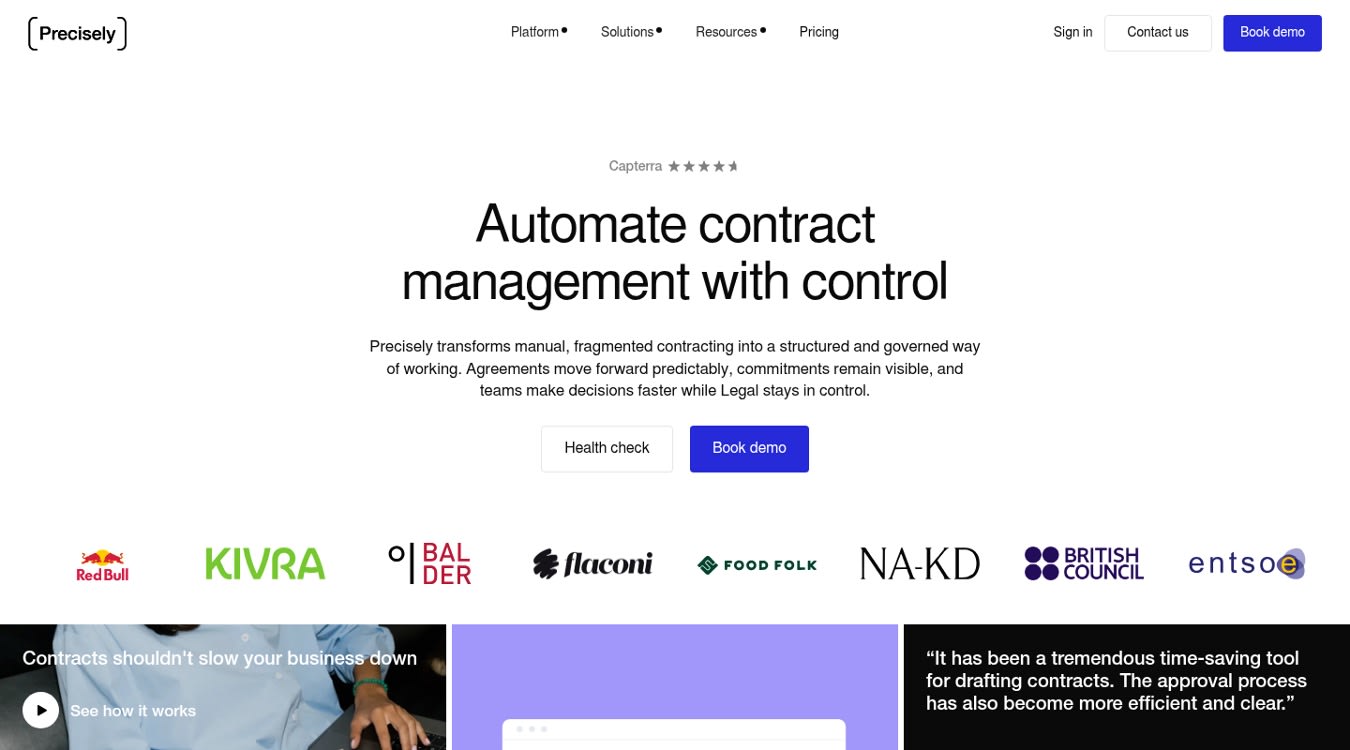
At a glance: Precisely is a Swedish CLM platform (preciselycontracts.com, a different company from the US data firm of the same name) built around template automation: you turn your Word precedents into dynamic, logic-driven templates, and the business then generates compliant agreements through guided questions. Approval flows and e-signing complete the lifecycle, with an archive and metadata reporting behind them. Its own documentation states hosting on Google Cloud in Frankfurt, with backups in Finland and signed documents archived in Dublin, so EU residency comes without extra configuration.
Price range: Quote-based, aimed at mid-sized legal and commercial teams.
What you'll get with Precisely:
- Template automation: Word precedents become guided, self-serve templates with conditional logic and calculation fields.
- Approval workflows and roles: department-level permissions let sales, HR, marketing and account teams work inside guardrails legal set.
- E-signing and archive: signature flows feed a searchable repository with metadata for reporting.
- EU hosting by default: Frankfurt production with Finnish backups, and signed archives in Dublin, per the vendor's own guide.
Users on G2 rate it 4.2/5 across 22 reviews, with praise concentrated on support quality and the time the template engine recovers. One reviewer's numbers make the case better than any feature list:
"On some contracts, we have gone from 20 hours in preparation to less than one while satisfying all governance and stakeholders in the process.", Niels F., IGA Advisory Practice Manager, in a 5/5 G2 review (Precisely averages 4.2/5 across 22 G2 reviews)
Pros
- The template engine turns 20 hours of drafting into minutes for standardised agreements, which is the strongest self-service story in this comparison
- Stated EU hosting, from Frankfurt production through to Dublin archives, answers data-residency questions out of the vendor's own documentation
- Reviewers single out responsive, native-language support as a reason they stay
- Metadata capture at creation feeds clean reporting later, instead of a tagging project after the fact
Cons
- Reviewers report that building templates takes real learning time, and busy teams can stall with half their agreements still outside the system
- Counterparties often resist the in-platform redlining and drag negotiations back into Word, which blunts the workflow advantage
- The system manages documents rather than ongoing supplier performance
6. Oneflow
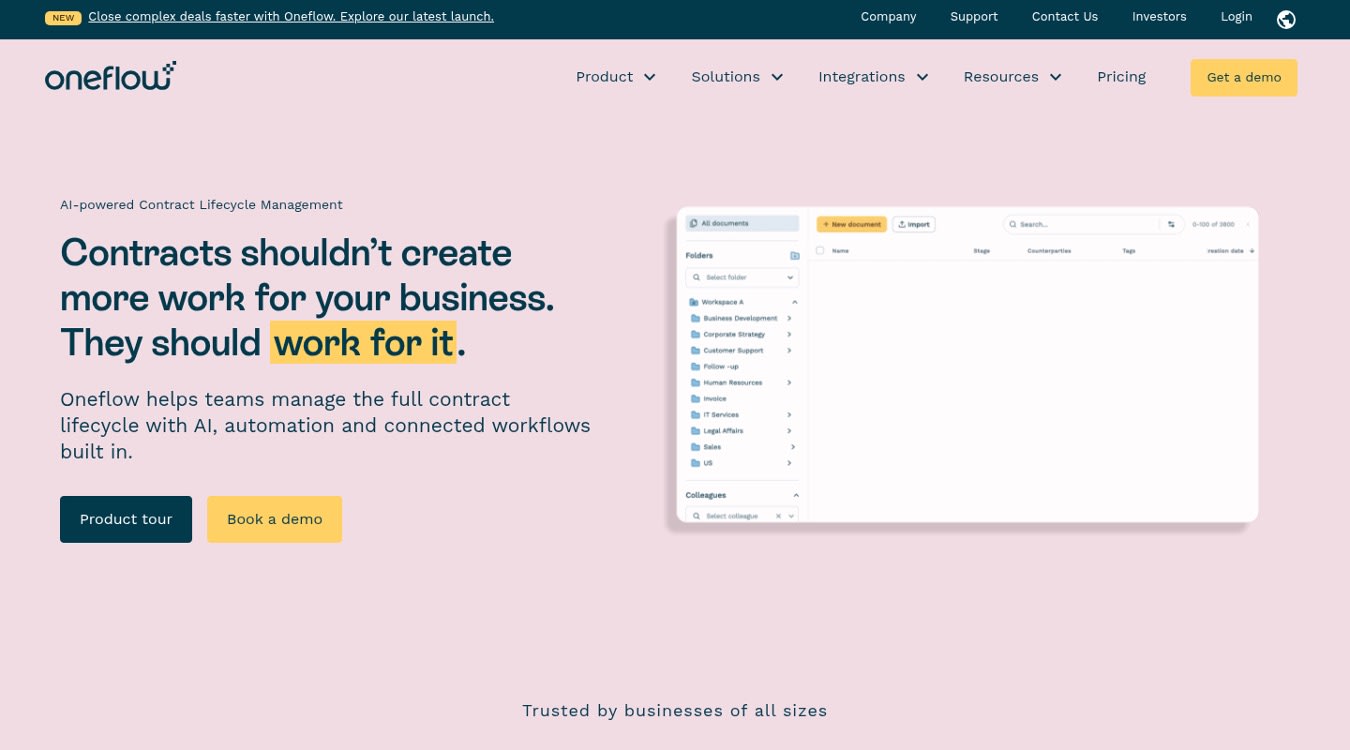
At a glance: Oneflow is a Stockholm-based contract platform, trading on Nasdaq First North Growth Market, that treats agreements as live, interactive web documents rather than static PDFs. Templates, real-time editing, e-signing and a shared repository serve sales, HR, finance and operations teams, with AI layered across the platform for review, extraction, risk flagging and insight. Its reviewer base runs deep for this category: 4.4/5 on G2 across 372 reviews, most of them from European teams.
Price range: Published on its G2 listing: a Business tier from €50 a month at entry scale, with Enterprise on request.
What you'll get with Oneflow:
- Interactive contracts: live documents where both sides edit and sign, with comments inside the document instead of versions flying by email.
- Template library: uniform agreements your whole team can generate without touching the legal text.
- CRM integrations: connections into CRMs such as HubSpot and Pipedrive pull deal data into documents and push status back.
- Repository with reminders: company-wide visibility of agreements, with renewal reminders you configure per document.
- Platform AI: review, data extraction and risk flagging run across the contract base.
The review volume gives a fair picture of strengths and rough edges alike. On the strength side, a mid-market reviewer describes the before-and-after that most adopters echo:
"Oneflow has simplified and improved our process by allowing us to create templates, easily edit contracts to be specific to the campaign, send via the platform, and have counterparties add comments in the platform for review.", Madison P., Influencer Marketing Manager, in a 5/5 G2 review (Oneflow averages 4.4/5 across 372 G2 reviews)
Pros
- Interactive documents beat PDF-and-email negotiation for speed, and 372 G2 reviews averaging 4.4/5 back the experience with volume
- A published entry price in euros keeps the barrier low for small UK teams
- CRM integrations make it a natural fit where contracts start life as deals
- A listed parent company gives buyers financial visibility most private CLM vendors can't offer
Cons
- Reviewers note that renewal reminders need setting up per document rather than arriving by default, which reintroduces the human-memory risk this software category exists to remove
- One sales representative's 1.5-star G2 review calls the formatting options horrible and flags the missing spell check, worth testing if your team produces client-facing paper
- Some users report paying extra to unlock functions they expected in their licence, so confirm the feature list against your tier in writing
- The platform handles document flow rather than broader vendor oversight
7. M-Files
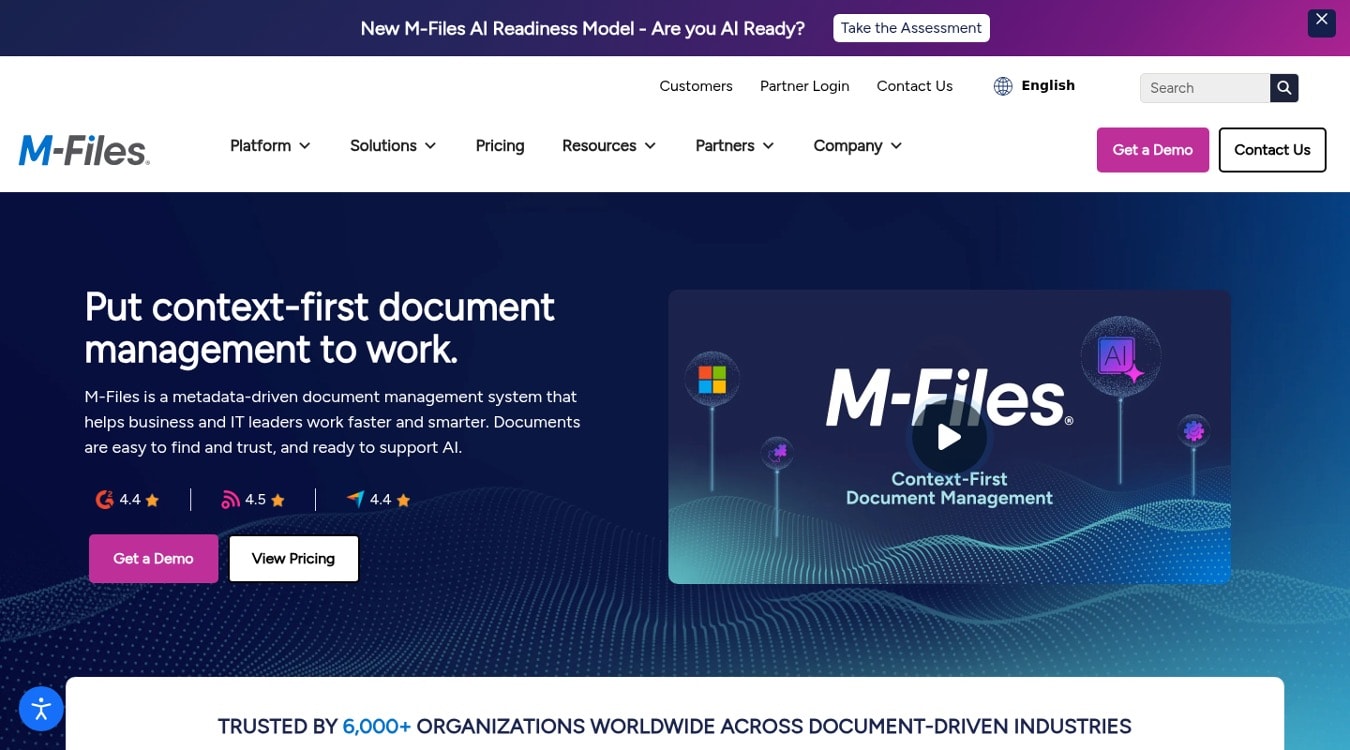
At a glance: M-Files is a metadata-driven document management platform, now majority-owned by Haveli Investments and Bregal Milestone, that organises content by what it is rather than where someone filed it. Contracts become one document class among many, tagged to the people, processes, clients and projects that give them meaning, with workflow automation, version history and Microsoft 365 integration across the lot. For organisations whose contract chaos is one symptom of wider document chaos, it fixes the disease rather than the symptom.
Price range: Quote-based; G2's pricing insights report a typical four-month implementation and a 20-month payback period, useful planning figures in the absence of a price list.
What you'll get with M-Files:
- Metadata-first filing: documents carry tags instead of living in folders, so one contract surfaces under its customer and under its project at once, with renewal dates a filter away.
- Workflow automation: approval and review flows run on document state across the business, contracts included.
- Version control and history: check-in and check-out discipline with full audit history on every document.
- Microsoft 365 depth: the vendor positions itself as the only document management system native to Microsoft 365, extending collaboration and Copilot to managed content.
Users rate it 4.4/5 across 273 G2 reviews. The recurring theme, good and bad, is metadata: transformative when the organisation tags with discipline, fragile when it doesn't. One reviewer captures the everyday payoff:
"What helped me most was simply not having to remember where documents were stored anymore.", Kaleem A., Software Engineer, in a 4.5/5 G2 review (M-Files averages 4.4/5 across 273 G2 reviews)
Pros
- One governed system for every document type beats running a contract silo next to a document silo, and 273 G2 reviews averaging 4.4/5 show the model works at scale
- Metadata filing means a contract surfaces by customer or by project without anyone deciding which folder wins
- Deep Microsoft 365 integration meets UK mid-market IT estates where they already live
- Version history and workflow state give auditors the trail they ask for across the whole document base
Cons
- It's a document platform first, so contract-specific machinery such as clause-level obligation tracking and negotiation tooling runs shallower than on dedicated CLM systems
- Reviewers warn that the system is only as good as its tagging discipline, and that inconsistent metadata degrades search right where you need it
- Setup draws repeated criticism as hard work, and G2's reported four-month implementation with a 20-month payback demands patience a small team may not have
- Supplier risk scoring, fraud monitoring, spend analytics and audit management for third parties all fall outside what a document management system can see
8. Sypro
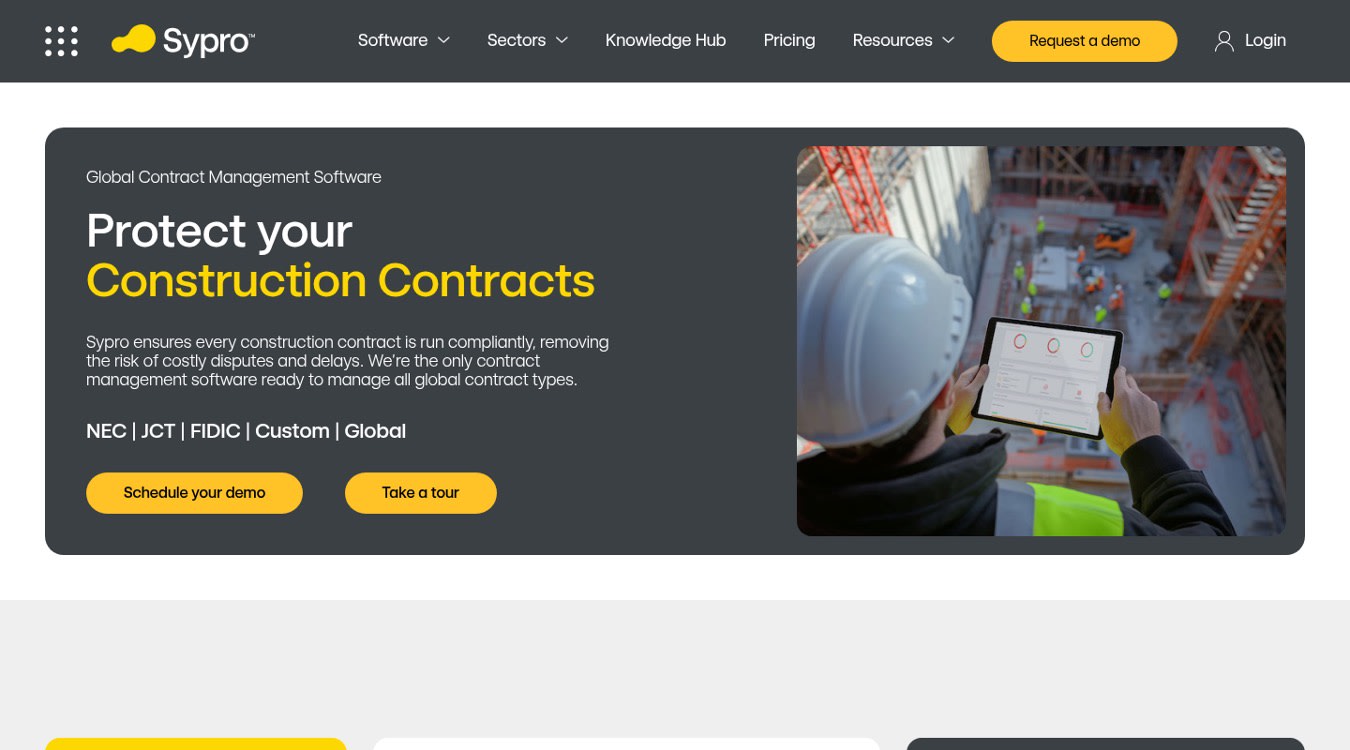
At a glance: Sypro is the specialist in this comparison, and deliberate about it. The Hull-based company builds contract management for UK construction, administering NEC, JCT, FIDIC and custom contract forms with the notice and compensation-event workflows those contracts demand. Case studies on its site include Transport for Wales, Willmott Dixon, VINCI at The Christie and AtkinsRéalis, which is as construction-establishment as references get. It appears here as a contrast: if your contracts are construction contracts, the general-purpose platforms above will store them without administering them, and Sypro does the administering.
Price range: Quote-based through a UK sales team.
What you'll get with Sypro:
- Contract-form fluency: NEC, JCT, FIDIC and custom forms managed to their own mechanics rather than squeezed into generic workflow.
- Deadline-driven administration: the notice and assessment clocks that decide construction disputes, tracked as first-class features.
- UK project pedigree: major UK infrastructure and construction names among its published case studies.
No usable presence exists for the product on mainstream review platforms, so reference calls carry the evaluation weight here.
Pros
- Purpose-built NEC and JCT administration does a job no general contract management system on this page attempts
- UK construction case studies including Transport for Wales and Willmott Dixon speak the sector's language
- A focused UK vendor means support that understands contract events rather than software tickets alone
Cons
- Outside construction it isn't a contender, since its own site shows no vendor management or supplier risk features, and no spend functionality either
- The absence of public review-platform coverage leaves buyers dependent on vendor-arranged references
- Organisations with a mixed contract estate will still need a general contract management system alongside it, with the integration work that implies
9. Ironclad
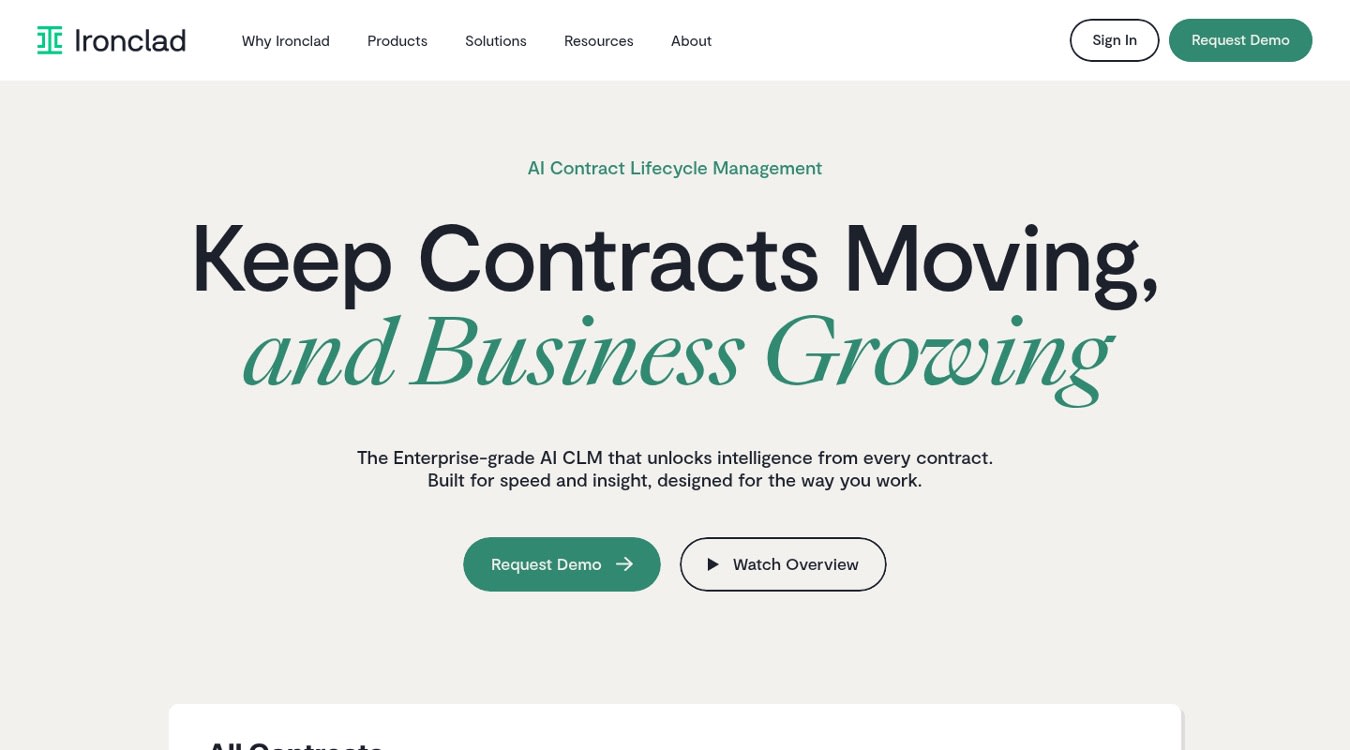
At a glance: Ironclad is the enterprise workflow heavyweight: a CLM built for legal teams running high contract volumes through a drag-and-drop Workflow Designer, with AI redlining, a clause library and negotiation machinery that handles the hard paper global companies sign. Gartner Peer Insights puts it at 4.6/5 across 285 ratings, the highest review volume in its market there, and its G2 profile shows 4.4/5 across 324 reviews. For a UK buyer the capability case is strong and the fit questions are real.
Price range: Quote-based; market reporting puts a 100-licence deployment at around $80,000 a year, with pricing per workflow on top, reported at about $5,000 each.
What you'll get with Ironclad:
- Workflow Designer: custom multi-step processes with conditional approvals and exception routing, built in-house without code.
- AI redlining and clause tools: negotiation support with playbooks and version tracking, backed by a central clause library.
- Two-way Office and Google integration: redlining flows through Word and Docs rather than around them.
- Contract family trees: amendments and renewals stay linked to their parent agreements.
- Enterprise integrations: Salesforce and Slack connections wired into contract processes.
Customer feedback praises the workflow flexibility and negotiation tooling while flagging heavy configuration and a training burden for people outside legal, on top of the price.
Pros
- The Workflow Designer handles approval complexity most rivals can't model, which is why enterprise legal ops teams keep choosing it
- Negotiation and redlining tools rank with the best in the category, backed by a 4.6/5 Gartner Peer Insights average across 285 ratings
- Strong integrations let contract workflows reach the sales and collaboration tools a large business runs on
Cons
- Ironclad's own security page describes US-hosted cloud infrastructure, which UK buyers with residency preferences need to assess before shortlisting
- Per-workflow pricing on top of licences means costs climb with every process you automate, and reported figures put sizeable deployments deep into six figures over a contract term
- Its permission model runs to a single full-administrator role, with no multi-entity support beyond workflow-level workarounds, awkward for UK groups running several legal entities
- The software focuses purely on contract workflows rather than vendor monitoring
10. DocuSign
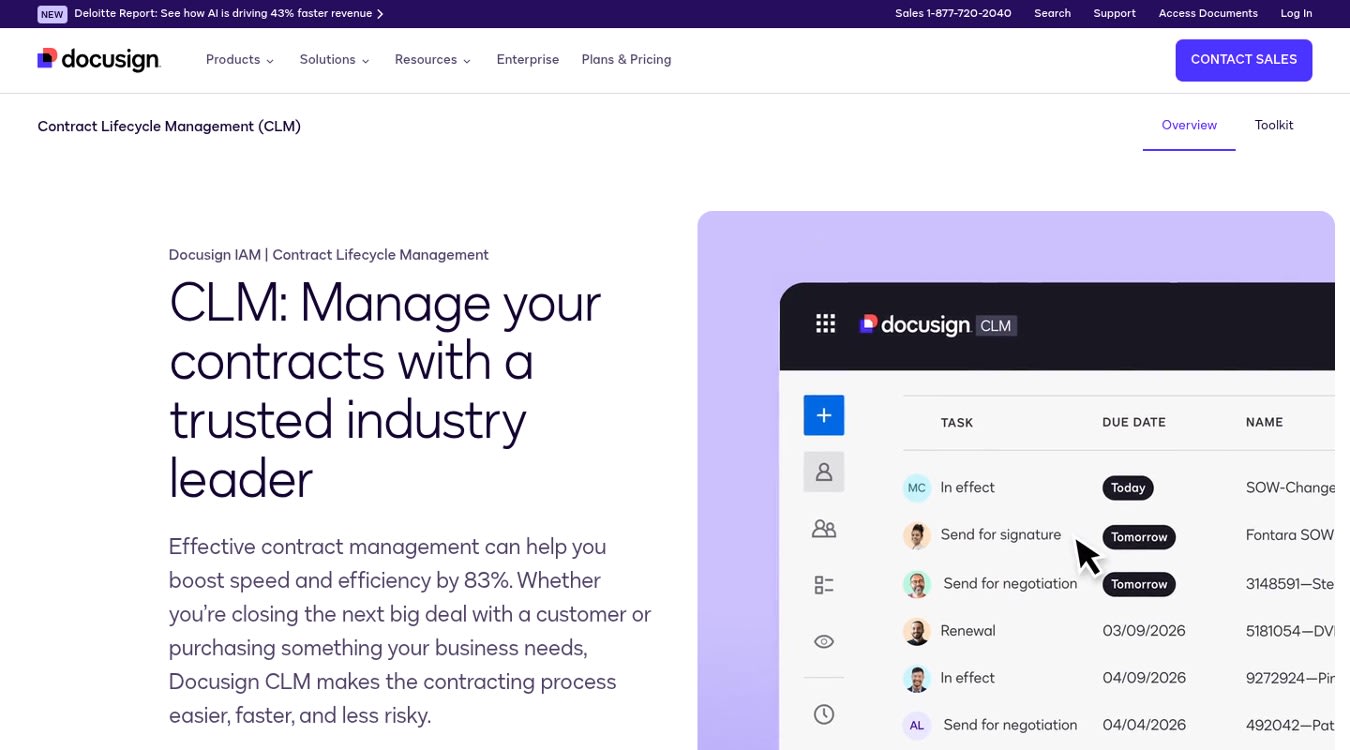
At a glance: DocuSign is the name your counterparties already know, and in the UK it's the pricing-transparency exception: published pound pricing for eSignature, running from £8 a month for Personal up to £33 for each user per month on Business Pro, with a £20 Standard tier between. Beyond signature, its CLM sits inside the Intelligent Agreement Management platform, which DocuSign sells on separate enterprise quotes, bringing workflow automation and a clause library with deep Salesforce integration. The company states that its London and Dublin employees support more than 40,000 UK and Ireland customers, so local presence isn't in question.
Price range: eSignature from £8 a month, published in pounds; CLM quote-based as a separate enterprise purchase.
What you'll get with DocuSign:
- Market-standard eSignature: the signing experience counterparties trust, with published UK pricing.
- CLM workflow automation: multi-step approvals and routing rules with conditional logic at the enterprise tier.
- Clause library and templating: Word-based drafting against standard language.
- Salesforce depth: approvals and agreement data flowing through existing Salesforce processes.
- Agreement analytics: reporting on agreement status and cycle times across the estate.
Its G2 profile for the CLM product shows 4.3/5 across 503 reviews, a huge sample that skews toward praise for workflow power and criticism of implementation length and interface age.
Pros
- Its eSignature plans carry the only GBP price list in this group, so at least one part of the purchase gets budgeted without a sales call
- Brand trust speeds counterparty signing in a way no challenger matches
- A stated UK and Ireland operation with 40,000+ customers means local support and commercial presence at scale
- Enterprise workflow and Salesforce integration serve complex approval structures well, with 503 G2 reviews behind the CLM product
Cons
- DocuSign's data-residency page lists five storage regions, and the UK isn't one of them, a gap UK-residency-minded buyers should log
- CLM is a separate quote-based purchase from the signature product, and reviewers report long implementations and heavy admin before value lands
- Reviewer criticism recurs on the interface and on advanced workflows arriving as paid add-ons
- Agreement management here covers documents without broader supplier tracking
Contract management software pricing for UK buyers
Pricing in this category runs from tens of pounds a month to six-figure enterprise agreements, and the model matters more than the sticker.
Per-seat pricing
Costs scale with the people who need access. Oneflow's published entry tier works this way at the low end, as does DocuSign eSignature at £20 to £33 per user per month on its published UK plans. The risk is the ceiling it builds: teams start rationing licences, and the platform never reaches the whole-company adoption that makes contract data trustworthy.
Flat and user-band pricing
Zefort publishes the clearest version here, from €995 a month covering 20 users, with bands stepping up at 50 and 80. You trade a higher entry point for adoption without arithmetic inside each band.
Volume-based pricing
Gatekeeper sizes its tiers by third parties under management rather than by seats, with users unlimited. This matches cost to the complexity you manage, and it means a supplier count, not a headcount, drives your quote.
Quote-only enterprise pricing
Juro, Summize, Precisely, Sypro, Ironclad and DocuSign CLM all quote. Reported market figures hint at the ranges, such as around $80,000 a year for a 100-licence Ironclad deployment, but your figure arrives through a sales process. Budget two things alongside the licence: the weeks the quote process takes, and implementation services, which at the enterprise tier can rival year-one licence costs.
Hidden costs to budget for
- Implementation services: enterprise rollouts bill configuration and migration work as a separate line, and it lands after you've committed.
- Premium integrations: Salesforce, ERP and SSO connectors sometimes carry their own price, so name yours in the quote request.
- Per-process charges: Ironclad's reported per-workflow pricing shows how automation itself can become a metered cost.
- Feature-tier surprises: Oneflow reviewers describe paying again for functions they expected in the licence; get the feature list against your tier in writing from every vendor.
- Renewal escalation: quote-only vendors reprice at renewal, when switching costs sit on your side of the table; cap increases in the original agreement.
Whatever the model, run the three-year total: licence, implementation, integrations and the price of the users you'll add in year two. The cheapest month-one figure wins that comparison less often than you'd think.
Implementation and rollout expectations
Timelines in this market run between days and seasons, and the drivers are predictable. Capture-focused tools deploy fastest: Zefort-style repositories can go live as fast as you can feed them contracts. Sprint-based and browser-first platforms come next, with Summize citing around four weeks to a first live use case and Juro rating at the top of its category for implementation speed. The configurable platforms ask for more: public G2 averages report about four months to implement Gatekeeper and M-Files, which fits tools that model your suppliers or your whole document estate rather than a single workflow. The enterprise tier is less predictable than its reputation suggests: DocuSign CLM averages about three months on the same G2 measure, matching Juro, yet its reviewers describe heavy admin work before value lands, so read averages as a floor and your own integration list as the real schedule.
Whatever the tier, the same variables stretch or shrink the plan. Legacy migration is the big one: loading a decade of scanned agreements with metadata worth trusting is a project in itself, and vendors quote it as one. Integration scope comes next, since each connection into identity, e-signature, CRM or finance systems adds its own testing cycle. Training closes the loop, because a platform the wider business never learns becomes a legal-only archive within a year.
Three questions keep any rollout honest. Who migrates the legacy archive, and at what metadata quality? Which integrations land in phase one rather than someday? Which named person owns adoption after go-live? A platform without answers to all three will miss its own timeline, whatever the tier.
Common misconceptions worth clearing up
"More features means a better outcome." The deepest platforms show some of the weakest adoption aside from legal, because configurability arrives as clutter for everyone else. Judge the interface your non-legal colleagues will see on a random Tuesday.
"AI is the differentiator." Extraction and review now ship almost everywhere. The differentiators are whether people trust the output enough to act on it, and what data the AI can reach. A model that sees the whole supplier relationship, spend included, answers questions a contracts-only model can't.
"UK hosting is standard by now." Among vendors here that publish locations, the stated regions are Irish, German, Finnish and American; a stated UK region didn't appear once in this research. Check the vendor's own security pages, and treat silence as a fact to record rather than a blank to fill in the vendor's favour.
"Compliance features can wait until renewal." Payment practices reports fall due every six months with director-level criminal exposure for failure, and KPI assessments on £5m+ public contracts publish on the authority's schedule. The duties run on the calendar, not on your procurement cycle.
The verdict for UK buyers in 2026
The best contract management software for a UK business is the platform your whole organisation still opens next spring, feeding records complete enough to answer a regulator or an auditor without a scramble. For teams whose work ends at the agreement itself, the focused tools above, Juro's editor and Zefort's archive among them, do their jobs well at honest prices. The UK's direction of travel, though, keeps joining contracts to the suppliers behind them: payment terms now flow down public supply chains, and authorities publish performance on larger contracts every 12 months. Large companies put their payment behaviour on the record twice a year, too.
Gatekeeper tops our rankings for UK businesses because it unifies vendor compliance and contract records into a single system, supporting evidence gathering and compliance workflows to help meet these modern regulatory demands. Put a final pair of candidates up against your own contract mix and demand your real paperwork in every demo. Then buy the contract management system that turns next year's compliance calendar into routine.
Want to publish a guest post on aamax.co?
Place an order for a guest post or link insertion today.
Place an Order