

8 Document Parsing Tools That Handle Tables and Complex Layouts
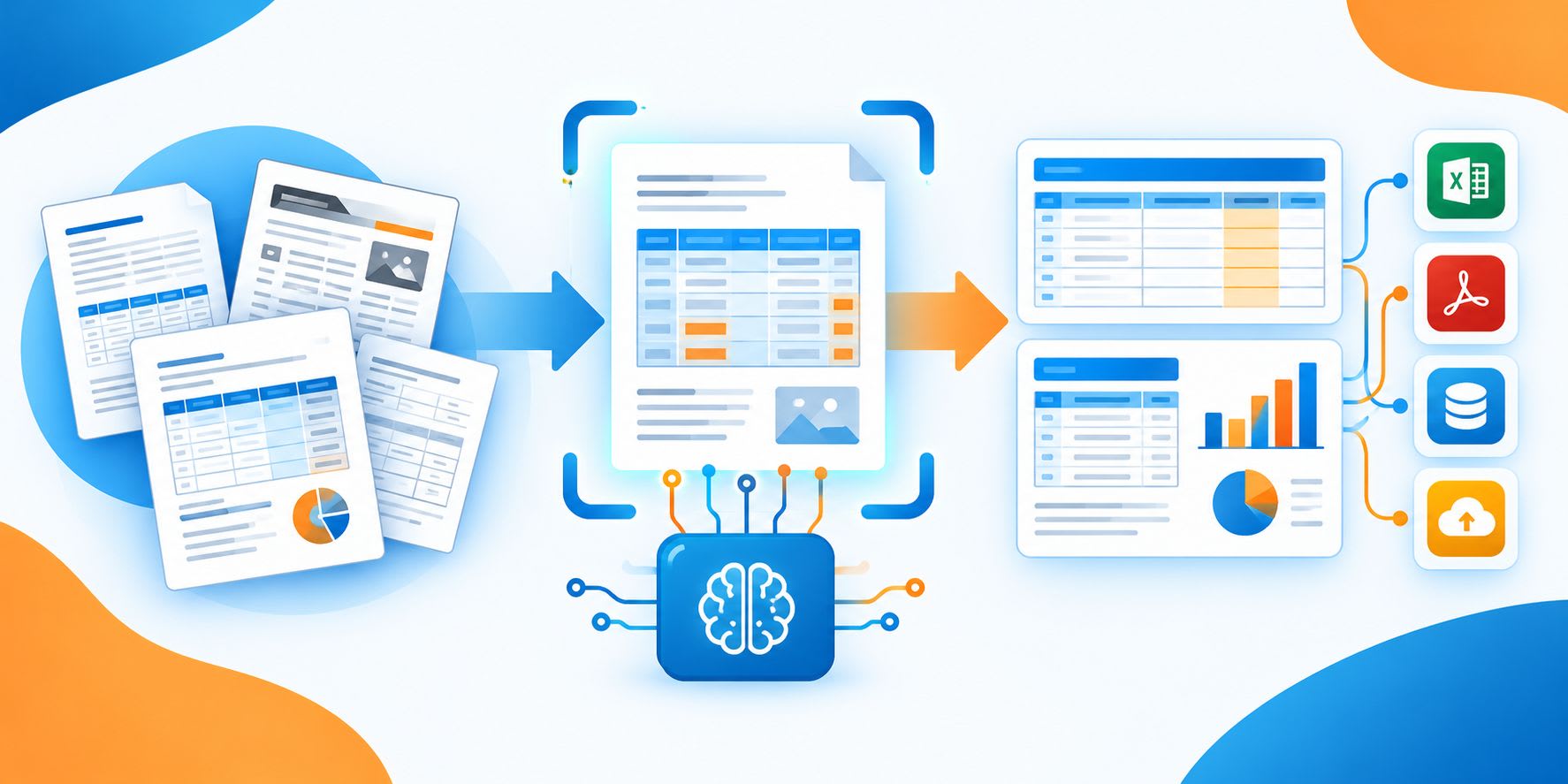
Multi-column layouts, merged table headers, embedded charts, and non-standard reading orders are where standard text extractors break down. When a parser fails on a complex PDF or scanned document, it doesn't just miss text—it scrambles spatial context, causing downstream RAG pipelines and automated workflows to hallucinate or ingest corrupted data.
The Hidden Cost of Poor Parsing in RAG and AI Pipelines
For teams building Retrieval-Augmented Generation (RAG) applications or automated AI agents, extraction accuracy isn't just a text issue it directly impacts model reliability, user trust, and API operational costs:
- Hallucinations from Scrambled Context: If an AI OCR API or basic text extractor reads a multi-column balance sheet or legal contract out of order, the LLM ingests false relationships between numbers and clauses, producing hallucinated answers.
- Inflated API Costs: Raw, unstructured JSON or uncompressed text payloads contain massive structural clutter, inflating token counts and unnecessarily increasing LLM inference bills.
- Broken Chunking: Standard vector database chunking relies on clean document boundaries like headers and table grids. Scrambled parsing breaks these boundaries, causing vector stores to ingest low-density, noisy embeddings.
Handling complex layouts requires specialized engines equipped with vision models, spatial positioning logic, and high-precision layout analysis. Below are 8 of the best document parsing tools specifically engineered to extract tables and maintain structural hierarchy across dense enterprise files.
At a Glance: Feature Comparison
Tool | Deployment Model | Primary Focus | Best For |
ABBYY FineParser | Self-Hosted Docker | Layout Preservation & Token Efficiency | Local, air-gapped LLM/RAG pipelines |
LlamaParse | Cloud / API | RAG Optimization & Table Parsing | LlamaIndex & generative AI stack integration |
Unstructured | Open-Source / Cloud API | Bulk Partitioning & Chunking | Heterogeneous document ingestion pipelines |
Reducto | Cloud / API | Vision-Native Parsing for Complex PDFs | Multi-column, multi-page financial & legal docs |
Amazon Textract | Cloud API (AWS) | Table & Key-Value Extraction | Native AWS serverless enterprise workflows |
Hyperscience | Hybrid / Enterprise | Form Extraction & Human-in-the-Loop | High-volume operational compliance & forms |
Azure AI Document Intelligence | Cloud / Containers | Prebuilt Models & Custom Layouts | Microsoft Azure ecosystem & hybrid clouds |
Google Document AI | Cloud API (GCP) | Semantic Extraction & Specialized Models | Multi-language processing inside Google Cloud |
1. ABBYY FineParser
Best for: Developers needing self-hosted, CPU-optimized document parsing software that retains multi-column layout and table structure without cloud API dependencies.
Powered by decades of optical character recognition (OCR) and layout analysis engineering, ABBYY FineParser is delivered as a containerized Docker engine. It converts complex PDFs and image files into structured JSON or token-optimized markdown (DocLang) for downstream AI processing.
Layout & Table Capabilities: Uses spatial layout models to maintain nested tables, merged header cells, and multi-column reading orders without scrambling text chunks.
Standout Feature: 100% self-hosted Docker deployment running on standard CPUs, ensuring complete data privacy and air-gapped security.
Key Strengths: Up to 40% LLM token reduction via DocLang output, 200+ language support, and asynchronous REST API integration.
2. LlamaParse
Best for: AI developers building Retrieval-Augmented Generation (RAG) applications using the LlamaIndex framework.
LlamaParse is a specialized document parsing service designed from the ground up to generate high-density markdown and structured representations optimized for LLM chunking and embedding.
Layout & Table Capabilities: Parses multi-column pages, handles nested tables, and extracts embedded figures or charts while preserving hierarchical section headings.
Standout Feature: Direct native integration with LlamaIndex vector store ingestion pipelines.
Key Strengths: Markdown generation with explicit HTML table blocks for complex spanning cells, layout-aware reading order, and customizable parsing prompts.
3. Unstructured
Best for: Data engineering teams handling bulk ingestion of mixed, heterogeneous file types for LLM pipelines.
Unstructured provides an open-source library alongside enterprise cloud APIs built to partition, clean, and chunk unstructured documents into standardized elements.
Layout & Table Capabilities: Automatically identifies document structural elements (titles, narrative text, header cells, tables) and reconstructs complex table geometries into clean structured text or HTML.
Standout Feature: Built-in modular connectors that stream data directly from S3, Azure Blob, Google Cloud Storage, and vector databases.
Key Strengths: Advanced multi-modal visual parsing models, open-source core, and flexible chunking strategies.
4. Reducto
Best for: Engineering teams needing an AI OCR API optimized for dense financial statements, legal contracts, and multi-column reports.
Reducto is a developer-first parsing engine built on top of vision models designed specifically to convert visually complex PDF documents into structured data payloads.
Layout & Table Capabilities: Reconstructs borderless tables, multi-page financial statements, and complex multi-column reading flows without dropping layout hierarchy.
Standout Feature: Vision-native layout engine that evaluates visual document geometry rather than relying solely on hidden PDF text layers.
Key Strengths: Interactive inspection UI, high-precision visual table bounding, and automated file splitting capabilities.
5. Amazon Textract
Best for: Organizations natively integrated into AWS requiring scalable serverless document extraction.
Amazon Textract goes beyond basic optical character recognition to automatically read and extract data from scanned documents, forms, and tables using machine learning.
Layout & Table Capabilities: Dedicated Tables feature preserves row and column relationships in structured or semi-structured tables without manual coding.
Standout Feature: Specialized analysis features for specialized domain documents like financial lending, invoices, and identity forms.
Key Strengths: Deep integration with AWS Lambda, S3, and Augmented AI (A2I) for automated human review workflows.
6. Hyperscience
Best for: Enterprise operations processing high volumes of complex forms, low-quality scans, and handwritten documents.
Hyperscience combines automated document processing with a built-in Human-in-the-Loop (HITL) system, ensuring maximum accuracy for mission-critical enterprise workflows.
Layout & Table Capabilities: Excels at extracting tabular data from skewed, low-resolution, or handwritten forms where traditional OCR tools struggle.
Standout Feature: Automated confidence scoring that routes low-confidence fields directly to human operators for review.
Key Strengths: High-throughput processing, strong operational analytics, and flexible hybrid/on-premises deployment options.
7. Azure AI Document Intelligence
Best for: Enterprise teams in Microsoft ecosystems building custom layout models or hybrid cloud applications.
Formerly known as Form Recognizer, Azure AI Document Intelligence uses machine learning to extract text, key-value pairs, tables, and structures from automated documents.
Layout & Table Capabilities: Layout analysis feature extracts text, table structures (rows, columns, headers), and visual markups (selection marks, checkboxes).
Standout Feature: Containerized deployment support allowing developers to run Azure parsing models locally on edge devices or private VPCs.
Key Strengths: Prebuilt models for contracts, invoices, and IDs, custom model training interfaces, and extensive SDK support across multiple languages.
8. Google Document AI
Best for: Google Cloud Platform (GCP) users processing multi-language document workflows requiring custom entity extraction.
Google Document AI provides a suite of pre-trained processors and custom tools for parsing semi-structured and unstructured documents at scale.
Layout & Table Capabilities: Uses the Layout Parser to segment pages into structured regions, accurately reading nested tables, multi-column blocks, and visual headers.
Standout Feature: Deep integration with Google's foundation vision and language models for custom extractor tuning.
Key Strengths: Comprehensive multi-language support, seamless integration with BigQuery and Vertex AI, and enterprise-grade scalability.
Summary & Recommendation
For air-gapped or private cloud applications: Choose ABBYY FineParser or containerized Azure OCR to run local parsing inside your own security boundary without sending sensitive documents over external APIs.
For LLM, RAG, and Agentic pipelines: Look to LlamaParse, Unstructured, or Reducto to convert complex visual structures into clean, token-efficient markdown or JSON.
For high-volume, cloud-native enterprise operations: Leverage Amazon Textract, Google Document AI, or Hyperscience to pair table extraction with serverless scalability or human-in-the-loop workflows.
Want to publish a guest post on aamax.co?
Place an order for a guest post or link insertion today.
Place an Order