


What is SOC 2 Compliance and How It Matters for Your Marketing Company
SOC 2 is an independent audit framework from the American Institute of Certified Public Accountants (AICPA) that tests how a service organization protects the data its clients entrust to it. Marketing companies fall inside that definition more often than most owners expect, because agencies, martech vendors and consultancies routinely store, process and move customer data on behalf of other businesses.
That reality is changing how marketing services are bought. Enterprise procurement teams increasingly send security questionnaires to agencies in the same way they send them to software vendors, and a SOC 2 report is the document that answers most of those questions at once.
This guide explains what SOC 2 compliance means, what the term stands for, how the framework applies to marketing work, how to become SOC 2 compliant, which documentation auditors expect and where compliance software fits. It is written for marketing leaders, operations managers and founders who need a clear picture before they commit time and budget.
What Is SOC 2 Compliance?
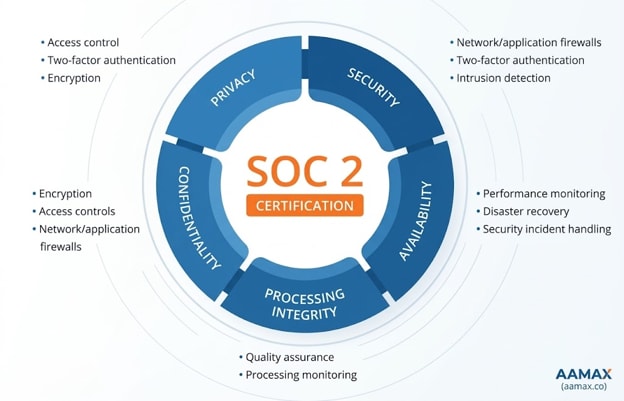
SOC 2 compliance is the status of an organization whose data protection controls have been examined by an independent certified public accountant (CPA) against the AICPA Trust Services Criteria, and which holds a report describing the result. The report is an attestation rather than a certification. It covers a defined system, a defined scope and a defined period.
What SOC 2 Stands For
SOC 2 stands for System and Organization Controls 2. The AICPA now uses the phrase System and Organization Controls, which replaced the earlier term Service Organization Controls. The number identifies the report type, since SOC 1 and SOC 3 address different subject matter.
SOC Compliance Meaning in Practice
The meaning of SOC compliance is often misread as adherence to a fixed checklist. SOC 2 does not work that way. A company selects the criteria that apply to its services, designs its own controls to meet them and then lets an auditor test whether those controls exist and operate as described.
In practice, a SOC 2 compliant company can show evidence of how it controls access to data, how it approves and records system changes, how it responds to security incidents and how it oversees the vendors that touch client information. No regulator requires a SOC 2 report. Clients ask for it, and contracts often make it a condition of doing business.
SOC 1, SOC 2 and SOC 3 Compared
The three SOC report types answer different questions and reach different readers.
Report | What it examines | Typical reader | Distribution |
SOC 1 | Controls relevant to a client's financial reporting | Client finance teams and their auditors | Restricted use |
SOC 2 | Controls over security, availability, processing integrity, confidentiality and privacy | Client security, legal and procurement teams | Restricted use, usually shared under NDA |
SOC 3 | A public summary of the SOC 2 result without detailed test results | General public and prospects | General use, can be published |
A marketing company that handles client payroll or billing data could meet SOC 1 requests. When a prospect asks for a security report, the request almost always means SOC 2.
The Five Trust Services Criteria
The AICPA organizes SOC 2 around five Trust Services Criteria, also called categories. Security is mandatory in every SOC 2 report. The other four are added when a company's services and client commitments call for them. The criteria date from 2017, and the AICPA revised their points of focus in 2022.
Security
Security covers protection of systems and data against unauthorized access, disclosure and modification. For a marketing company, this means controls such as single sign on and multifactor authentication for ad platforms, CRM and analytics tools, role based access to client workspaces, endpoint protection and activity logging.
Availability
Availability confirms that systems are operational and accessible as committed in service agreements. It matters when a marketing company hosts landing pages, runs marketing automation or provides reporting dashboards that clients depend on daily. Backups, monitoring and recovery planning sit under this criterion.
Processing Integrity
Processing integrity addresses whether systems process data completely, accurately and on time. Lead routing rules, audience syncs, attribution calculations and scheduled email or SMS sends all fall here. A dropped lead or a duplicated send is an integrity failure.
Confidentiality
Confidentiality protects information that a client has designated as confidential. In marketing work, that includes unreleased campaign plans, pricing, customer lists, contract terms and launch embargoes. Encryption, access limits and retention and disposal rules support this criterion.
Privacy
Privacy governs how personal information is collected, used, retained, disclosed and disposed of, in line with the organization's privacy notice and applicable law. It is the most relevant criterion for companies that manage consumer contact data, consent records or behavioral data. SOC 2 does not replace legal duties under laws such as GDPR or CCPA, but documented privacy controls can support them.
Many first reports cover Security alone, or Security with Confidentiality. Each added criterion widens the audit scope and the cost, so the selection should follow what clients actually ask for.
SOC 2 Type 1 vs Type 2 Reports
A Type 1 report tells the reader whether controls are suitably designed on one specific date. A Type 2 report tells the reader whether those controls operated effectively across a stated period. Both are issued by a licensed CPA firm, and both cover the same Trust Services Criteria.
Factor | SOC 2 Type 1 | SOC 2 Type 2 |
What the auditor opines on | Design of controls as of a single date | Design and operating effectiveness over an observation period |
Time covered | One date | Commonly three to twelve months |
Evidence reviewed | Policies, configurations and system settings at that date | Samples from across the period, such as access reviews, change tickets, training records and incident logs |
Typical use | First proof of a working control environment | Standard request in enterprise security reviews |
Effort and cost | Lower | Higher |
After the observation period closes, the auditor usually needs a few weeks to test samples and issue the report.
Which Report a Marketing Company Should Pursue First
A company facing its first enterprise security review often starts with Type 1 to answer an immediate request, then opens the Type 2 observation window straight away. Enterprise buyers tend to give Type 2 more weight because it shows controls working over time instead of on a single day.
SOC 2 is not a one time project. Reports are renewed on an annual cycle, and buyers expect a recent reporting period. When a report ends several months before a client review, companies commonly issue a bridge letter, a short management statement that confirms no significant changes to controls since the report date.
SOC 2 for Marketing: Why It Matters for a Marketing Company
SOC 2 matters to a marketing company because the company holds its clients' customer data and the systems that process it, and clients now expect proof of how that data is protected. The framework was written with software and cloud providers in mind, but its logic applies to any organization that stores, processes or transmits data for another business.
Marketing Companies Are Service Organizations
Agencies, martech vendors, consultancies and analytics providers all qualify as service organizations in the AICPA sense. Day to day work places the following data in their hands:
- Customer and lead lists exported from client CRMs
- Email and SMS subscriber lists with consent, opt in and opt out records
- Login access to ad accounts, analytics properties and tag managers
- Behavioral and attribution data used to build audiences and reports
- Creative assets, campaign plans and budgets covered by NDAs
Once that data sits in the agency's systems, the agency becomes part of the client's vendor chain, and the client's own security obligations extend to it.
Vendor Security Reviews Now Reach Agencies
Client procurement, legal and security teams run vendor risk reviews before signing contracts. These reviews include long security questionnaires, security sections in requests for proposals and data processing agreements. A SOC 2 report answers a large share of those questions in one document. Without one, each new client triggers a custom questionnaire cycle that delays contract signature.
Clients in healthcare, financial services and education often pass their own regulatory obligations down to every vendor that touches their data. Marketing partners serving those sectors tend to meet the SOC 2 question earliest.
The Martech Stack Widens the Attack Surface
A typical agency stack includes a CRM, marketing automation, email and SMS platforms, ad platforms, analytics, tag managers, project management software, shared drives and reporting tools. Contractors and freelancers add further access points. Every integration is a possible path to client data.
The common failure patterns are well known: shared logins, long lived API tokens, broad permissions granted for convenience, former staff who keep access after leaving, and exported spreadsheets stored on personal devices. SOC 2 controls target exactly these gaps through access provisioning and removal, multifactor authentication, device management, vendor oversight and logging.
Channel Specific Data Risks
Each marketing channel creates its own exposure, which shapes which Trust Services Criteria a company brings into scope.
- Email: subscriber lists, engagement history and segmentation attributes
- SMS: phone numbers, message content, timestamps, delivery logs and opt in and opt out records
- Paid media: customer match audiences uploaded to ad platforms and conversion data sent through server connections
- Analytics and CDP work: user level behavioral data stitched across devices and sources
A leaked phone number list with message history carries more personal exposure than a leaked list of email addresses, so SMS heavy programs often justify adding Confidentiality and Privacy to the audit scope.
What SOC 2 Does Not Do
A SOC 2 report does not guarantee that a breach will never occur. It states that specific controls were designed, and for Type 2 operated, within a defined scope. It does not replace legal duties under laws such as GDPR, CCPA, TCPA or CAN SPAM, and it says nothing about the quality of campaign work. Readers of a report should check its scope, its period and any exceptions the auditor noted.
How to Get SOC 2 Compliance
Getting SOC 2 compliant means scoping your services, building and operating controls, gathering evidence and passing an examination by an independent CPA firm. The sequence below is how most marketing companies approach it when they become SOC 2 compliant for the first time.
- Define the scope. Decide which services, systems, locations, people and data fall inside the audit, and which Trust Services Criteria apply. Scope usually covers the production systems and tools that touch client data, not the entire business. Start with Security and add criteria only when clients require them.
- Assign ownership. Name an executive sponsor and a compliance lead, and involve IT, HR, legal and account delivery. Controls fail when only one team owns them.
- Run a risk assessment. Map where client data is stored, how it moves between tools and who can reach it. Record the risks, their likelihood and impact, and how each will be treated.
- Complete a gap assessment. Compare current practices with the selected criteria and list missing controls, missing policies and missing evidence.
- Write policies and procedures. Formalize how the company handles access, change, incidents, vendors, data retention and employee conduct.
- Implement and operate controls. Typical controls include multifactor authentication, quarterly access reviews, encryption, device management, logging and monitoring, security awareness training, background checks and documented onboarding and offboarding.
- Collect evidence. Keep records that show each control operating on schedule. Start early, because a Type 2 audit samples activity across the entire observation period.
- Engage an auditor and complete the examination. The auditor reviews the system description, tests controls, discusses any exceptions with management and issues the report.
- Maintain and renew. Continue monitoring, repeat reviews on schedule and plan the next annual audit cycle.
How Long SOC 2 Compliance Takes
Preparation for a company that begins without formal controls usually takes several months before an audit window can open. A Type 1 examination can follow quickly once controls are in place. A Type 2 examination adds the observation period, which commonly runs three to twelve months, plus time for testing and report writing. Audit fees depend on scope, the number of criteria, company size and report type, so quotes from several CPA firms give the most reliable comparison.
How to Choose a SOC 2 Auditor
Only a licensed CPA firm can issue a SOC 2 report. Software cannot. The AICPA has published a notice stating that it is reviewing allegations about quick turn SOC services and that it will act where auditors are unlicensed, not enrolled in peer review or not following professional standards. Marketing companies should confirm the firm's CPA licensure and peer review status, ask about experience with service providers of similar size, and treat promises of a fast and easy report with caution.
SOC 2 Compliance Documentation
SOC 2 compliance documentation is the written record that shows an auditor what the company commits to, how it operates and that it operates that way consistently. It falls into four groups: policies, a system description, management's assertion and operating evidence. A policy that does not match actual practice becomes an exception in the final report, so every document should describe what the team really does.
Core Policies and Procedures
Auditors expect written policies for the areas covered by the selected criteria. A marketing company's first set typically includes:
- Information security policy
- Access control and acceptable use policies
- Change management procedure
- Incident response plan
- Risk assessment and risk treatment procedure
- Vendor management policy
- Data classification, retention and disposal policy
- Business continuity and disaster recovery plan
- Onboarding, offboarding and background check procedures
- Privacy notice and consent handling procedure, when the Privacy criterion is in scope
Operating Evidence
Evidence proves that controls run as written. For a Type 2 report, the auditor samples evidence from across the observation period.
Record | What it proves | Marketing company example |
Access review logs | Access is reviewed and approved on schedule | Quarterly review of who can reach client CRM and ad accounts |
Provisioning and removal tickets | Joiners, movers and leavers are handled promptly | Contractor access removed on the day a project ends |
Change tickets and approvals | Changes are authorized and tested | Updates to automation workflows or tracking tags |
Training completion records | Staff receive security training | Annual training and phishing exercise results |
Risk register | Risks are identified and treated | Entry for client exports stored in shared drives |
Incident log and reviews | Incidents are detected and handled | Response to a compromised ad account credential |
Vendor inventory and review records | Third parties are assessed | Review of a reporting tool vendor's security report |
Backup and recovery test results | Recovery works as planned | Restore test of campaign assets |
Device management reports | Laptops are encrypted and patched | Encryption and patch status for all staff devices |
System Description and Management's Assertion
The system description explains the services in scope, the infrastructure and software that support them, the people and procedures involved, the data handled and the boundaries of the system. Management then signs an assertion that the description is fairly presented and that controls were suitably designed, and for Type 2, that they operated effectively. A finished SOC 2 report typically contains the auditor's opinion, management's assertion, the system description and the control tests with their results.
Subservice Organizations and Vendor Reports
Marketing companies rely on cloud hosts, CRM vendors and automation platforms. The system description must state whether those providers are carved out or included in scope. Collect each critical vendor's own SOC 2 report, review its exceptions and record the complementary controls your team must perform on its side of the relationship.
The Role of Compliance Software in Marketing
Compliance software supports SOC 2 by collecting evidence, tracking controls and keeping policies current. It does not make a company compliant, and it cannot issue a report, because only a licensed CPA firm can do that.
Two Categories of Compliance Software Marketing Teams Use
The phrase covers two different toolsets, and marketing teams often need both.
Category | Purpose | Typical functions |
Prepares and monitors the company's own control environment | Evidence collection, control mapping, policy management, access and device monitoring, vendor tracking | |
Governs how campaigns use customer data | Consent capture, preference centers, opt out and suppression management, message approval records |
This guide focuses on the first category. The second supports legal duties such as consent and opt out handling, which SOC 2 does not replace.
What SOC 2 Compliance Software Does
A marketing stack spans dozens of SaaS tools, so manual evidence collection becomes slow and error prone. Software addresses that in several ways:
- Connects to identity providers, HR systems, cloud accounts, ticketing tools and device management to pull evidence automatically
- Maps controls to the Trust Services Criteria and highlights gaps
- Supplies policy templates and records staff acknowledgment and training completion
- Monitors controls continuously and flags drift, such as an account without multifactor authentication or a departed contractor who still has access
- Tracks the vendor inventory and schedules vendor reviews
- Gives the auditor a shared workspace to request and review evidence
What Software Cannot Do
Software cannot decide the audit scope, write policies that match how a team actually works or change habits. It proves only what it is connected to, so a control that lives in a spreadsheet or a chat thread can pass an automated check and still fail in practice. A dashboard that shows all green is not an auditor's opinion.
How to Evaluate SOC 2 Compliance Software
Start by asking the CPA firm which platforms it has worked with and what evidence formats it accepts. Then compare options against these points:
- Integration coverage: support for the tools your team actually uses, including identity, HR, device and ticketing systems
- Control mapping: alignment with the criteria you selected, with room to customize controls
- Evidence quality: records the auditor accepts without repeated manual requests
- Policy tooling: editable policies that reflect real practice instead of fixed templates
- Vendor risk features: inventory, review reminders and storage for vendor reports
- Portability: the ability to export evidence and history if you change platforms
- Pricing clarity: transparent pricing, renewal terms and cost of adding frameworks later
The AICPA has issued ethics guidance on CPA firm business arrangements with SOC tool providers. It is reasonable to ask an auditor to disclose any such arrangement before you sign.
Common SOC 2 Mistakes Marketing Teams Make
Most audit problems in marketing companies come from a small set of repeatable errors.
- Scoping too broadly. Placing every system and all five criteria in a first audit multiplies the controls to prove. Begin with the systems that handle client data and the criteria clients request.
- Copying policies without adapting them. A generic template that describes controls the team does not run produces exceptions. Policies must match daily practice.
- Overlooking contractors and freelancers. Contractors often hold access to client accounts, yet their onboarding, device standards and offboarding are rarely documented.
- Allowing shared logins to ad and analytics accounts. Shared credentials remove individual accountability and defeat access reviews. Use named accounts with multifactor authentication.
- Skipping vendor oversight. Many agencies lack a current vendor inventory or any record of reviewing the security reports of the platforms they depend on.
- Collecting evidence late. A Type 2 observation period cannot be recreated afterwards. Evidence for access reviews, training and change approvals must exist from the first day of the window.
- Treating the report as the finish line. Staff turnover, new tools and new clients change the control environment during the year, and the next audit will test those changes.
- Overstating status. Describing the company as SOC 2 compliant before a report exists, or implying that a vendor's report covers your own operations, creates credibility and contractual risk.
Frequently Asked Questions About SOC 2 Compliance
What does SOC 2 stand for?
SOC 2 stands for System and Organization Controls 2. It is a reporting framework from the AICPA that evaluates how a service organization protects client data against the Trust Services Criteria.
Is SOC 2 mandatory for marketing companies?
No law requires SOC 2. Clients often require it by contract or through vendor security reviews, which makes it a practical requirement for agencies and martech vendors that serve enterprise or regulated clients.
Is SOC 2 a certification?
No. SOC 2 is an attestation. A licensed CPA firm examines your controls and issues a report. People often say certified informally, but the report describes a specific scope and period rather than granting a permanent credential.
Can a company fail a SOC 2 audit?
SOC 2 does not use a simple pass or fail result. The auditor issues an opinion, which may be unqualified, qualified or adverse, and the report lists any exceptions found in testing. An adverse opinion signals that controls did not meet the criteria.
How is SOC 2 different from ISO 27001?
SOC 2 is an attestation report from a CPA firm against the Trust Services Criteria and is most common in North American vendor reviews. ISO 27001 is an international certification of an information security management system, issued by an accredited certification body. Companies selling globally sometimes hold both.
Does SOC 2 make a company compliant with GDPR or CCPA?
No. SOC 2 evaluates controls against the AICPA criteria. GDPR and CCPA are laws with their own requirements, such as lawful basis, data subject rights and breach notification. Documented SOC 2 controls can support those duties but do not satisfy them on their own.
How often must a SOC 2 report be renewed?
No rule sets a renewal interval, but Type 2 reports are normally refreshed every year because clients expect a recent reporting period.
Which Trust Services Criteria should a marketing company include?
Security is required. Add Confidentiality when clients share nonpublic plans or customer lists, Privacy when the company manages consumer personal data, Availability when clients depend on hosted platforms or dashboards, and Processing Integrity when the company runs data pipelines or automated sends.
Does a small marketing agency need SOC 2?
The answer depends on the client base. An agency that serves enterprise or regulated clients, or that keeps receiving long security questionnaires, has a strong reason to plan for SOC 2. An agency serving small businesses may first need sound basic controls and a clear written security overview.
Conclusion
SOC 2 compliance gives a marketing company independent evidence that it protects the client data it handles. The framework rests on five Trust Services Criteria, with Security always included, and it is delivered as a Type 1 or Type 2 report by a licensed CPA firm. For agencies and martech vendors, the report shortens vendor reviews and answers the questions that enterprise and regulated clients ask first.
A practical starting point has four steps:
- List the client data your company holds and every tool that touches it.
- Review recent client security questionnaires to see which controls buyers ask about most.
- Run a gap assessment against the Security criterion and decide whether other criteria are needed.
- Speak with several CPA firms about scope, timeline and fees before selecting software or committing to a date.
Compliance software can reduce the manual work along the way, but scope, policies and daily habits remain the responsibility of the team.
Want to publish a guest post on aamax.co?
Place an order for a guest post or link insertion today.
Place an Order