

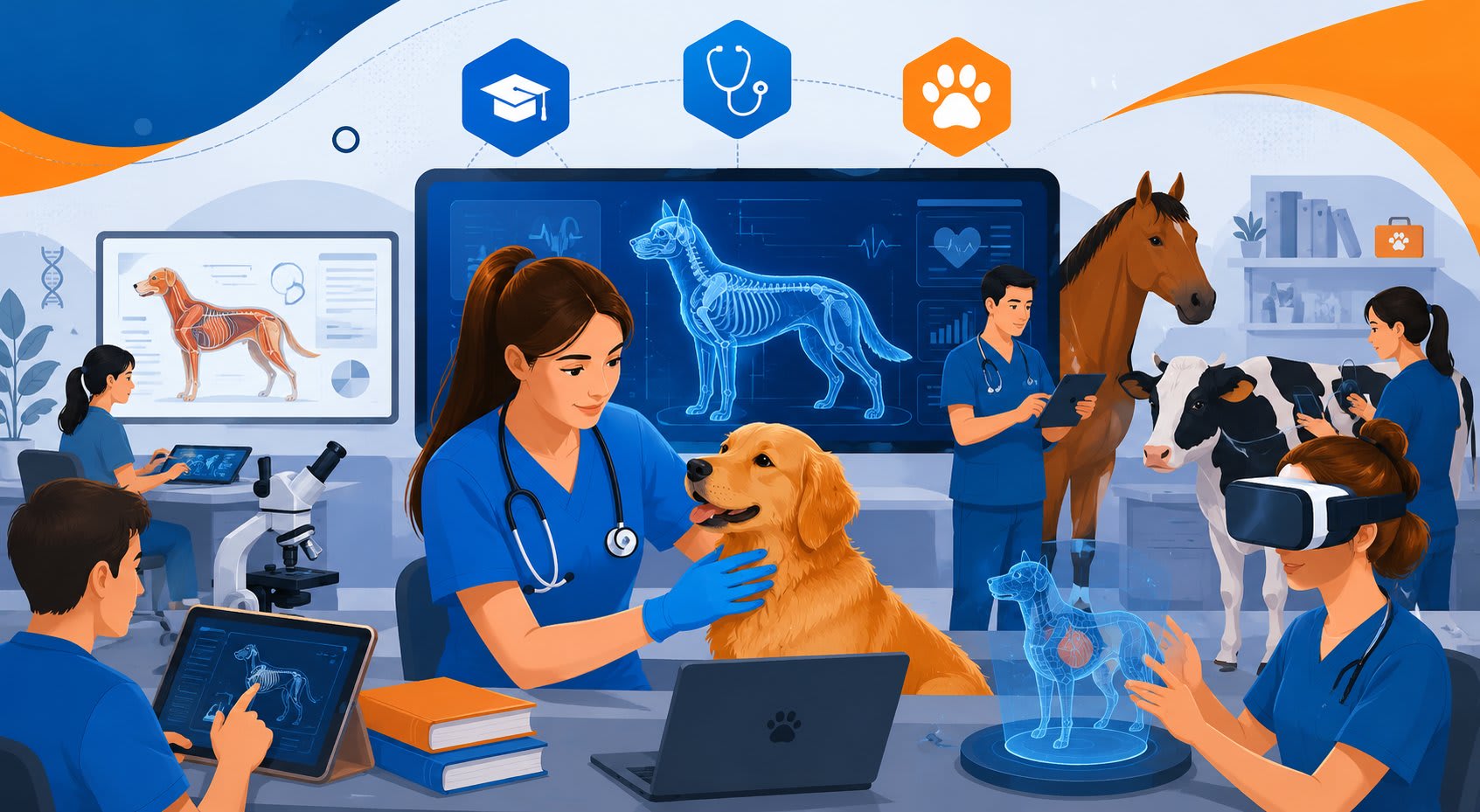
The Growing Role of Technology in Veterinary Science Education
Veterinary education is shifting faster than most institutions are ready to admit. Students today aren't hunched over the same thick textbooks their professors used; they're navigating immersive simulations, AI-driven platforms, and mobile tools that genuinely fit the chaos of their schedules. According to Grand View Research, e-learning dominated the veterinary education market in 2024 and is also anticipated to grow at the fastest CAGR over the forecast period. That's not a trend you can afford to wave away; it's a full-scale restructuring of how veterinary professionals are built, and institutions slow to adapt are quietly producing graduates who'll struggle in a digitally driven field.
Expanding Opportunities with Veterinary E-Learning Platforms
Modern veterinary e-learning environments aren't generic academic platforms with a veterinary logo stamped on the login page. They're purpose-built for animal science learners, designed from the ground up to handle the genuine complexity of the field.
Customizable Learning Environments Tailored for Veterinary Science
Digital pathology slides, 3D anatomical models, and multi-species resource libraries. These features distinguish serious veterinary platforms from the rest. Accessibility features, including screen readers and adjustable content formatting, ensure students with disabilities aren't quietly left behind. That inclusivity isn't a footnote. It matters enormously for where the profession goes next.
Harnessing Technology for Early Engagement in a Youth Veterinary Education Program
Here's where things get genuinely exciting because this technology doesn't have to wait for college enrollment to start working. Early engagement is already proving its worth. Many youth veterinary education program now combine hands-on skill development with experiences such as visits to animal care facilities, interactive learning environments, and guidance from experienced professionals. Gamified lessons and career simulations don't just entertain, they build lasting enthusiasm and foundational knowledge long before a student ever submits a college application.
Shaping Tomorrow's Veterinarians with Advanced Veterinary Technology in Education
Before getting into the specifics, it's worth stepping back and asking the real question: how exactly are these technologies being deployed in classrooms and clinical settings, and do they actually move the needle? Spoiler: yes, considerably.
The adoption of veterinary technology in education is accelerating globally, reshaping both how students learn and what they're capable of before they ever set foot in a live clinical environment.
Current State of Veterinary E-Learning: A Statistical Overview
Veterinary e-learning platforms are seeing adoption rates that would've seemed ambitious five years ago. The reasons aren't mysterious: flexibility, accessibility, and the ability to revisit dense material at 11 pm when it finally starts clicking. Students in rural areas, working professionals balancing jobs alongside studies, and international learners who previously had almost no options are all benefiting enormously.
These platforms are genuinely closing the gap between theoretical knowledge and practical readiness in ways a lecture hall simply cannot replicate.
Interactive Simulations and Virtual Labs: Elevating Clinical Skills Training
Strong adoption numbers are encouraging, but the more interesting story is how students are actually learning. Virtual reality and augmented reality tools now let students practice surgical procedures, run diagnostics, and work through emergency protocols in risk-free environments, no real patient harmed, no confidence shattered by a single early mistake. Scenario-based learning makes complex multi-species cases genuinely memorable rather than just temporarily memorized for an exam.
Artificial Intelligence and Data Analytics in Personalized Veterinary Education
VR is impressive. Gamification is engaging. But the experience becomes meaningfully more powerful when AI quietly adapts what each student sees, based on how they're actually performing. Smart question banks adjust difficulty in real time. Predictive analytics flag learning gaps before they detonate on exam day. That's not a luxury feature anymore; it's becoming foundational to how modern veterinary classrooms operate.
Supporting Veterinary Education Advancements with Cutting-edge EdTech Solutions
Veterinary education advancements don't live only in the visible learning tools; they depend equally on the infrastructure running underneath: credentialing systems, research platforms, and global accessibility solutions that most people never think about until something breaks.
Integrating Blockchain for Credentialing and Continuing Professional Development
Blockchain-backed e-certificates give veterinarians tamper-proof, instantly verifiable credentials. Compared to paper-based systems easily lost and easily questioned, this is a substantial operational upgrade. License renewal and continuing education compliance become far less administratively painful when verification is automated, transparent, and permanent.
Exploring the Potential of Artificial Intelligence in Veterinary Research Training
AI is extending its influence well beyond adaptive quizzes and personalized study paths. It can scan thousands of research papers and surface the relevant literature in minutes. Students working through diagnostic simulations receive guided, AI-supported feedback that mirrors real clinical decision-making rather than generic multiple-choice responses.
Bridging the Global Education Gap: Multilingual and Cross-border Veterinary Learning
Real-time translation tools and cross-border collaboration platforms are quietly doing something remarkable, making it possible for a student in rural Kenya to access a curriculum quality comparable to someone studying in Boston. That's a genuinely powerful equalizer, and it deserves more attention than it typically receives.
Best Practices for Implementing Technology in Veterinary Science Curricula
Strong implementation demands two things simultaneously: educator confidence and institutional safeguards. Neither substitutes for the other.
Faculty Development for Tech-Enhanced Veterinary Teaching
Educators need structured, sustained training, not a single orientation session followed by radio silence. Resistance to change softens quickly when faculty can see measurable student outcomes tied to early adoption efforts.
Ensuring Data Security and Privacy in Veterinary E-Learning
FERPA-compliant platforms, encrypted data transmission, and clear institutional data governance policies are non-negotiable requirements for any serious veterinary e-learning deployment. These aren't optional add-ons. They're on the floor.
The Future of Digital Learning for Veterinarians
The future of digital learning for veterinarians is both exciting and, honestly, a little dizzying in the best way.
Predicting the Next Wave of Veterinary Technology in Education
IoT-enabled animal monitoring, next-generation AI diagnostics, and immersive remote labs are already in early development at leading veterinary schools. Curricula are being actively redesigned so graduates hit day one of practice already familiar with the tools they'll use daily.
Opportunities and Challenges Ahead
The digital divide remains real and stubbornly persistent. Inconsistent internet access, device costs, and tight institutional budgets continue to limit adoption in lower-resource environments. Adapting veterinary technology in education initiatives, including youth programs for under-resourced communities, must stay a deliberate strategic priority, not an afterthought addressed after the easier wins are claimed.
Common Questions About Technology in Veterinary Education
What is the role of technology in veterinary science education today?
Technology supports clinical simulations, personalized AI-driven learning, mobile study tools, and global accessibility. It's reshaping how veterinary students learn practical skills and access course content without location or scheduling barriers.
How does virtual reality improve clinical training in vet schools?
VR allows students to practice surgical and diagnostic procedures in risk-free simulated environments. Repeated virtual practice builds muscle memory and procedural confidence before students work with actual patients.
What are the best platforms for veterinary e-learning and why?
Top platforms offer multi-species resources, 3D anatomy models, AI-adapted content, and accessibility tools. The best ones combine clinical depth with flexible delivery and robust assessment tracking for measurable learning outcomes.
Want to publish a guest post on aamax.co?
Place an order for a guest post or link insertion today.
Place an Order