

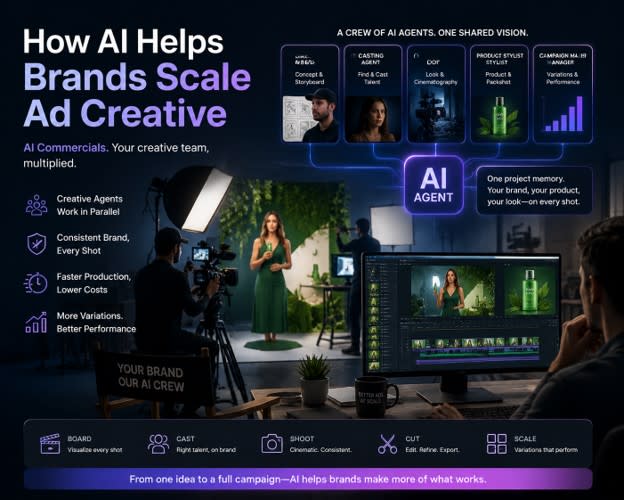
How AI Helps Brands Scale Ad Creative
Brands no longer need just one strong video ad. A modern campaign may require a hero film, shorter social cuts, product versions, different hooks, regional adaptations, vertical videos, and fresh creative for ongoing testing. The real challenge is producing all of that while keeping the product, visual identity, message, and overall campaign world consistent.
That pressure is arriving at the same time as AI becomes a larger part of video advertising. Forbes reports that the Interactive Advertising Bureau projects nearly 40% of video advertising will be generated or substantially enhanced by AI in 2026.
This is where AI Commercials are changing the production equation. Instead of treating AI as a way to make isolated clips, brands can build connected workflows where the brief, product references, cast, visual rules, and approved creative decisions stay available throughout production.
For marketing teams, the opportunity is not simply to make ads faster. It is to create more useful variations from the same creative foundation while maintaining the details that make the campaign recognizably theirs.
AI helps brands scale ad creative by turning a campaign brief into a reusable production system. Teams can develop, cast, board, generate, edit, adapt, and localize commercials from shared brand and product context rather than rebuilding each version from the beginning.
Why Ad Creative Needs More Scale
Performance advertising rewards experimentation. A brand may begin with one campaign concept but soon need several opening hooks, different product moments, multiple lengths, alternate calls to action, and versions designed for different channels.
The production challenge grows quickly. If every version becomes an independent project, teams repeat the same decisions about casting, product appearance, lighting, typography, framing, music, and messaging.
AI Commercials offer another approach. A brand can establish the creative foundation first and then create variations from those approved decisions.
A practical campaign structure might include:
- One master creative direction
- Several opening hooks
- Multiple product or offer versions
- 6, 15, and 30 second edits
- Vertical and landscape cuts
- Market-specific dialogue and text
- Alternate end frames and calls to action
This turns creative scaling into a controlled variation process instead of a series of unrelated productions.
How AI Commercials Maintain Brand Consistency
Creative volume only helps when audiences can still recognize the brand.
The first step is giving the production system enough information about what must remain constant. This can include the brand book, campaign script, product photography, packaging details, color palette, type rules, tone of voice, reference films, approved cast, and visual references.
This information is a campaign bible stored in project memory. Boards and individual shots can then be developed against the same foundation.
Product references are especially important. Multiple angles, close views, scale references, and information about materials can give the system clearer guidance about how an item should appear throughout the commercial. It is recommended locking approved product and visual decisions before building related shots.
This matters because consistency is not simply about displaying the same logo. It can include:
- Product proportions and packaging
- Cast appearance and wardrobe
- Lighting and color treatment
- Camera and lens language
- Typography and graphic rules
- Brand voice and messaging
- Packshots and end frames
Once these elements are treated as campaign rules, scaling becomes much easier to manage.
Build Commercials Like a Production Crew
One useful development in AI advertising is the move from a single generation tool toward systems that divide production into specialist roles.
Invideo Agent follows this crew-based approach. A brand can hand over a brief, brand book, product references, and creative material. The project can then be developed shot by shot, including boards, casting, visual direction, product moments, packshots, and final frames. Specialist agents working from shared project memory, allowing different parts of production to move in parallel.
For teams exploring AI Commercials, this is particularly relevant when one campaign needs to become many deliverables. Rather than treating every new video as a separate brief, invideo Agent can keep the brand, product, cast, and look available while different creative agents work on parts of the commercial. That means one agent might develop product beauty shots while another works on environments or casting.
The practical benefit is increased production capacity without requiring the creative team itself to grow at the same rate. The human team still decides what feels right, approves directions, and shapes the final work. As brands create more versions of their campaigns across channels, having a clear system for repurposing creative assets at scale helps marketing teams extend the value of existing content while maintaining consistency across different formats.
For example, jewellery ads demand precision in showcasing product details, reflections, materials, and premium visuals. AI-powered creative workflows can help teams plan and produce these commercials with greater consistency. This video walks through how AI agents can support the creation of jewellery ads, from initial direction to the finished film.
3 different bodyshapes, 3 different heights and 3 different ages all in the same outfit!
The recently launched invideo Agent Two extends the idea as a frontier intelligence agent for serious creative work. It can read materials such as scripts, PDFs, brand books, videos, Drive files, and reference links, while specialist agents can share project information and hand off work between departments.
Scale Winners Across More Campaigns
Producing more creative does not mean every idea deserves equal investment. A more practical workflow is to create several controlled variations, measure performance, and expand the concepts that work.
For example, suppose a 15-second product ad performs well because of its opening demonstration and quick product reveal. Instead of replacing the whole concept, a team could retain its structure while testing:
- A different opening line
- Another audience or cast choice
- A new product color
- A different offer
- A shorter social cut
- A localized market version
The ads workflow takes a similar process for scaling a winning creative across products, characters, languages, and formats while retaining approved campaign elements.
This makes AI Commercials useful for performance teams because the production workflow can follow what campaign data is already showing. Creative testing becomes connected to production rather than sitting after it.
The same principle can support Blog Marketing campaigns. A brand launching a research report, product guide, or educational article can turn its strongest ideas into short video ads, social cuts, visual explainers, and retargeting creative. This creates a clearer link between editorial content and paid distribution without requiring a completely separate creative idea for every channel.
Adapt One Campaign Across Markets
Localization is another area where creative requirements multiply.
Changing spoken language is only one part of the job. A useful regional version may also require new on-screen text, revised timing, culturally appropriate casting, altered offers, and changes to scenes that do not translate well to another market.
With AI Commercials, teams can separate what should remain fixed from what needs adaptation. The product, campaign identity, core visual treatment, and major story beats might stay consistent, while dialogue, supers, cast, or selected locations change.
Consider a workflow in which an original commercial can be analyzed before creating a plan for elements that stay and elements that change across markets.
This gives international teams a more structured way to think about localization. Instead of reproducing the entire commercial independently for every region, they can adapt selected layers of an approved campaign.
Turn One Film Into More Assets
The value of a commercial often continues after the hero film is complete.
The same approved shots and campaign world can support shorter edits, social versions, still imagery, product visuals, alternate end frames, and different aspect ratios. An approved film can become platform-specific cuts for channels such as Instagram Reels, TikTok, YouTube Shorts, connected TV, and other placements.
AI Commercials therefore work best when teams think beyond the first export. The production should be planned around a family of assets from the start.
Editing is part of that process too. Once approved footage is available, context-aware editing can help teams assemble cuts, compare versions, insert brand assets, and make repeated changes across campaign variations without losing sight of the original creative plan.
Keep Humans Directing the Creative
Scaling production should not mean handing every creative choice to automation.
People still need to decide what the campaign should communicate, what fits the brand, which performance feels believable, and whether a particular visual idea deserves to become part of the campaign.
A useful workflow keeps human approval at important points:
- Brief: Define the audience, proposition, product, and objective.
- Creative direction: Lock the visual world and brand rules.
- Boards: Review the commercial before full generation.
- Production: Generate and compare takes.
- Assembly: Judge pacing and narrative as a complete film.
- Variation: Build new cuts from approved creative.
- Measurement: Use campaign results to guide the next round.
That combination of human direction and automated production is where AI Commercials can provide the most practical value.
Conclusion
The biggest change in AI advertising is not simply faster video generation. It is the possibility of treating an entire campaign as a connected production system.
AI Commercials can help teams keep products, cast, visual language, messaging, and brand rules connected while producing more hooks, cuts, formats, and localized versions. Agent-based workflows add another layer by allowing specialist creative tasks to happen in parallel while sharing the same project context.
For brands, the next step is to start with one well-defined campaign. Lock the product and creative rules, create several controlled variations, measure what works, and expand from approved material rather than rebuilding everything.
If your team could turn one strong commercial into an entire campaign, which creative variations would you test first?
Frequently Asked Questions
What are AI Commercials?
AI Commercials are advertising videos created or substantially developed with artificial intelligence. Depending on the workflow, AI can assist with concepts, scripts, casting, storyboards, scene generation, product shots, voices, music, editing, localization, and campaign variations while creative teams continue to direct and approve the work.
Can AI keep products consistent in ads?
It can improve product consistency when the workflow starts with strong references. Brands should provide clear product images from multiple angles, close views, packaging information, scale references, and material details. Approved product shots can then act as visual anchors for related scenes rather than asking the system to interpret the product again for every shot.
How can brands scale video ad variations?
Start with an approved master concept and identify which elements can change. Teams can then test different hooks, products, cast choices, offers, durations, calls to action, and formats while keeping core brand rules fixed. This reduces repeated production work and makes performance testing easier to organize.
Can AI create localized commercials?
Yes. AI-assisted workflows can support translated dialogue, voiceovers, on-screen text, regional cast changes, and selected scene adaptations. Brands should still review each version for cultural meaning, legal requirements, product claims, and language quality before publishing it in a new market.
Does AI replace advertising creative teams?
AI is more useful as production support than as a replacement for creative judgment. Human teams still define the strategy, audience insight, message, brand standards, and final creative decisions. AI can handle more of the repetitive production work and help teams explore a wider range of executions.
How should brands start using AI for ads?
Begin with one controlled campaign rather than trying to automate the entire advertising operation. Prepare the brief, brand guidelines, product references, approved visual direction, and campaign goals. Build a small number of variations, review them carefully, measure their performance, and then expand the workflow based on what proves useful.
Want to publish a guest post on aamax.co?
Place an order for a guest post or link insertion today.
Place an Order