

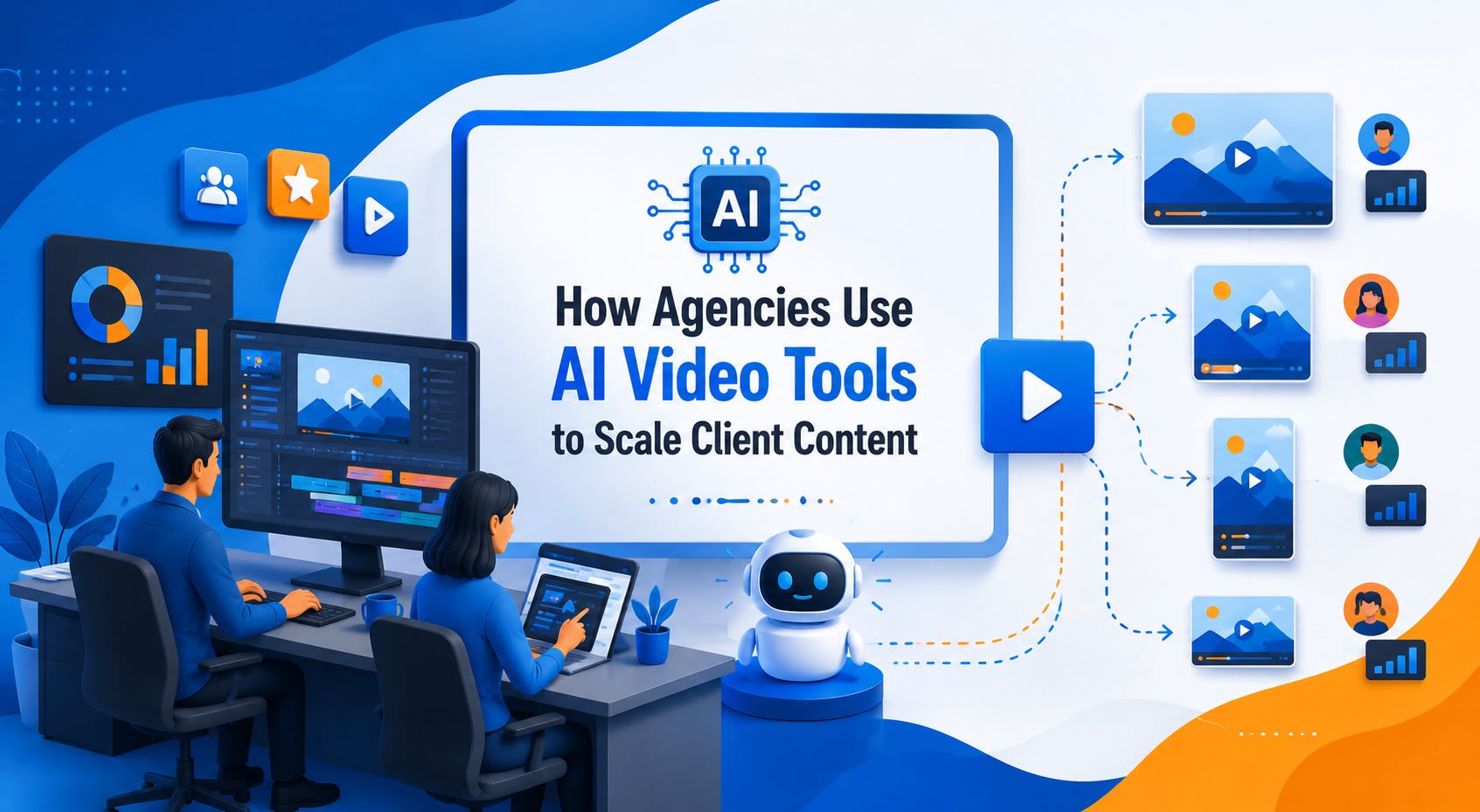
How Agencies Use AI Video Tools to Scale Client Content
Performance agencies are using AI video tools to produce 10 to 20 times more creative output per client without growing headcount proportionally, mainly by automating the parts of video production that used to consume the most editor hours: scripting variations, generating UGC-style talking-head content, batch-producing aspect ratios, and iterating on winning ads. The shift has moved video production from a bottleneck function priced at $200 to $600 per finished asset down to something closer to $15 to $40 per asset when measured at scale, while freeing the agency's senior strategists to focus on what actually moves performance.
The economic change here is real, but the operational change is bigger. Agencies that adopted AI video workflows early aren't just producing more. They're restructuring the team itself, with fewer mid-level editors and more strategists, brand-side account leads, and what some are now calling creative operations managers who sit between strategy and the AI production layer.
Where AI Video Slots Into the Agency Workflow
The typical agency creative process used to run: brief, script, shoot or source footage, edit, deliver, iterate. AI video collapses the middle three stages for most short-form work. A strategist writes a brief and 8 to 12 hook variations. Those go straight into an AI tool that generates avatar-led or product-led video at 1080x1920, 1080x1080, and 1920x1080 in one batch.
The time from brief to first cut, which used to run 3 to 5 working days for a 30-second ad set, now runs 4 to 8 hours for the same volume. That's not a marginal improvement. It changes the kind of campaigns an agency can take on. Clients who could previously support one or two creative refreshes a month can now sustain weekly refreshes at the same agency fee, which improves their performance and improves the agency's retention. The agencies winning new business in 2026 are usually the ones leading their pitch with creative velocity rather than creative quality alone.
How Agencies Structure Creative Testing at Volume
The point of producing more creative isn't more creative. It's more learning per dollar of media spend. Performance agencies use AI video to test isolated variables systematically, in ways that were too expensive to do with traditional production. A typical testing matrix for a single client might run four hook variations against three actor types against two background styles, which produces 24 unique videos. Trying to shoot that matrix with real creators would cost somewhere in the $5,000 to $15,000 range and take two weeks. With AI, the same matrix runs at $300 to $600 in tool credits and ships the same day.
The learning that comes out of that volume compounds. Industry data on creative testing has linked structured variation testing with 20 to 40 percent improvement in cost per acquisition over a six-month window, mostly because the agency builds a real understanding of what works for the specific client rather than recycling assumptions from other brands. Agencies that run this kind of testing also tend to retain clients longer, because the relationship moves from "we make your ads" to "we have proprietary data on what converts for your category."
Pricing Models Are Shifting Toward Output Volume
The traditional agency pricing model, hourly or per-asset, doesn't survive contact with AI production. When an agency can produce 200 video variants in the time it used to take to produce 20, charging per asset means either dropping prices dramatically or charging clients for outputs the agency didn't really work on.
The model most performance shops have moved toward is a monthly retainer tied to creative volume and testing cadence rather than to specific deliverables. A typical performance creative retainer for a mid-market DTC client now sits somewhere between $4,000 and $12,000 a month, covering 40 to 120 video assets, ongoing testing, and the strategy work around it. Larger accounts with $100,000+ in monthly ad spend often pay $15,000 to $30,000 monthly, with the agency taking on what amounts to a full in-house creative function.
The agencies that haven't restructured pricing are getting squeezed from both sides. Their clients see other agencies offering more output for the same fee, and their own margins erode because they're still costing AI-produced assets as if they took six hours each. Most of the agency consolidation conversation in 2026 traces back to this pricing pressure rather than to any direct AI replacement risk.
Maintaining Brand Consistency Across Many Clients
The harder operational problem at agency scale is brand consistency. A single agency might run 15 to 40 active clients, each with its own typography, colour palette, tone, and approved actor types. AI tools that generate output without proper brand controls produce a sea of homogenised content that all looks the same, which is the fastest way to lose a client who cares about how their brand shows up.
The fix that's worked best is brand-specific template libraries inside whichever AI platform the agency uses. Each client gets a locked preset with the right fonts, colour rules, caption styles, aspect ratios, and approved avatar or actor types. Junior team members generate against the preset rather than from scratch, which keeps output on-brand even when the production is fully automated. Setting up a proper preset for a new client takes around 4 to 8 hours of senior creative time, and it pays back within the first month of production.
For agencies running this at scale, the operational stack usually consolidates around one or two core platforms rather than a different tool per client. End-to-end AI ads software that handles avatar generation, script variations, batch output, and brand presets in one place reduces the operational overhead significantly compared to stringing together three or four point solutions, which is the trap most early-adopter agencies fell into in 2024 before the category consolidated.
How This Looks Different Across Agency Types
The impact varies a lot by agency model. Performance and direct-response agencies see the biggest gains, because their work was always volume-driven and the AI-friendly content types (UGC-style ads, product demos, hook testing) sit at the centre of their service. A performance agency that adopts AI video properly can plausibly triple its client roster without adding headcount, which has driven the boutique-agency growth boom of the last 18 months.
Brand-led agencies and creative shops have moved more cautiously, and rightly. Brand work depends on craft and conceptual originality that AI tools genuinely don't replicate well at the top end. These agencies have absorbed AI video selectively, using it for utility work like social cutdowns and platform variants while keeping hero brand films in traditional production.
Production companies, the ones that actually shoot, have been hit harder than agencies on the operational side. Their pre-production and editing departments have shrunk, while the shooting day itself has held up.
Want to publish a guest post on aamax.co?
Place an order for a guest post or link insertion today.
Place an Order