

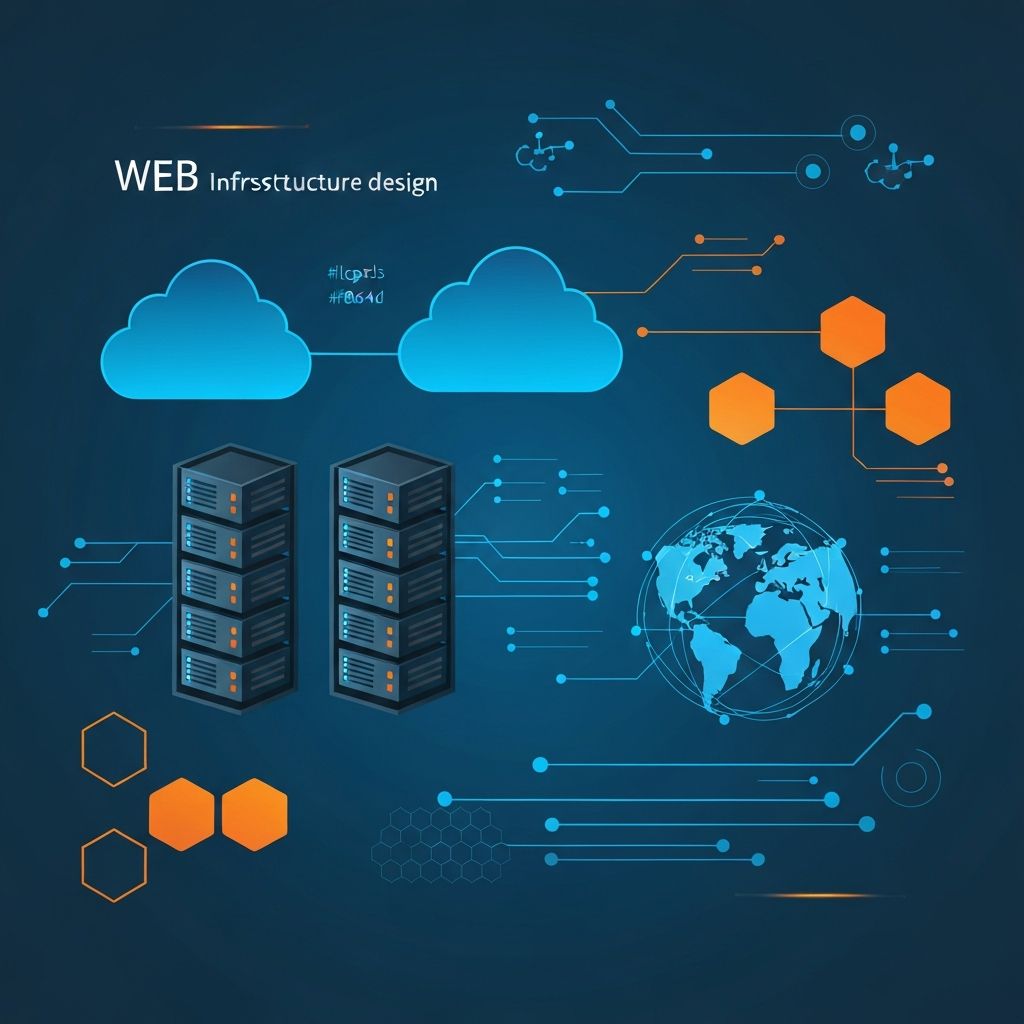
Web Infrastructure Design
Why Web Infrastructure Design Matters More Than Ever
Behind every great website lives an infrastructure quietly doing the heavy lifting: serving pages, storing data, processing transactions, scaling under traffic spikes, defending against attacks, and recovering from failures. Web infrastructure design is the discipline of planning and building that backbone deliberately. It is rarely glamorous, yet it determines whether a brand’s digital presence is a reliable revenue engine or a fragile liability. In 2026, with users expecting instant load times, near-zero downtime, and seamless experiences across regions, infrastructure choices have direct business consequences.
At AAMAX.CO, we treat infrastructure as a first-class design problem, not a checkbox handled at deployment time. Our infrastructure decisions are driven by the same rigor we bring to interface design: clear goals, measurable outcomes, and a deep respect for the people who will live with the system long after launch.
The Building Blocks of Modern Web Infrastructure
Modern web infrastructure typically includes several layers: a content delivery network for global edge caching, an application layer where business logic runs, databases for structured and unstructured data, object storage for files, queues and background workers for asynchronous tasks, observability tools, and security controls layered throughout. Each layer has many viable options, and the right combination depends on traffic patterns, latency requirements, regulatory constraints, and team expertise.
Cloud platforms like AWS, Google Cloud, and Azure offer enormous flexibility, while platform-as-a-service providers such as Vercel and managed database services dramatically reduce operational overhead. The trade-offs are real: more control means more responsibility, while more abstraction means less low-level tuning. Our web development consulting services help clients navigate these trade-offs with clarity rather than guesswork.
Designing for Performance at the Edge
Performance is no longer a nice-to-have; it is a ranking factor, a conversion lever, and a brand impression. Edge networks dramatically reduce latency by serving cached content from locations close to the user. Static assets, marketing pages, and increasingly even dynamic content can be delivered from the edge with the right architecture.
Frameworks like Next.js have brought edge-aware development into the mainstream, allowing applications to mix static, server-rendered, and edge-rendered routes within a single codebase. Our Next.js web development projects routinely leverage these capabilities to deliver experiences that feel instant on every continent.
Scalability and Elasticity
Traffic on the web is rarely predictable. Marketing campaigns, viral moments, seasonal peaks, and product launches can multiply traffic by ten or a hundred in minutes. Infrastructure must scale elastically, expanding capacity when needed and contracting when demand falls so that costs remain reasonable. Auto-scaling compute, managed databases with read replicas, queue-based workloads, and stateless application design all contribute to elasticity.
The opposite challenge is also real: over-provisioning expensive infrastructure for a steady, modest workload wastes money that could fund product development, marketing, or hiring. Right-sizing infrastructure is an ongoing discipline, not a one-time decision.
Reliability, Redundancy, and Disaster Recovery
Reliability is built, not bought. Multi-zone deployments, automated failover, regular backups, well-tested restore procedures, and runbooks for common incidents are the difference between a brief blip and a multi-day outage. The hardest part of disaster recovery is not having backups; it is verifying that they actually work under realistic conditions. Teams that practice failure—through chaos testing, game days, and tabletop exercises—recover dramatically faster when real incidents strike.
Redundancy also applies to dependencies. Heavy reliance on a single third-party service, especially one without a clear SLA, creates fragility. Designing graceful degradation paths, where non-critical features fail quietly while core functionality continues, protects user experience during partial outages.
Security as a Design Concern
Security cannot be bolted on after launch. It must be designed into infrastructure from the start. This includes network segmentation, least-privilege access control, encrypted data at rest and in transit, secrets management, regular dependency updates, vulnerability scanning, web application firewalls, rate limiting, and bot mitigation. Authentication and authorization design—who can access what, under which conditions—deserves as much attention as visual design.
Compliance frameworks like GDPR, CCPA, HIPAA, and PCI DSS add concrete requirements that infrastructure design must satisfy. Our back-end web development teams build security controls into every layer of the stack, treating compliance as a baseline rather than a hurdle.
Observability and Continuous Improvement
You cannot improve what you cannot see. Modern web infrastructure design includes deep observability: structured logs, distributed tracing, application metrics, real-user monitoring, synthetic checks, and clear dashboards. Alerts must be actionable rather than noisy, and on-call rotations must be humane rather than punishing.
Observability also fuels product decisions. Slow database queries, error-prone code paths, underused features, and unexpected user behavior all surface through good telemetry. Teams that invest in observability iterate faster and ship with greater confidence.
Cost-Aware Architecture
Infrastructure costs can quietly spiral, especially as a product grows. Cost-aware design treats budget as a constraint to optimize for, just like performance or reliability. Choosing the right database for the workload, caching aggressively where appropriate, archiving cold data, and shutting down unused environments all add up. Detailed cost dashboards, tagging strategies, and regular reviews keep spending aligned with business value.
DevOps, CI/CD, and Developer Experience
Infrastructure design is not only about runtime systems. It also shapes how engineers ship changes. Robust continuous integration and deployment pipelines, ephemeral preview environments, infrastructure-as-code, and clear release processes turn deployment from a nerve-wracking event into a routine occurrence. Strong developer experience translates directly into faster feature delivery, fewer bugs, and lower turnover.
For teams building rich applications, our web application development service includes the CI/CD and infrastructure work that turns ambitious ideas into production-ready software.
Hire AAMAX.CO for Web Infrastructure Designed to Last
Web infrastructure design is the difference between a website that quietly compounds value and one that constantly costs you sleep. As a full-service partner, we combine architectural expertise, security discipline, and product thinking to deliver infrastructure that scales gracefully with your business. Hire AAMAX.CO and let our team design, build, and operate a foundation worthy of your ambitions. Explore our website development services to see how we turn infrastructure into a long-term competitive advantage.
Want to publish a guest post on aamax.co?
Place an order for a guest post or link insertion today.
Place an Order