

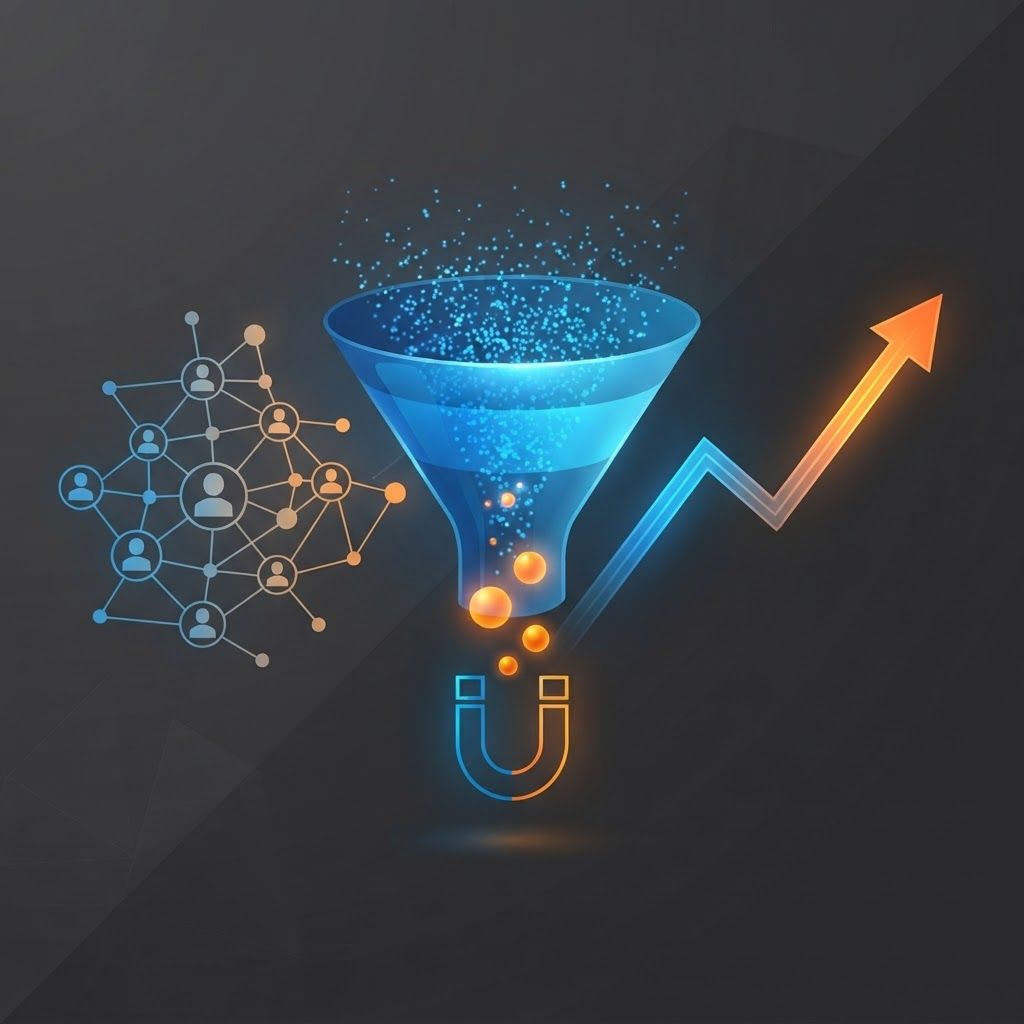
How to Increase Leads With SEO
Traffic Is Not the Goal — Qualified Leads Are
Plenty of businesses achieve impressive organic traffic and still generate almost no enquiries. This happens when SEO is treated as a visibility exercise rather than a demand capture system. Sessions, impressions, and keyword counts are inputs. Leads are the output that pays for the work. Increasing leads with SEO therefore requires a different starting point: instead of asking which keywords have the highest volume, you ask which searches are made by people who are close to buying, and whether your pages are built to convert them.
The framework has three parts. First, target search intent that correlates with commercial action. Second, build pages designed to convert rather than merely inform. Third, connect the whole thing to your sales process so you can measure and improve what actually produces revenue.
How AAMAX.CO Turns SEO Into Pipeline
We build lead-focused search programmes for service businesses, B2B companies, and local providers who need enquiries rather than applause. Our SEO services begin by mapping the queries your best customers actually use before they buy, then designing landing pages, service pages, and comparison content engineered around those decisions. Because AAMAX.CO is a full service digital marketing company delivering web development, digital marketing, and SEO worldwide, we can build the pages, wire up the tracking, and optimise the conversion path as one continuous piece of work. If your traffic looks healthy but your enquiry volume does not, we can usually diagnose the gap quickly.
Target Commercial and Transactional Intent First
Search intent falls broadly into four categories: informational, navigational, commercial investigation, and transactional. Informational content builds audience and topical authority, but it rarely produces an enquiry on the first visit. Commercial and transactional queries are where leads live, and they are usually far less competitive than the broad head terms everyone chases.
Look for patterns that signal readiness: service plus location, best or top provider phrasing, comparison and alternative queries, pricing and cost questions, and problem-specific phrases that only someone experiencing the problem would type. These searches often have modest volume but convert at multiples of informational traffic. Build a dedicated page for each meaningful cluster instead of trying to serve them all from one generic services page.
Build Service and Solution Pages That Convert
A page that ranks but does not convert is a leak, not a win. Strong commercial pages share a recognisable structure. They open with a clear statement of what you do and who it is for, so a visitor knows within seconds whether they are in the right place. They articulate the specific problem in the customer's own language before describing the solution.
Then they provide proof: relevant case examples, measurable outcomes, client logos, testimonials, credentials, and any independent validation you have. They explain the process, because uncertainty about what happens next is a major source of hesitation. They address objections directly — pricing ranges, timelines, contract terms, what happens if it does not work. And they present a single, obvious primary call to action repeated at natural decision points rather than a scattering of competing buttons.
Create Bottom-of-Funnel Content Deliberately
Most content calendars are dominated by top-of-funnel explainers. Balance them with content built for people already evaluating options. Comparison pages that honestly assess alternatives capture high-intent searchers who are deciding between providers. Pricing and cost pages attract people with budget who are trying to qualify you. Alternative pages capture demand from users dissatisfied with a competitor.
Case studies serve double duty as both ranking assets for problem-specific queries and as proof for buyers already on your site. Detailed FAQ resources built from real sales conversations often rank for long-tail queries with remarkable conversion rates. These pages are less glamorous than thought leadership, but they are where enquiries come from.
Capture Local and Location-Based Demand
If you serve specific geographies, local search is one of the highest-converting channels available. Optimise your business profile with accurate categories, service descriptions, hours, photos, and a steady flow of genuine reviews. Keep your name, address, and phone number consistent everywhere they appear.
Build genuinely distinct location or service-area pages, each with locally relevant content: local case examples, area-specific considerations, team details, and directions. Thin pages that swap a city name into an otherwise identical template rarely rank and never persuade. If you have physical premises, implement LocalBusiness schema and make your contact options impossible to miss on mobile.
Optimise the Conversion Path, Not Just the Page
Small friction points quietly destroy lead volume. Audit your forms and remove every field you do not genuinely need to qualify an enquiry; each additional field reduces completion. Offer multiple contact routes — form, phone, chat, and calendar booking — because different buyers prefer different channels.
Make sure your calls to action are visible without scrolling on mobile, that your load times are fast on real devices, and that your thank-you experience sets clear expectations about response times. Then reduce the commitment required for people not ready to talk: a useful download, a diagnostic tool, a checklist, or a short assessment lets you capture contact details and nurture over time instead of losing the visit entirely.
Track What Matters and Close the Loop
You cannot increase leads you do not measure. Set up conversion tracking for every meaningful action: form submissions, calls, chat conversations, and bookings. Attribute those conversions back to landing pages and, where possible, to query clusters, so you can see which topics produce enquiries rather than only sessions.
Then push further and connect outcomes to your CRM so you know which organic pages produce qualified opportunities and closed revenue, not just raw enquiry counts. That distinction changes priorities: a page generating five enquiries that all close is worth far more than one generating fifty that never qualify. Feed those insights back into your keyword strategy and content roadmap every quarter, and extend the same intent thinking to emerging channels with GEO services so you remain visible as buyers increasingly begin their research inside AI-generated answers.
Want to publish a guest post on aamax.co?
Place an order for a guest post or link insertion today.
Place an Order