

How to Boost Ecommerce SEO With Internal Linking Exam Answers
Ecommerce sites live and die by how easily shoppers and search engines can navigate them. With hundreds or thousands of product and category pages, the way those pages connect to one another has an enormous impact on rankings, crawlability, and conversions. Internal linking is the practice of connecting your own pages with meaningful links, and for ecommerce it is one of the highest-leverage, lowest-cost optimizations available. This article is framed around the common questions — the "exam answers" — that store owners and marketers ask about internal linking, giving you a clear, practical playbook for boosting ecommerce SEO through smarter site structure.
Grow Your Store With AAMAX.CO SEO Services
Optimizing internal links across a large catalog takes structure, tooling, and ongoing maintenance. At AAMAX.CO, our search engine optimization team designs internal linking architectures that guide both shoppers and crawlers to your most valuable pages, improving rankings and revenue at the same time. As a full-service digital marketing company serving clients worldwide, we combine technical SEO, content, and web development, so your store’s structure supports growth from the ground up. If your catalog has outgrown its site structure, we can help you rebuild it for scale.
What Is Internal Linking and Why Does It Matter?
Internal linking refers to any hyperlink that points from one page on your domain to another page on the same domain. These links do three critical jobs. First, they help search engines discover and crawl your pages, ensuring important products are not stranded deep in the site. Second, they distribute authority — often called link equity — from strong pages to the pages that need a ranking boost. Third, they guide shoppers toward related products and helpful content, increasing time on site and conversions. For ecommerce, where inventory is vast and category pages are the primary ranking targets, internal linking is foundational rather than optional.
How Should Ecommerce Site Architecture Be Structured?
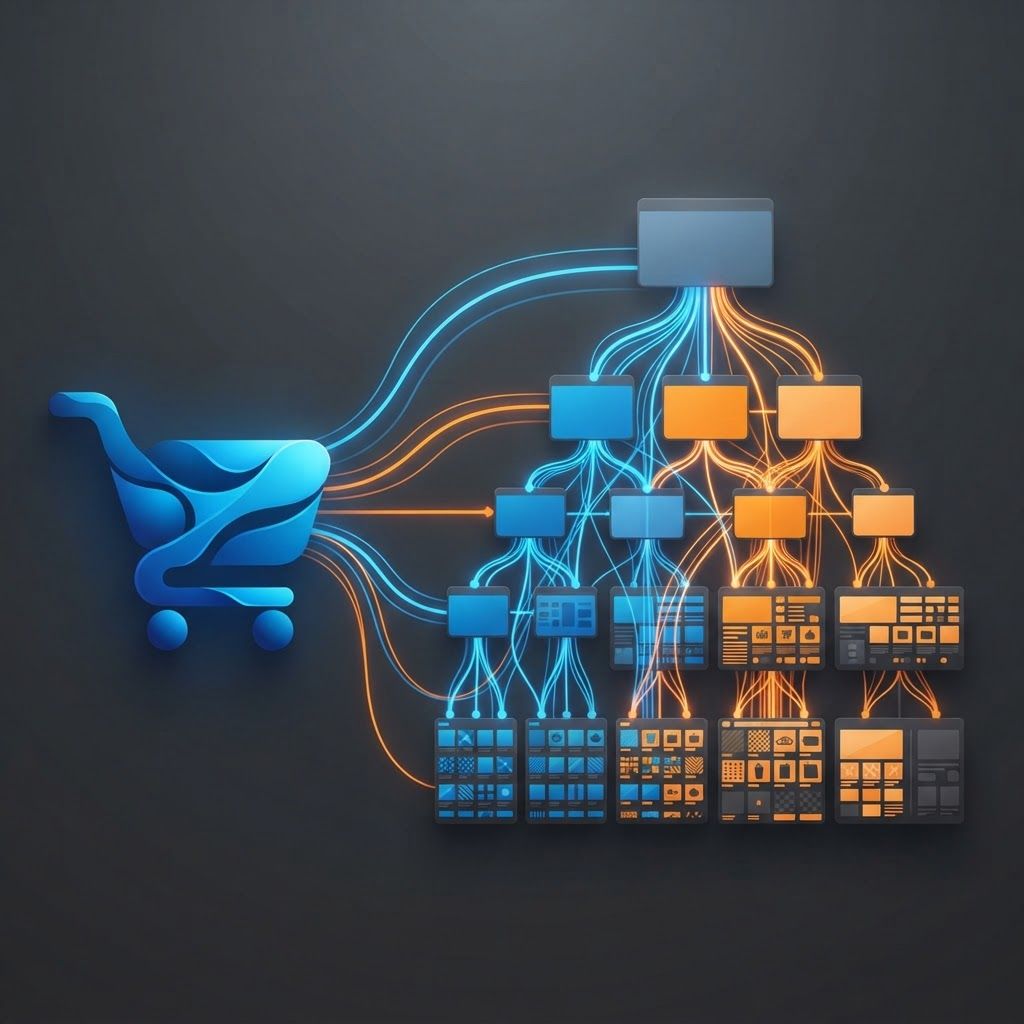
The best answer is a shallow, logical hierarchy. Aim for a structure where any product is reachable from the homepage in as few clicks as possible, ideally three or fewer. Organize the site into clear tiers: homepage, main categories, subcategories, and product pages. This pyramid ensures that authority flows naturally from your strongest page — the homepage — down to categories and then to products. A flat, well-organized architecture prevents important pages from becoming orphaned and makes it easy for both users and crawlers to understand how everything relates.
Which Pages Deserve the Most Internal Links?
Category and subcategory pages typically deserve the most internal links because they target high-value, high-volume keywords and act as hubs for many products. Your best-selling and highest-margin products also merit strong internal linking. A useful principle is to point more links toward the pages you most want to rank. Conversely, pages with little SEO value — such as certain filtered URLs or utility pages — should not absorb link equity that could go to revenue-driving pages. Prioritizing links this way ensures your authority is invested where it produces the greatest return.
How Should Anchor Text Be Written?
Anchor text — the clickable words in a link — tells search engines what the destination page is about, so it should be descriptive and relevant. Use natural, keyword-rich anchors like the category or product name rather than generic phrases such as "click here." At the same time, keep anchors varied and human; over-optimizing every link with the exact same keyword can look manipulative. The goal is clarity for shoppers and context for crawlers, achieved through descriptive language that reflects the linked page honestly.
How Do Content and Blogs Support Product Pages?
Content marketing is one of the most powerful internal linking tools for ecommerce. Buying guides, comparison articles, and how-to posts naturally link to relevant category and product pages, passing authority and capturing shoppers earlier in their journey. A well-planned content hub can funnel readers from informational queries toward purchase-ready pages, boosting both rankings and conversions. Integrating editorial content with your catalog is a hallmark of mature digital marketing, and it turns your blog from a cost center into a revenue driver.
What About Related Products and Breadcrumbs?
Two automated linking patterns are especially valuable for ecommerce. Related product and "customers also bought" modules create relevant internal links at scale while increasing average order value. Breadcrumb navigation reinforces your site hierarchy, gives users an easy way to move up levels, and provides search engines with clear structural signals — especially when marked up with structured data. Both patterns strengthen internal linking without requiring manual effort on every page, which is essential when managing large catalogs.
How Do You Handle Faceted Navigation and Duplicate URLs?
Faceted navigation — filters for size, color, price, and so on — can generate an explosion of near-duplicate URLs that waste crawl budget and dilute authority. The answer is disciplined control: use canonical tags to consolidate duplicates, and carefully manage which filtered pages should be crawlable and indexable. Only expose filter combinations that target genuine search demand. Handling this correctly keeps search engines focused on your valuable pages instead of drowning in low-value variations.
How Do You Measure Internal Linking Success?
Track improvements in crawl coverage, indexation of key pages, rankings for category keywords, and reductions in orphaned pages. Tools that visualize internal link distribution help you spot pages receiving too few links. Over time, you should see stronger rankings for target categories, better crawl efficiency, and improved on-site engagement. Regular audits keep the structure healthy as inventory changes, which is critical because ecommerce catalogs are never static.
Turning Internal Links Into Sales
Internal linking is a rare optimization that improves SEO and user experience simultaneously, and for ecommerce it directly influences revenue. Build a shallow, logical hierarchy, funnel authority toward high-value categories and products, write descriptive anchor text, use content and automated modules to link at scale, and control faceted URLs carefully. Done well, internal linking transforms a sprawling catalog into a coherent, high-performing store. If you want expert help mapping and implementing an internal linking strategy across your entire catalog, our team is ready to build it with you.
Want to publish a guest post on aamax.co?
Place an order for a guest post or link insertion today.
Place an Order