


Heedroom Gives Teams a Decision Inbox for Their AI Agents
At a growing number of companies, AI agents are taking on work that once kept a person checking a screen all day. They match invoices against purchase orders and onboard new suppliers. In shared inboxes, they triage messages or draft replies to refund requests. Run more than a couple at once, though, and a practical question becomes harder to answer: which agent needs a human right now?
Heedroom is a workspace built specifically for teams dealing with that question in their daily operations.
An agent can be running and still be stuck
Most agent-monitoring tools are good at telling someone whether an agent is active. They have much less to say about whether it needs a decision.
Take a back office with six agents running in parallel. October invoices are being matched against purchase orders, the morning inbox is being sorted, and a reply to a customer refund request is taking shape. Elsewhere, an agent has gone quiet. It found two bank account numbers on file for the same supplier and won't guess which is correct.
All six look equally busy from the outside. Yet only one is stuck, and it produces no visible output. A simple "running / not running" dashboard will miss it.
Put the question where someone can answer it
Heedroom puts the blocked decision at the center of the screen. The context needed to answer it sits alongside the question, saving the person responsible a trip through a separate agent log.
Say a signed contract lists one account number and a follow-up email lists another. The agent doesn't choose between them. It shows what it found and where the conflicting information came from, then explains what will happen once someone picks an answer.
The workspace groups agents by business function rather than technical structure, under Finance, Operations, Inbox & admin. A finance lead can open their team's view without hunting through branch names or technical labels that mean nothing outside engineering.
There is still technical information on display. Each agent shows its underlying model and runtime, plus an estimated cost. Real deployments mix tools, with a more capable model handling judgment calls in one agent while a cheaper one does routine sorting in another. Those details matter when something fails. Identifying the agent is only part of the job; a model limitation calls for a different response from a data problem.
The team also made a deliberate choice about silence. When an agent stops reporting, Heedroom marks its status as "unknown." Calling that an "all clear" would hide a failure a business can least afford to miss: a process that has stalled without anyone noticing.
Which decision comes first?
An unopened report might have been waiting longer than a question about a supplier's account. But if that question blocks every subsequent payment to the supplier, it deserves attention first.
Heedroom's inbox is designed to put the decision with the widest downstream impact at the top. It also shows the reasoning behind that order, leaving a person able to override it.
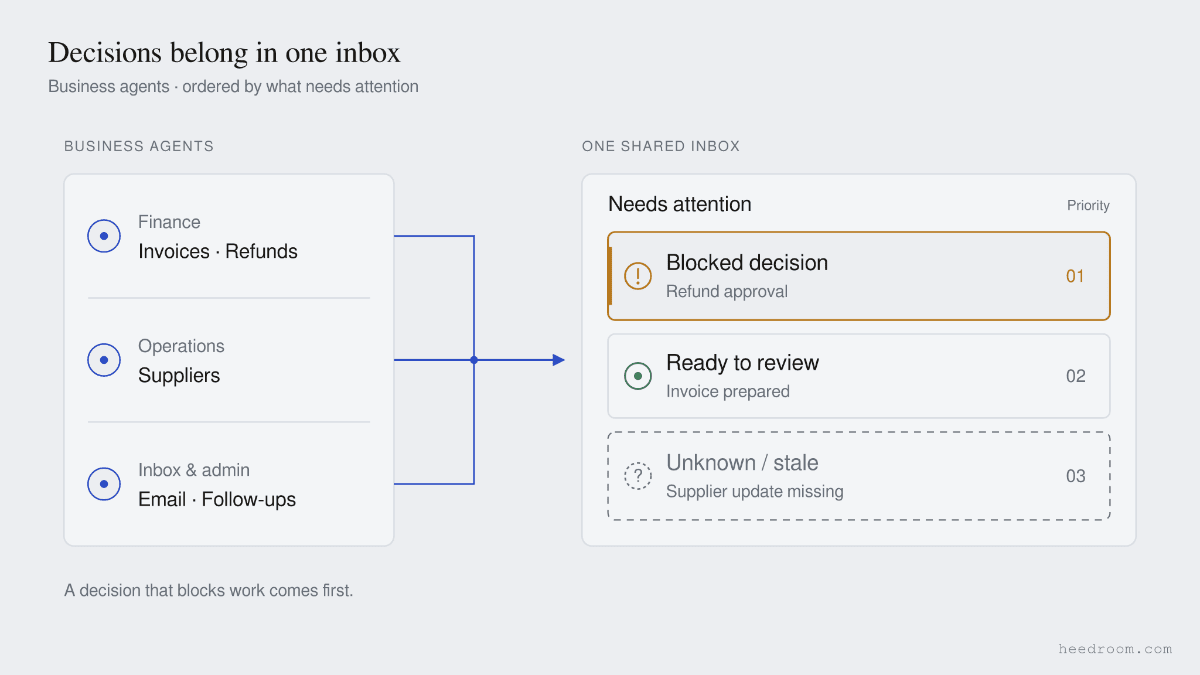
Heedroom brings decisions from different business areas into one queue, with questions that block work at the top.
Another requirement is harder to meet, and the team is still building toward it. Every automated check needs to be tied to the exact data it evaluated at the time. Otherwise, a later edit to an order or contract can leave an "approved" checkmark attached to a decision that is no longer accurate. The check passed; the information has since changed.
Heedroom remains an early-stage product, live as an interactive prototype at heedroom.com. It is aimed at teams that have moved past experimenting with AI agents and now use them in operations where a wrong guess costs real money.
Want to publish a guest post on aamax.co?
Place an order for a guest post or link insertion today.
Place an Order