

How Should Pages Be Structured for SEO
Structure Is How Search Engines Read Your Page
A well-structured page does two jobs at once. It guides a human reader to the answer they came for, and it gives a crawler an unambiguous map of what the page covers and how its sections relate. Poor structure undermines both. Content buried under vague headings, walls of undifferentiated text, and navigation that hides important pages behind multiple clicks all reduce the likelihood of ranking, even when the underlying information is excellent.
Good structure begins before writing. It starts with deciding what single search intent the page serves, then organising every element to satisfy that intent as directly as possible. Pages that try to serve three intents at once typically rank for none of them, because search engines cannot determine which query the page best answers.
How AAMAX.CO Can Help You Get Page Structure Right
Structural problems are the most common issue we find in technical audits, and they are usually inherited from templates rather than written by hand. At AAMAX.CO, we rebuild information architecture and page templates so that heading hierarchies, URL patterns, internal links, and schema markup all reinforce the same topical signals. Our SEO services include intent mapping for every URL, so each page has one clear job and a supporting internal link structure that channels authority where it produces revenue. Because we are a full service digital marketing company offering web development, digital marketing, and SEO worldwide, we implement the template changes ourselves rather than leaving you with recommendations. Hire us and your site structure will stop working against your content.
Heading Hierarchy Done Properly
Use exactly one H1 per page, and make it describe the page's primary topic in plain language that matches how people search. The H1 should generally align closely with the title tag, though the title tag can be shortened or made more compelling for search result display.
Use H2 elements for the main sections of the page. Each H2 should be self-explanatory: a reader scanning only the H2s should understand the full scope of the page. Use H3 elements for subsections within an H2, and avoid skipping levels, since jumping from H2 straight to H4 breaks the semantic outline that crawlers and screen readers rely on.
Write headings as descriptive statements rather than single keywords. A heading reading Pricing Models for Local Service Businesses communicates far more than one reading Pricing. Never use headings purely for visual styling; if you want large text that is not a section boundary, style a paragraph instead.
The Anatomy of a High-Performing Page
Effective pages tend to follow a recognisable pattern. The opening section answers the core question or states the core benefit within the first hundred words, because both readers and AI-driven answer engines extract from the beginning of a page. Delaying the answer to build suspense costs you both engagement and featured placements.
Following the introduction, a short overview or table of contents on long pages helps orient readers and can generate jump links in search results. The body then progresses from broad to specific, with each section handling one subtopic completely before moving on. Supporting elements such as lists, comparison tables, definitions, and examples break up density and are frequently extracted for rich results.
Close with a clear next step. Whether that is a related resource, a contact route, or a product page, the ending should not leave the reader stranded, because a dead end wastes the attention you earned.
URL Design and Site Hierarchy
URLs should be short, lowercase, hyphenated, and descriptive. Include the primary topic words and omit stop words, dates, session parameters, and numeric identifiers where possible. Keep the folder depth shallow; most sites work best with content reachable within three clicks of the homepage.
Organise the hierarchy around how users think about your offering rather than your internal departments. Group related pages under logical parent sections so that both crawlers and visitors can infer relationships from the path alone. Once a URL is published and earning links, avoid changing it unnecessarily, and always redirect one-to-one when a change is unavoidable.
Internal Linking as Structural Glue
Internal links do more than aid navigation. They distribute authority, establish topical relationships, and signal which pages you consider most important. Link from established, well-linked pages to newer pages that need visibility. Use descriptive anchor text that reflects the target page's topic rather than generic phrases like click here.
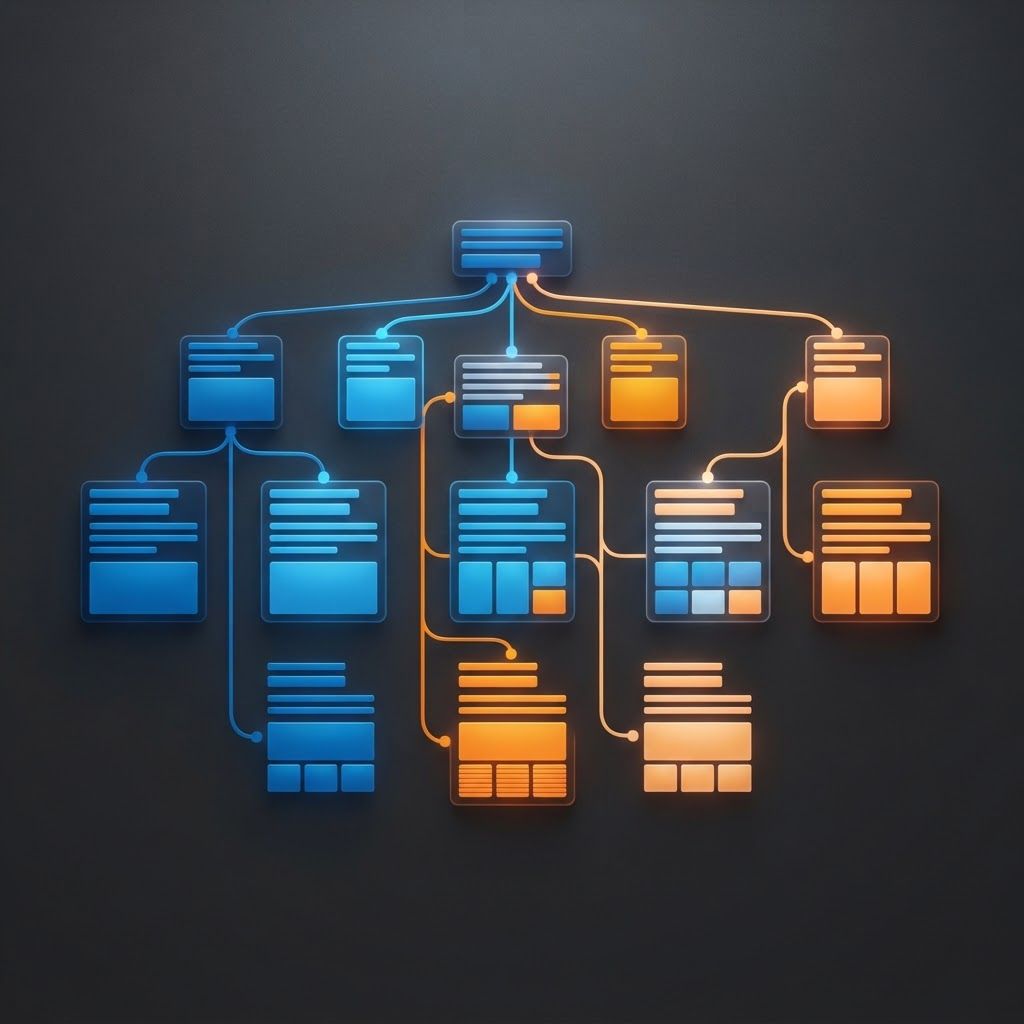
Build topic clusters: a comprehensive pillar page linking down to detailed subtopic pages, each of which links back up to the pillar and sideways to closely related siblings. This pattern makes your coverage of a subject legible to search engines and consistently outperforms a flat collection of unconnected articles.
Audit for orphaned pages, which receive no internal links at all and are therefore difficult to discover and easy to devalue. Also watch for excessive linking in navigation and footers, which dilutes the signal each link carries.
Technical Structure Elements
Use semantic HTML elements: header, nav, main, article, section, aside, and footer. These give crawlers structural context that generic containers cannot. Place your primary content inside the main element, and keep boilerplate such as sidebars and promotional blocks outside it.
Add structured data appropriate to the page type. Article, product, FAQ, breadcrumb, organisation, and local business markup all help search engines interpret your content and can produce enhanced results. Include breadcrumb navigation, which reinforces hierarchy for both users and crawlers.
Ensure content is present in the server-rendered HTML. If critical text and links only appear after client-side JavaScript executes, you introduce unnecessary risk. Finally, verify that your structure holds on mobile, where collapsed accordions and hidden tabs can affect how content is perceived and consumed.
Common Structural Mistakes
Multiple H1 elements, keyword-stuffed headings, single-sentence sections, and pages targeting several unrelated intents all weaken structure. Equally damaging are near-duplicate pages competing for the same query, which split signals and prevent either from ranking well. Consolidate them into one authoritative page and redirect the rest.
Final Thoughts
Give every page one clear intent, one H1, descriptive H2s in a logical order, an answer near the top, semantic markup, and internal links that connect it to its topic cluster. Keep URLs shallow and stable. These fundamentals are unglamorous but they determine whether your content ever gets a fair hearing. If you want your architecture rebuilt as part of a broader digital marketing strategy, our team can handle it end to end.
Want to publish a guest post on aamax.co?
Place an order for a guest post or link insertion today.
Place an Order