

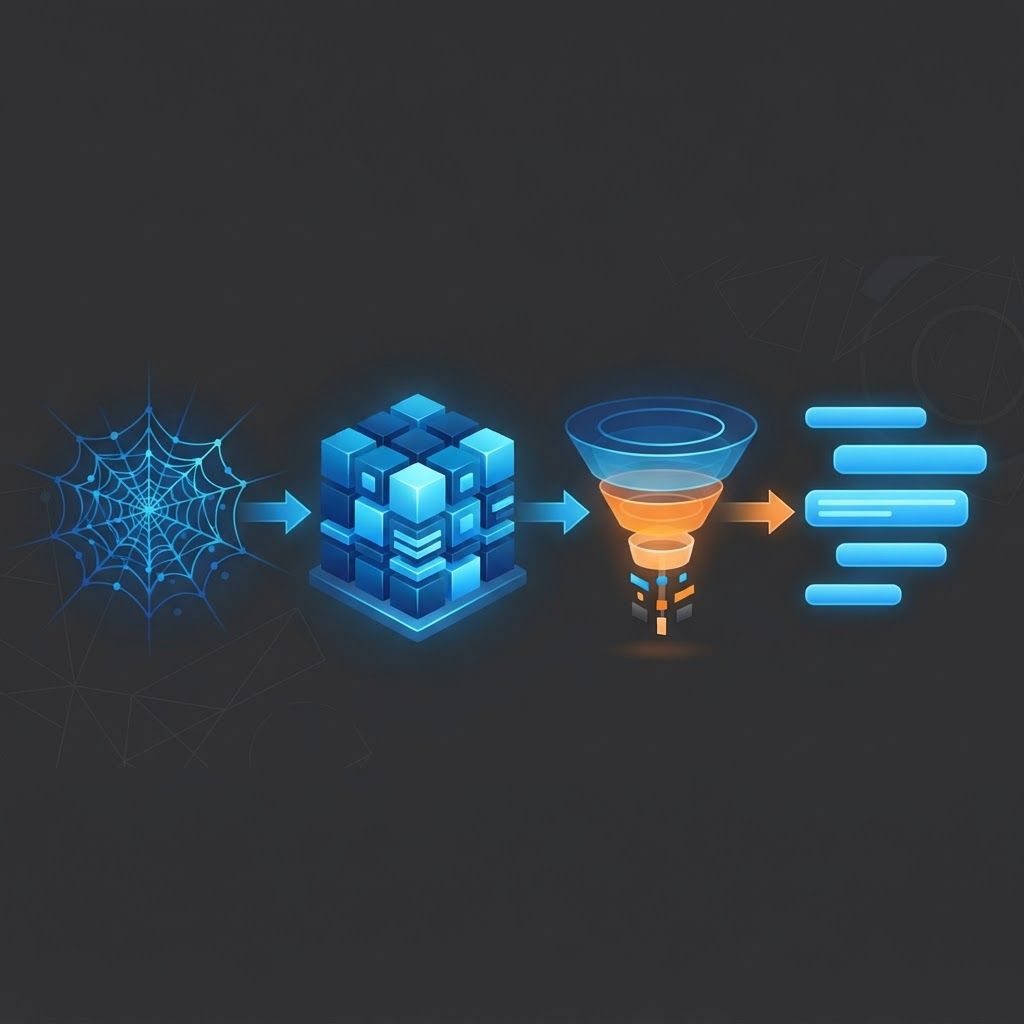
How SEO Works Infographic
Search Explained as a Visual Flow
SEO becomes far easier to understand when you stop treating it as a checklist and start seeing it as a pipeline. Information moves through distinct stages, and your visibility depends on surviving each one. An infographic works so well for this subject because the process is genuinely sequential: discovery, crawling, rendering, indexing, ranking, presentation, and finally the click and the experience that follows.
This article walks through that flow stage by stage, in the order an infographic would present it, and then explains how to design an SEO infographic that actually earns links rather than sitting unnoticed on a blog.
How We Visualise and Execute Strategy at AAMAX.CO
We are AAMAX.CO, a full service digital marketing company offering web development, digital marketing, and SEO services worldwide. We use visual frameworks like this with clients because clarity drives better decisions: when a stakeholder can see where their site fails in the pipeline, prioritisation becomes obvious. Our SEO services team maps your site against every stage of this flow, identifies the exact point where visibility breaks down, and executes the fixes with your development and content teams.
Stage One: Discovery
Search engines must first learn that a page exists. Discovery happens through links from pages already known, through sitemaps you submit, and through references across the web. A page with no internal links pointing to it and no sitemap entry may remain undiscovered indefinitely, no matter how good it is.
Practical implication: every important page needs at least one crawlable link from an established part of your site, and your sitemap should list current, canonical URLs only.
Stage Two: Crawling
Once discovered, a crawler requests the page. It follows redirects, respects directives in your robots file, and consumes a finite amount of attention across your site. Large sites with faceted navigation, endless parameter combinations, or infinite calendars can waste that attention on worthless URLs while important pages go unvisited.
Practical implication: keep your architecture shallow and logical, avoid redirect chains, block genuinely useless URL patterns, and make sure server responses are fast and reliable so crawling is not throttled.
Stage Three: Rendering
Modern crawlers execute code to see the page as a browser would. If your primary content or navigation only appears after a client-side process that fails, times out, or requires interaction, the crawler may effectively see an empty page.
Practical implication: ensure critical content and links exist in the served markup or render reliably. Test with a rendering tool rather than assuming what appears in your browser is what a crawler receives.
Stage Four: Indexing
Rendered content is analysed and stored. The system extracts meaning, identifies entities, evaluates whether the page duplicates something already stored, and selects a canonical version among similar pages. Not everything crawled gets indexed; thin, duplicate, or low-value pages are frequently excluded.
Practical implication: give each page a distinct purpose, avoid near-duplicate variants, use canonical tags deliberately, and add structured data so machines can interpret your entities, products, and relationships confidently.
Stage Five: Ranking
When a query arrives, the system interprets intent, retrieves candidate pages, and orders them using many signals. Broadly these fall into relevance, which is how well the content matches the interpreted need; quality and trust, which include authority signals such as credible references; and experience, which covers speed, stability, mobile usability, and freedom from intrusive interruptions.
Practical implication: match the format and depth searchers expect, build genuine authority through content worth citing, and remove friction from the page experience. Ranking is comparative, so you are always being measured against what already ranks.
Stage Six: Presentation and the Click
Ranking is not the end. Your result competes visually against other results, rich features, and increasingly against generated summaries that answer questions directly. Titles, descriptions, structured data enhancements, and brand familiarity all influence whether anyone actually clicks.
Practical implication: write titles that lead with specific value, support them with descriptions that add detail, and implement eligible structured data to occupy more space and communicate more information.
Stage Seven: Satisfaction
After the click, the visitor either gets what they came for or returns to the results. Fast answers, clear structure, credible evidence, and an obvious next step keep people engaged and convert visibility into revenue. Persistent dissatisfaction eventually shows up as declining performance.
Practical implication: answer the question near the top, structure content for scanning, prove claims, and make the desired action unmistakable.
Designing an SEO Infographic That Earns Links
If you plan to publish an infographic on this subject, design for usefulness rather than decoration. Follow a single narrative left to right or top to bottom so the sequence is obvious. Limit yourself to a small palette and two type styles so the content, not the styling, carries attention. Label every stage plainly and keep supporting text short enough to read at a glance.
Make it genuinely referenceable by including something original: your own data, a diagnostic decision path, or a clearer explanation than existing versions. Publish it with substantial accompanying text, because a lone image cannot rank for much on its own. Provide descriptive alternative text and a text summary for accessibility and for machines. Offer an embed snippet so anyone sharing it links back, and share it with communities and publications that cover the topic rather than hoping it spreads passively.
Use the Pipeline as a Diagnostic Tool
The real power of viewing SEO as a flow is diagnosis. If a page is not visible, walk the stages: is it discovered, crawled, rendered, indexed, ranked, clicked, and satisfying? The stage where the answer becomes no is your actual problem, and fixing anything downstream of it is wasted effort. If you would like an experienced team to run that diagnosis across your site and execute the fixes, we are ready to help.
Want to publish a guest post on aamax.co?
Place an order for a guest post or link insertion today.
Place an Order