

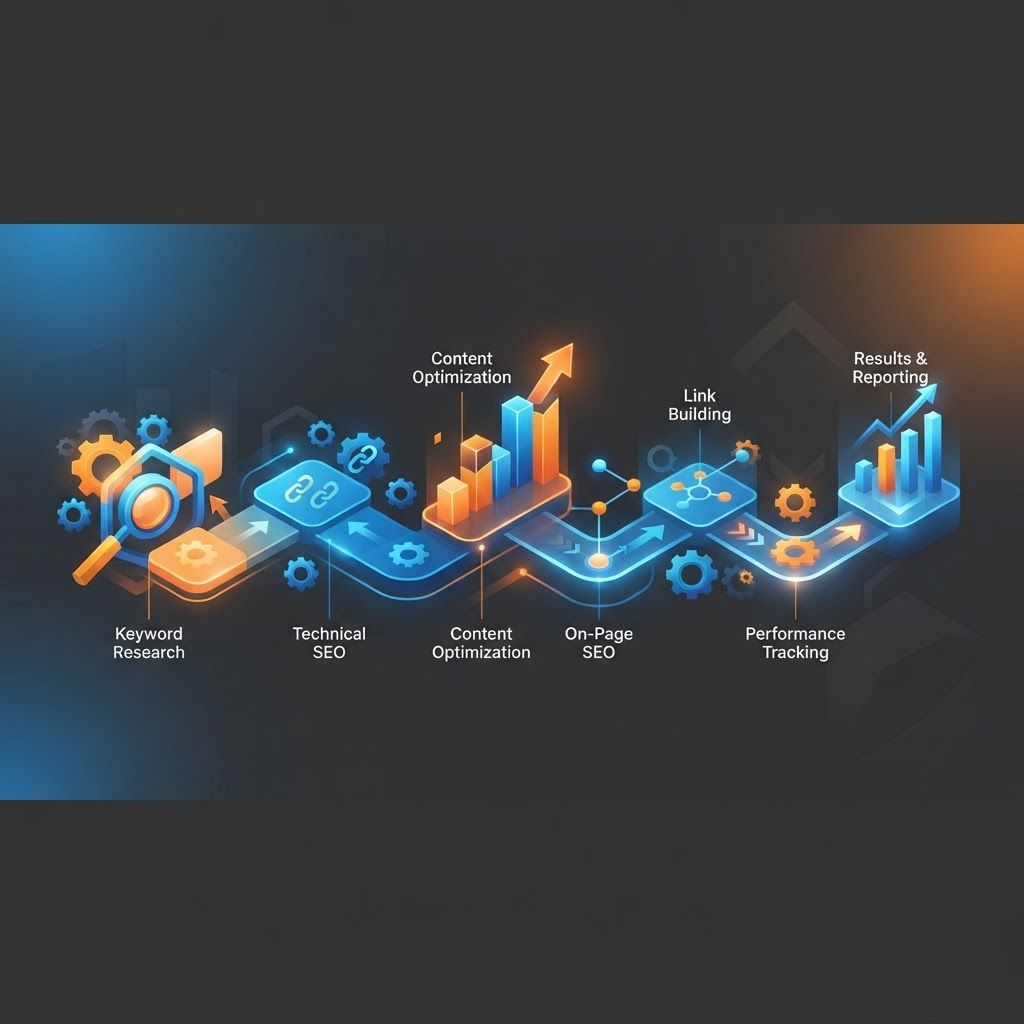
How SEO Is Carried Out
SEO Is a Process, Not a Trick
The most common misconception about search engine optimisation is that it is a set of tweaks you apply once. In reality, SEO is carried out as a continuous programme with distinct phases that feed into each other: discovery and research, technical remediation, on-page optimisation, content production, authority development, and measurement that informs the next cycle. Each phase produces outputs the next phase depends on. Skip the research and you build content nobody searches for. Skip the technical work and your best content never gets crawled properly. Skip measurement and you have no idea which activities are creating value.
Understanding the sequence matters because it determines where your budget should go first. A site with severe indexation problems does not need more blog posts; it needs its crawl path fixed. A technically flawless site with thin content does not need another audit; it needs substance. Diagnosing correctly before prescribing is the difference between a campaign that compounds and one that stalls.
How AAMAX.CO Carries Out SEO for Clients
At AAMAX.CO we run search campaigns as structured engagements with clear phases, deliverables and reporting. We begin with a full technical and competitive audit, agree on priority targets tied to commercial outcomes, then work through remediation, content and authority building in sprints so you can see progress every month rather than waiting six months for a verdict. Because we are a full service digital marketing company offering web development, digital marketing and SEO services worldwide, our developers and content team sit alongside our strategists, which means recommendations actually get implemented instead of sitting in a document. If you want search engine optimization carried out as a disciplined process with accountability at every step, we can take it from audit to results.
Phase One: Discovery and Research
Everything begins with understanding the business. What products or services actually generate profit? Which customer segments matter? What is the average order value or lifetime value? Without this, keyword selection becomes an exercise in chasing traffic volume rather than revenue. Next comes keyword and intent research: building a map of the queries your audience uses across the entire journey, from early problem awareness through comparison to purchase.
Competitive analysis runs in parallel. Identify who ranks for your priority terms, what content formats they use, how strong their link profiles are, and where they are weak. Gaps in competitor coverage are usually the fastest route to early wins. Finally, benchmark your current state: rankings, organic sessions, conversions, indexed pages and technical health, so you have a defensible baseline.
Phase Two: Technical Foundations
Technical SEO ensures search engines can crawl, render, understand and index your site efficiently. The core checks include crawlability and robots directives, XML sitemaps, canonical tags, redirect chains, duplicate and parameterised URLs, status code errors, mobile rendering, JavaScript dependency, page speed and Core Web Vitals, structured data validity, and HTTPS implementation. Site architecture is part of this too: important pages should be reachable within a few clicks of the homepage, and internal linking should reflect the actual hierarchy of importance.
Technical issues are prioritised by impact, not by how easy they are to fix. Pages that cannot be indexed at all are catastrophic. A slightly slow image on a low-traffic page is cosmetic. Ruthless prioritisation is what makes technical work worth the investment.
Phase Three: On-Page Optimisation
On-page work aligns each page with its target intent. That includes title tags that are specific and compelling, meta descriptions written to earn clicks, a single clear H1, logical subheadings, descriptive URLs, optimised images with meaningful alt text, and internal links using natural anchor text. It also includes content quality: does the page actually answer the query completely, is it current, is it easy to scan, does it include the evidence and detail a decision-maker needs?
Consolidation is an underrated part of this phase. Many sites have several weak pages competing for the same term. Merging them into one authoritative page and redirecting the rest almost always outperforms leaving them fragmented.
Phase Four: Content Production
With research and structure in place, content becomes a production line rather than a guessing game. Build an editorial calendar organised into topic clusters, each with a defined target query, intent, format and internal linking plan. Prioritise commercial pages first, then supporting informational content that captures demand earlier in the journey and funnels it inward.
Quality control matters enormously. Every piece should include original insight, accurate detail, clear structure and a genuine reason to exist. Content that merely restates what already ranks adds nothing and dilutes site quality. Refreshing existing content is often more profitable than publishing new material, because pages with existing history respond quickly to improvement.
Phase Five: Authority and Off-Page Work
Authority building means earning references from other credible sites. The sustainable methods are all based on creating something worth referencing: original research and data, genuinely useful tools, expert commentary, notable partnerships, sponsorships, media coverage and thought leadership placed on relevant publications. Digital PR consistently outperforms transactional link buying because the links are editorial, contextual and durable.
For local businesses, this phase includes citations, review generation and community involvement. For ecommerce, it includes product reviews, comparison placements and affiliate relationships. The tactics differ by model but the principle is constant: relevance and credibility over raw volume.
Phase Six: Measurement and Iteration
Reporting should connect activity to outcomes. Track organic sessions, keyword coverage, average position for priority clusters, indexation health, conversions and revenue from organic search, and assisted conversions where organic contributes earlier in the path. Segment by page type so you can see whether product pages, service pages or blog content is driving results.
Then iterate. Every reporting cycle should produce decisions: double down on what is working, fix what is underperforming, retire what is not worth maintaining. This loop is what turns SEO from a project into a compounding asset. Increasingly it also includes optimising for AI-driven answer surfaces, which is where our GEO services come in.
Realistic Timelines and Expectations
Technical fixes can show effects within weeks. On-page improvements to existing ranking pages often move within a month. New content in a competitive niche typically needs three to six months to mature, and authority building compounds over quarters rather than weeks. Anyone promising top rankings in days is describing a risk, not a strategy.
Final Thoughts
SEO is carried out through disciplined repetition: research what matters, remove technical barriers, optimise and consolidate pages, publish genuinely useful content, earn credible references, measure honestly and repeat. There is no shortcut, but there is a reliable method. If you would like an experienced team to run that method for your business and report on it transparently, we are ready to start with a full audit.
Want to publish a guest post on aamax.co?
Place an order for a guest post or link insertion today.
Place an Order