

How Many Internal Links per Page SEO
Ask how many internal links a page should have and you will get numbers ranging from three to three hundred. The honest answer is that there is no official limit, and the old guidance about keeping pages under one hundred links was a crawling constraint from an era of much smaller index capacity. What matters now is not a count but a distribution question: every internal link divides the authority a page can pass, and every link competes for a reader's attention. The right number is the number that serves navigation and topical relevance without turning a page into a directory.
How We Plan Internal Linking For Clients
Internal linking is the highest-leverage on-page work most sites neglect, because it costs nothing but requires a plan. At AAMAX.CO we map site architecture around topic clusters, identify the pages that deserve concentrated authority, find and fix orphaned URLs, and rewrite anchor text so it describes destinations accurately instead of saying read more. Our SEO services include full internal link audits alongside technical, content and authority work, and because we also build websites we can implement structural changes rather than just recommending them. We support clients worldwide across web development, digital marketing and SEO.
Why The Count Matters At All
Internal links do three jobs. They help crawlers discover URLs, they distribute authority through the site, and they signal what a page is about via anchor text and context. The distribution part is where volume becomes relevant. A page's ability to pass value is finite and shared among its outbound links, so a page linking to ten destinations concentrates far more into each than a page linking to two hundred.
Attention behaves similarly. Readers scan, and a paragraph containing six links reads as noise rather than guidance. Links that nobody clicks provide weaker behavioural signals than links that get used, so a smaller set of well-placed, relevant links usually outperforms an exhaustive set.
Sensible Ranges By Page Type
Rather than one universal number, think in terms of purpose. A blog article of one thousand to fifteen hundred words is generally well served by roughly three to ten contextual internal links, placed where they genuinely help the reader go deeper. A service or product page usually wants fewer, perhaps three to eight, because its job is conversion and every extra exit is a distraction.
Hub and category pages are the exception and legitimately carry more, often twenty to fifty, since listing children is their entire function. A homepage typically works best with a focused set, perhaps ten to thirty across navigation and body content, aimed at the pages you most want ranked. Treat all of these as starting points rather than rules, and let the page's role decide.
Placement Matters More Than Volume
Where a link sits changes how much weight it carries. Links inside the main body content, surrounded by relevant text, are the most valuable. Navigation links repeated across every template carry less individual weight precisely because they are sitewide. Footer links carry the least, and a footer stuffed with fifty links is one of the clearest signs of internal linking done without a plan.
Position within the body also counts. A link in the first few paragraphs, where engagement is highest, tends to be clicked and valued more than the same link buried near the end. If a link is important, place it where readers actually are.
Write Anchor Text That Describes The Destination
Anchor text is one of the strongest relevance signals you control on your own site. Use descriptive phrases that tell both readers and crawlers what they will find, and vary them naturally rather than repeating an identical exact-match phrase in every instance. Click here, read more and this page waste the opportunity entirely.
Avoid over-optimising in the other direction. Repeating the same commercial keyword as anchor text one hundred times across the site looks engineered and provides no additional benefit past a modest point. Write the link the way you would explain the destination to a colleague.
Depth, Orphans And Crawl Efficiency
Internal linking determines click depth, and click depth strongly influences how often a page is crawled and how much authority reaches it. Aim to keep important pages within three clicks of the homepage. Anything buried five or six levels deep will be crawled infrequently and will struggle to rank regardless of its quality.
Orphaned pages, those with no internal links pointing at them, are the most common structural failure. They usually appear when content is published without being added to a category, hub or related-posts module. Crawl your site periodically and cross-reference the URL list against your sitemap to surface them, then link them properly or remove them if they no longer serve a purpose.
Build Clusters, Not Random Cross-Links
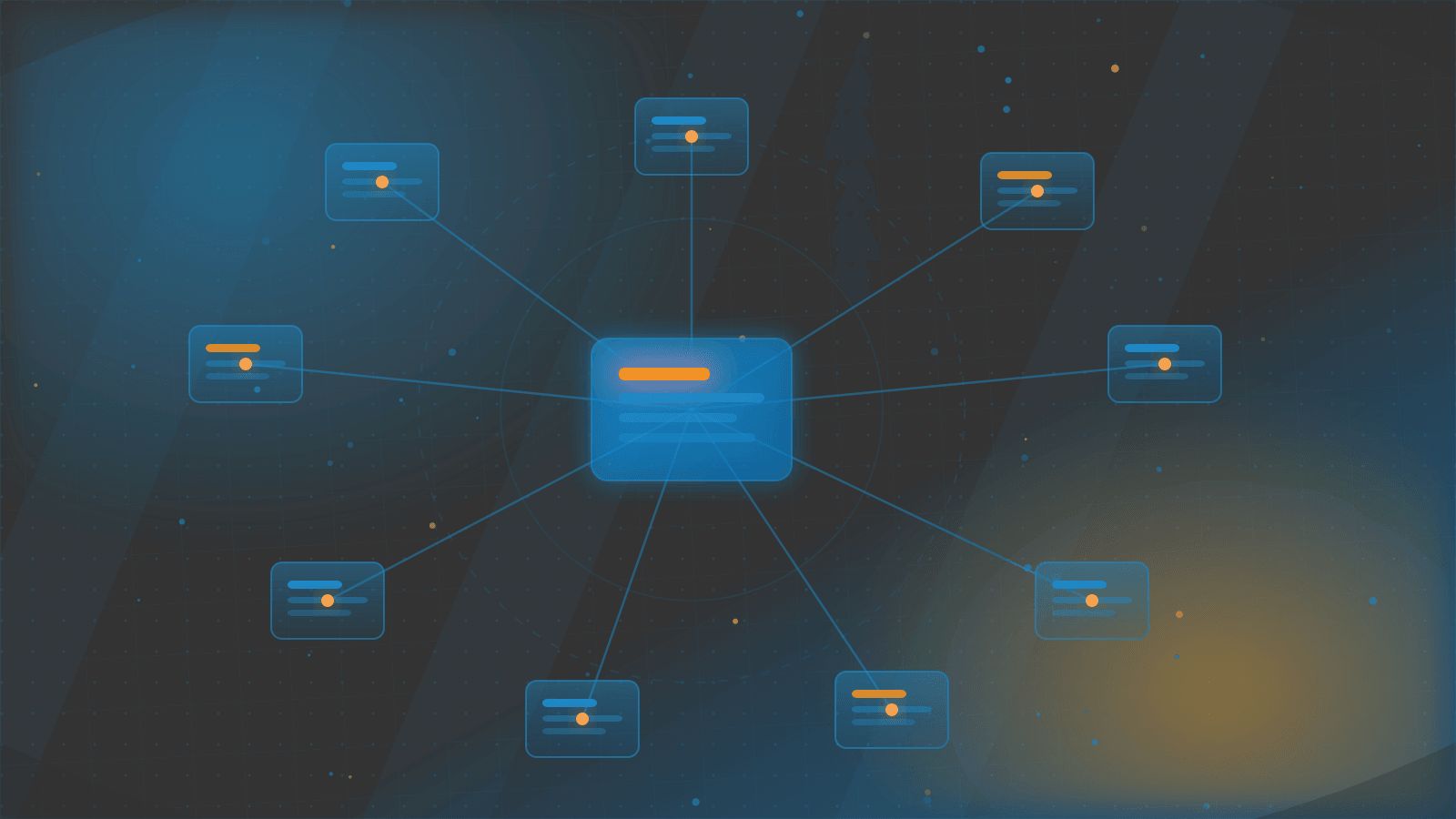
The most effective internal linking follows topic clusters. A pillar page covers a broad subject and links to focused supporting pages, each of which links back to the pillar and sideways to closely related siblings. This creates a dense, coherent neighbourhood of relevance that search engines can interpret easily.
Random cross-linking between unrelated pages achieves the opposite: it spreads authority thinly and muddies topical signals. Before adding a link, ask whether a reader of this page would genuinely want that destination next. If the answer is no, the link is decoration.
Common Mistakes To Avoid
Several patterns reliably cause problems. Automated related-posts plugins that inject twenty low-relevance links into every article inflate counts without adding value. Linking to the same destination repeatedly within one page provides no extra benefit beyond the first instance and looks manipulative when overdone. Linking through redirects rather than to final URLs wastes a hop and slightly dilutes value.
Linking to noindexed pages is another quiet waste, since you are directing authority to URLs you have asked search engines to ignore. And using JavaScript-dependent navigation that crawlers cannot follow can hide large sections of a site entirely. Standard anchor elements with href attributes remain the only reliably crawled link format.
How To Decide For Your Own Pages
Work from purpose rather than a target number. List the pages you most want to rank, then ensure each one receives contextual links from several genuinely relevant pages. Review your highest-authority pages and confirm they link outward to your priority destinations. Then read each page as a visitor and remove any link you would not click.
Measure the result. Watch whether the pages receiving more internal links gain impressions and positions over the following weeks, whether crawl frequency improves in your server logs or Search Console, and whether users move deeper into the site. Internal linking is one of the few SEO levers you control completely, with no dependence on anyone else's website. Used deliberately, it is also one of the most effective. If you would like help mapping and implementing that structure across a large site, our team does this work every day.
Want to publish a guest post on aamax.co?
Place an order for a guest post or link insertion today.
Place an Order