

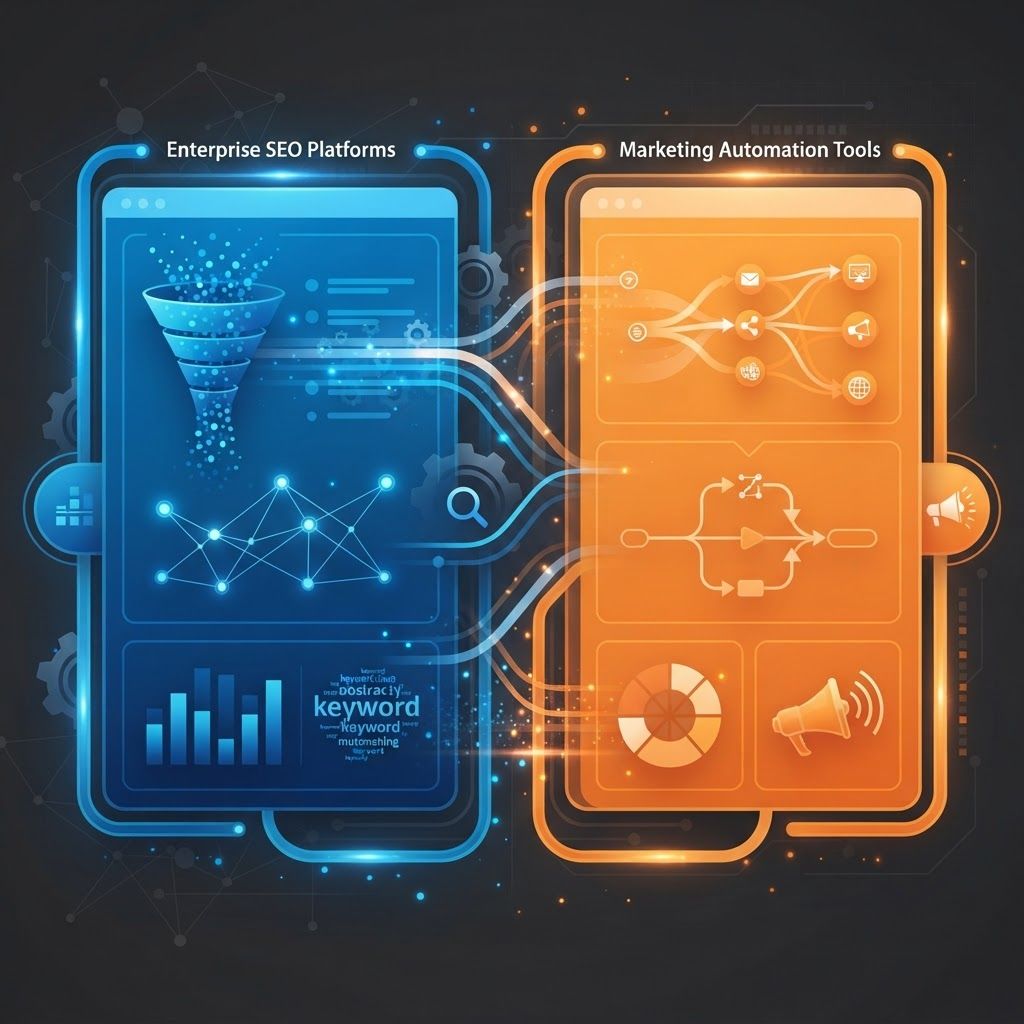
How Do Enterprise SEO Platforms Compare to Marketing Automation Tools
As organizations scale, their technology stack grows more complex, and two categories frequently sit at the center of digital growth conversations: enterprise SEO platforms and marketing automation tools. Both promise efficiency, visibility, and revenue, but they operate on different layers of the funnel and serve different teams. Understanding where each excels, where they overlap, and how they complement one another is essential for building a stack that drives measurable results rather than redundant costs.
How We Simplify the Stack at AAMAX.CO
At AAMAX.CO, we help enterprises cut through vendor noise and design a stack that actually fits their goals. As a full-service digital marketing company offering web development, digital marketing, and SEO services worldwide, we evaluate your workflows, integrate the right platforms, and make sure your search strategy and automation reinforce each other. When you hire us, our specialists bridge the gap between technical SEO and lifecycle marketing so no opportunity slips through the cracks.
What Enterprise SEO Platforms Actually Do
Enterprise SEO platforms are built to manage organic visibility at scale across thousands or millions of pages. They centralize keyword research, rank tracking, technical site audits, content optimization recommendations, backlink monitoring, and competitive analysis. Their value lies in surfacing organic opportunities, diagnosing crawl and indexation issues, and quantifying the revenue impact of ranking improvements. For large sites, these platforms make search engine optimization governable, letting distributed teams work from a single source of truth.
What Marketing Automation Tools Actually Do
Marketing automation tools, by contrast, focus on nurturing and converting known contacts. They orchestrate email sequences, lead scoring, segmentation, landing pages, forms, and multi-channel campaigns. Their strength is lifecycle management: moving a prospect from first touch to qualified lead to customer, then to repeat buyer. Automation platforms thrive on first-party data and behavioral triggers, personalizing outreach based on how contacts interact with your brand over time.
The Core Difference: Acquisition Versus Nurture
The simplest way to frame the comparison is acquisition versus nurture. Enterprise SEO platforms help you get discovered by people who do not yet know you, expanding the top of the funnel through organic search. Marketing automation tools help you convert and retain the audience you have already captured. One fills the pipeline; the other accelerates movement through it. Treating them as interchangeable leads to gaps, either strong traffic that never converts or sophisticated nurture flows with too few leads to work with.
Where They Overlap
Overlap exists in content and analytics. Both categories care deeply about content performance, and both increasingly offer reporting dashboards. SEO platforms recommend content to attract search demand, while automation tools deliver content to nurture demand. When connected, the content that ranks organically can feed automated journeys, and behavioral data from automation can inform which topics deserve more organic investment. This is where a coordinated strategy pays off.
Data and Integration Considerations
The real power emerges when these systems share data. Organic landing pages should capture leads into your automation platform, and lead quality data should flow back to inform SEO priorities. Without integration, teams optimize in silos and miss the full customer picture. Enterprise buyers should evaluate APIs, native connectors, and data warehouse compatibility before committing to any platform, because integration friction quietly erodes the value of both investments.
Cost, Team Skills, and Governance
Enterprise SEO platforms typically require technical SEO expertise to interpret audits and prioritize fixes, while automation tools require lifecycle marketers who understand segmentation and messaging. Budgets should account not just for licensing but for the talent needed to operate each system. Governance also matters: clear ownership prevents duplicated effort and ensures that insights from one platform actually influence decisions in the other.
Avoiding Common Buying Mistakes
Enterprises frequently stumble by purchasing overlapping tools that promise to do everything, then using only a fraction of each. Another common mistake is selecting a platform based on a compelling demo rather than the specific workflows your teams run daily. Before committing, map your actual processes, identify the gaps each category is meant to fill, and involve the practitioners who will use the software every day. Beware of long contracts signed before a proof of concept, and insist on evaluating integration quality with your existing systems, because a tool that cannot share data cleanly will create silos no matter how powerful it is in isolation. Finally, budget realistically for onboarding and ongoing enablement, since even the best platform delivers little value if teams never learn to use it well. Thoughtful evaluation prevents expensive shelfware and ensures each investment earns its place.
Building a Unified Growth Stack
Rather than choosing one over the other, mature organizations run both in concert. Use the SEO platform to expand qualified organic reach and the automation tool to convert that reach efficiently. Connect them through shared data and consistent reporting so leadership sees a single revenue story. As search discovery expands into AI-driven surfaces, keeping your organic and lifecycle efforts aligned becomes even more valuable. If you want help selecting, integrating, and operating this stack, our team at AAMAX.CO can design a solution tailored to your enterprise through end-to-end digital marketing expertise.
Want to publish a guest post on aamax.co?
Place an order for a guest post or link insertion today.
Place an Order