

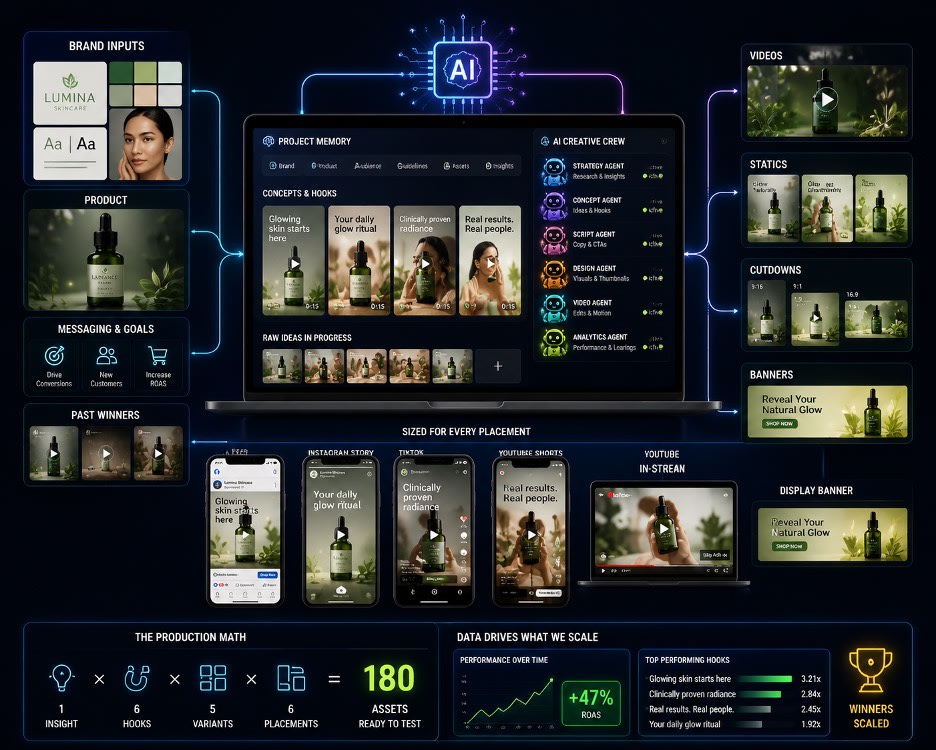
How AI Helps Scale Performance Marketing
Running successful ad campaigns has become less about creating one great advertisement and more about continuously testing, learning, and improving. Performance marketers today need multiple creative variations, platform-specific formats, fresh messaging, and faster production cycles to understand what connects with different audiences.
The challenge is that creative production often moves slower than campaign decisions. A marketing team may know that a new angle, audience segment, or offer needs testing, but producing the required videos, images, and variations can take days or weeks.
The growth of AI is changing this workflow. According to the IAB, the U.S. digital advertising industry reached nearly $300 billion in revenue in 2025, showing how much the advertising ecosystem has expanded around measurable digital channels. As competition increases, brands are looking for ways to create more relevant advertising assets without increasing production complexity.
AI Performance Ads help solve this gap by supporting faster creative development, personalization, testing, and optimization. Instead of replacing marketers, AI helps teams build more creative options, analyze patterns, and manage production at a larger scale.
How can AI Performance Ads improve ad scaling?
AI Performance Ads help brands scale campaigns by making creative production faster, more consistent, and easier to adapt across channels. AI tools can support everything from generating concepts and variations to resizing content for different placements and audiences.
The biggest advantage is creative flexibility. A team that previously produced a few versions of an advertisement can now explore more hooks, formats, visuals, and messaging approaches without increasing manual workload.
AI supports performance marketing teams in areas such as:
- Creating multiple ad variations from one core idea
- Adapting creatives for platforms like Meta, TikTok, and YouTube
- Testing different hooks, offers, and visual styles
- Maintaining brand consistency across large creative libraries
- Producing content for different customer segments
Making more ads is not the only objective. It is to create better testing opportunities so marketers can identify what works and make informed campaign decisions.
Why creative volume matters in marketing
Modern advertising success depends heavily on experimentation. Audience behavior changes quickly, and a creative approach that works today may not perform the same way weeks later.
Traditional production methods often limit testing because every new variation requires additional planning, design, editing, and approval cycles. This creates a gap between campaign insights and creative execution.
AI helps reduce that gap by allowing teams to move from one campaign idea to multiple creative directions more efficiently.
For instance, a skincare company would wish to try:
- A problem-focused opening about common customer concerns
- A product demonstration showing usage
- A testimonial-style approach
- A lifestyle-focused brand message
- Different offers for different customer groups
Instead of creating each version separately from scratch, AI workflows can help generate and organize these creative options faster.
This approach also supports better decision-making because marketers can test more ideas instead of relying on limited creative choices.
How AI improves creative testing workflows
Performance marketing depends on learning from results. Every impression, click, and conversion provides information about what audiences respond to.
However, collecting insights is only useful when teams can quickly turn those insights into new creative experiments.
AI Performance Ads workflows help connect campaign learning with production. When a certain visual style, message, or structure performs well, AI can help teams create additional variations based on those patterns.
Common testing areas include:
- Different opening hooks
- Product presentation styles
- Customer pain points
- Calls to action
- Video lengths
- Visual formats
- Audience-specific messaging
This creates a more continuous creative process. Instead of launching a campaign, waiting, and starting over, teams can keep improving their advertising library based on performance data.
How AI helps create effective marketing ads
Effective marketing ad creation with AI is becoming a practical approach for teams that need consistent output across multiple campaigns. AI can assist with idea development, scripting, visual planning, editing, and adapting content for different platforms.
The process usually begins with understanding the brand, audience, and campaign goal. From there, AI tools can help marketers explore creative directions and produce variations that match the intended message.
A strong AI advertising workflow still depends on human strategy. Marketers decide the positioning, audience, budget, and campaign goals. AI supports execution by reducing repetitive production work and helping teams explore more creative possibilities.
This balance allows brands to maintain creative control while improving speed.
How invideo Agent supports AI Performance Ads creation
Invideo Agent approaches ad production as a collaborative creative workflow rather than a simple generation process. It allows teams to bring their brand information, product details, guidelines, and previous creative examples into one project context so future ads are built around the same foundation.
Invideo Agent is designed to help teams increase the number of ads they can produce without losing consistency. Marketers can provide their product, messaging direction, and campaign requirements, and the system can help develop hooks, variations, statics, and versions for different placements. Several agents can work in parallel using shared project memory, allowing teams to explore more testing opportunities from one campaign idea.
Brands exploring AI powered performance ads can use this type of workflow to create product videos, variations, and placement-ready assets while keeping the brand identity connected throughout the process.
The workflow is built around a few practical steps:
- Set the brand foundation
Teams can provide brand guidelines, product information, audience details, and previous successful ads. - Develop creative concepts
Marketers can discuss ideas, refine hooks, and build campaign directions based on their goals. - Generate and review assets
The system helps create advertising materials that teams can review, adjust, and approve. - Expand winning ideas
Successful ads can become the foundation for additional variations across audiences, markets, and platforms.
The advantage comes from combining creative exploration with brand consistency. The team remains responsible for decisions, messaging, and approvals, while AI helps manage production tasks.
Scaling ads across multiple platforms
Every advertising platform has different requirements. A creative designed for a social feed may not work the same way in a short-form video placement or a display format.
AI helps solve this challenge by making adaptation easier. Instead of manually rebuilding every asset, teams can create versions designed for different placements.
A single campaign may require:
- Vertical videos for mobile-first platforms
- Square formats for social feeds
- Landscape versions for video platforms
- Short cutdowns for quick engagement
- Static images for retargeting campaigns
Invideo Agent can support this type of production by helping create versions for different placements while maintaining the campaign’s visual direction. The system can select suitable models from more than 200 image, video, audio, and music models depending on the creative requirement.
This allows marketing teams to spend more time analyzing results and less time managing repetitive production tasks.
How newer AI agents change creative workflows
The next stage of AI advertising is moving beyond single-task automation toward systems that understand larger projects.
Invideo Agent Two represents this shift by introducing a frontier intelligence agent designed for serious creative workflows. It focuses on project memory, expert agents, and the ability to understand different creative materials such as scripts, documents, brand books, Drive folders, YouTube links, and videos.
For marketing teams working on larger campaigns, this type of intelligence can help maintain continuity across multiple creative tasks. Different expert agents can handle specialized roles and share project context, reducing the need to repeatedly explain campaign requirements.
This approach is especially useful for brands managing multiple campaigns, product lines, or markets where consistency is important.
You can also watch a detailed discussion on how AI agents help scale winning advertisements here:
How to Scale Winning Ads with AI Agents
What should brands consider before using AI ads?
AI can improve advertising workflows, but successful campaigns still require strong marketing fundamentals. The technology works best when combined with clear positioning, customer understanding, and creative strategy.
Brands should focus on:
- Defining clear campaign goals before production
- Understanding the target audience
- Creating strong brand guidelines
- Reviewing AI-generated outputs carefully
- Measuring performance and improving continuously
AI should be viewed as a creative partner that helps teams move faster, not as a replacement for marketing expertise.
The most effective teams combine human judgment with AI-powered production capabilities. Strategy determines what needs to be created, and AI helps teams create, test, and refine those ideas at a larger scale.
Conclusion
AI Performance Ads are changing how brands approach creative production by making testing, personalization, and scaling more accessible. Instead of relying on limited creative output, marketing teams can explore more ideas, adapt content faster, and build campaigns around real performance insights.
A product like invideo Agent by invideo shows how AI can support this process by combining brand understanding, creative generation, and scalable production workflows. The future of performance marketing is likely to involve teams using AI to expand creative possibilities while keeping human strategy at the center.
FAQs
What are AI Performance Ads?
AI Performance Ads are advertisements created or improved with the support of artificial intelligence. They help marketers generate creative variations, adapt messaging, test different formats, and improve production speed while keeping campaign goals in focus.
Can AI create ads for different platforms?
Yes. AI tools can help adapt advertisements for different placements such as social media feeds, short-form video platforms, and display formats. This allows teams to create versions suited for different audience behaviors and platform requirements.
Does AI replace performance marketers?
No. AI supports marketers by reducing repetitive production work and helping them explore more creative options. Human teams still make important decisions around strategy, audience, messaging, budget, and campaign direction.
How does AI help with ad testing?
AI helps teams create more variations of an advertisement so they can test different hooks, visuals, offers, and messages. More testing options allow marketers to learn which creative approaches perform better.
What is the benefit of using AI for product ads?
AI can help brands create product-focused advertising content faster by supporting different formats, creative angles, and audience-specific variations. This is useful for businesses that need frequent updates across campaigns.
Are AI-generated ads suitable for large brands?
Yes. Large brands can use AI advertising workflows to support campaign scaling, localization, creative testing, and content production. The best results come when AI tools are combined with clear brand rules and human review.
Want to publish a guest post on aamax.co?
Place an order for a guest post or link insertion today.
Place an Order