

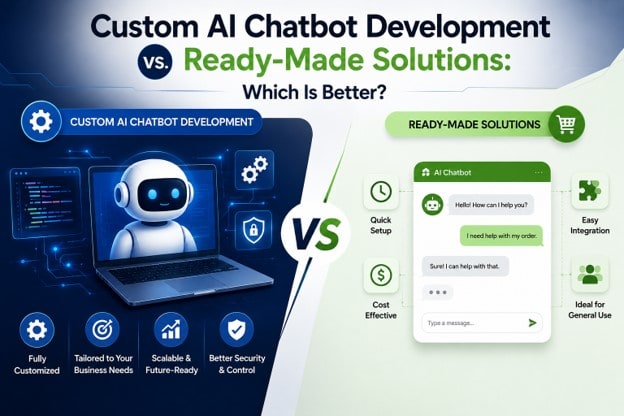
Custom AI Chatbot Development vs. Ready-Made Solutions: Which Is Better?
AI chatbots have evolved from novelty tools to integral systems across customer service, sales, marketing, and internal operations. With the increasing adoption, enterprises now stand at the crossroads between developing a custom AI Chatbot Development that suits their specific business process and is based on their specific data, and choosing an existing, ready-to-use chatbot platform. Both solutions are relevant to some extent; however, they address different issues. Choosing one of the options depends on the complexity of the requirements, the level of data and architecture control, and speed of deployment.
What Is Custom AI Chatbot Development?
When developing an AI chatbot on a custom basis, you create a conversational bot for your specific company, rather than configuring a pre-made template. This often includes selecting or tuning an AI model, incorporating Retrieval-Augmented Generation (RAG) to provide answers from your company's knowledge database, and creating a workflow that aligns with real business processes rather than general conversation. People building this type of chatbot often work with an AI development company like CodingCops, which can help with choosing the right AI models, integrating APIs and third-party tools, designing custom UI/UX, and implementing secure access controls.
What Are Ready-Made AI Chatbot Solutions?
Ready-Made chatbot platforms, on the other hand, are ready-to-use products that can be bought on a subscription basis and configured by companies rather than built from scratch. They include standard functionality such as conversational templates, common integrations with CRMs and helpdesk tools, and a control panel for people who lack technical expertise in creating content. The configuration process will depend on the vendor and may range from making simple branding adjustments to building flexible workflows.
Custom AI Chatbot Development vs. Ready-Made Solutions: Key Differences
The two approaches diverge across nearly every practical factor a business needs to weigh:
Factor | Custom AI Chatbot | Ready-Made Solution |
Development time | Weeks to months, depending on scope | Days to a few weeks |
Initial cost | Higher upfront investment | Lower upfront cost |
Customization | Extensive, built around specific workflows | Limited to the platform's configuration options |
Scalability | Architected for growth from the start | Depends on vendor infrastructure and pricing tiers |
Integrations | Custom API and system-level integrations | Pre-built connectors for common tools |
Security | Controlled by the business's own architecture | Depends on vendor security practices |
Maintenance | Requires an internal or partner development team | Handled largely by the vendor |
AI model flexibility | Choice of model, fine-tuning, and RAG design | Limited to models the vendor supports |
Data control | Full ownership of data and storage | Data often resides on vendor infrastructure |
Long-term cost | Can be lower over time at scale | Recurring subscription costs accumulate |
Best suited for | Complex, enterprise, or data-sensitive use cases | Small businesses and simple support needs |
Custom AI Chatbot Development: Benefits and Limitations
With custom development, companies have full control over customization, data processing, and user experience. Custom development allows for complex integrations with CRM and ERP systems, as well as the company’s database. The solution scales with the company without reaching the vendor's feature limit. With custom development, the company chooses the AI architecture and develops its own RAG pipeline.
These are indeed some of the most realistic trade-offs – increased costs, an extended development period, and continuous support from skilled professionals required to manage the system further. Companies that do not have their own team would definitely want a development partner for the entire process.
Ready-Made AI Chatbots: Benefits and Limitations
The time to deploy off-the-shelf platforms is shorter because most of the engineering work has already been done. Off-the-shelf platforms also offer integration and management features, which allow use even without a development team.
This becomes evident when the requirements are higher. The level of customization is limited to what the vendor provides; companies rely on the vendor's roadmaps and pricing, and data-handling concerns arise because discussions occur via third-party services.
Custom vs. Ready-Made AI Chatbots: Cost Comparison
It is wrong to compare costs based only on the initial cost of both methods. Custom development involves development costs, costs of using AI models or APIs, infrastructure, integration, and maintenance. Premade platforms will incorporate many of these costs into a monthly subscription fee that might seem less expensive at first but adds up over time.
What is important is the overall cost of ownership: how much it costs a business to develop, deploy, use, maintain, and customize a chatbot throughout its life cycle, rather than just how much it will cost them to launch it in month one.
Which Option Offers Better Scalability?
Scalability needs to be considered in relation to actual growth strategies, not volume as of now. A bot working fine in processing hundreds of messages might react to ten times that number differently, to different departments within the organization, or even to additional language capabilities. Custom solutions usually have scalability built into their design and a clear plan for upgrading the AI engine. Off-the-shelf solutions also offer scalability, but growth will be limited by the vendor's pricing models, among other factors.
Custom vs. Ready-Made Chatbots: Which Is More Secure?
Both approaches have their advantages and disadvantages in terms of security, but neither is necessarily more secure than the other. Security issues are connected to the way authentication and authorization are implemented, data encryption, access control configuration, logging, and endpoint protection. In the case of custom development, the company will be directly responsible for these aspects. For pre-built platforms, security issues depend on the vendor’s security approach, data storage policy, and certifications. Companies that work in regulated industries need to consider these aspects when evaluating both approaches.
Integration and Customization Considerations
Customized chatbots can be linked to CRM and ERP systems, helpdesk systems, company databases, proprietary APIs, and existing identity and access management systems, as the layer is designed to work with the systems the company is already using. Usually, ready-made solutions provide pre-built connections to popular applications, and they work well when a company uses technologies supported by the vendor. Issues arise when the system is not on the list of supported applications. This is where businesses either put up with the issue or seek AI-driven software development.
When Should You Choose Custom AI Chatbot Development?
Custom development tends to make sense for complex business workflows, enterprise applications, and situations involving sensitive data that a business needs to keep under its own control. It's also worth considering when a business needs multiple deep integrations, plans to apply generative AI integration services to connect the chatbot with internal systems, or has a long-term AI strategy the chatbot needs to fit into rather than sit apart from.
When Are Ready-Made AI Chatbots a Better Choice?
Off-the-shelf solutions will be best in situations where small businesses, easy-to-use automated FAQs, and basic customer support services are needed, since customization is not a major issue and cost is the primary factor.
Can Businesses Start With a Ready-Made Chatbot and Later Build a Custom Solution?
Yes, and it’s not uncommon either. The following is one viable solution: first, pinpoint the specific business problem that requires resolution by a chatbot; then introduce an out-of-the-box chatbot to solve it; evaluate usage statistics and performance; and identify the point at which platform limitations become critical. Then you will be able to set your own criteria for a custom chatbot using real-world data. For example, your initial step might involve AI PoC development engagement.
Custom AI Chatbot Development vs. Ready-Made Solutions: Which Is Better?
There's no universal answer. The right choice depends on business objectives, workflow complexity, budget, integration requirements, security and compliance needs, and the level of control the business wants over its data and AI model. Companies with straightforward requirements and deadlines are better off utilizing a pre-built platform. Companies that have intricate processes, handle confidential information, or those planning on implementing AI in the long-term would find more value in building an AI solution from scratch. Since chatbots can occasionally produce incorrect answers, a risk covered in more detail in this analysis of AI chatbot hallucinations, the underlying architecture matters as much as which path a business starts on. Talking through the specifics with an AI consulting services team before committing to either path can help clarify which factors matter most for a given business.
Want to publish a guest post on aamax.co?
Place an order for a guest post or link insertion today.
Place an Order