


Best HR Software for UK Mid-Market (200–1,000)
The Employment Rights Act 2025 has changed what a UK mid-market HR team has to get right. From April 2026, statutory sick pay and paternity leave become day-one rights, with a shorter unfair dismissal qualifying period and new rules on guaranteed hours and shift notice following in 2027. For a company in the 200 to 1,000-employee band, that means cleaner records and payroll that holds up to scrutiny. The best HR software for the UK mid-market now has to pair modern people management with payroll HMRC recognises and reporting a finance director trusts.
Most "best HR software" lists skew to small businesses or to heavy enterprise suites, so the mid-market band gets squeezed out. This guide fixes that. It ranks 11 platforms on how well they fit a UK company that has outgrown a starter tool but doesn't need a legacy HCM, with a close eye on UK payroll, compliance and room to scale. HiBob leads, and the reasons run through every section below.
The best HR software for UK mid-market companies at a glance
Here's how the 11 platforms compare on the three things a scaling UK team cares about most: who each one suits, how it handles UK payroll and HMRC, and about what it costs per employee.
| Platform | Best suited to | UK payroll and HMRC | Indicative UK price |
|---|---|---|---|
| HiBob (Bob) | Modern mid-market people teams, 200-1,000 | Native, HMRC-recognised (RTI, IR-35, P60/P11D) | Quote-based, per employee |
| Personio | European-HQ mid-market teams | Preliminary payroll; RTI via a bureau/integration | Custom quote based on employee count and selected products |
| Sage HR | Finance-led teams in the Sage stack | HMRC-recognised payroll (separate module) | Modular, quote-based |
| BambooHR | US-rooted teams wanting a simple HRIS | No native UK payroll (US payroll only) | From $10 per employee/month |
| Breathe | Small UK businesses under about 150 staff | No native payroll; integrates | Low SME monthly tiers |
| Access PeopleHR | UK SMEs planning a later step up | Built-in payroll, HMRC compliant | From GBP 3 per employee/mo |
| IRIS Cascade | Payroll-led HR teams | Payroll via Staffology; managed option | Staffology HR from GBP 0.76/employee/mo; Cascade quote-based |
| BrightHR | Compliance-first small firms | Outsourced managed payroll (CIPP team) | Quote-based |
| CIPHR | Established UK organisations wanting one suite | Real-time payroll, direct HMRC integration | Quote-based |
| Factorial | Smaller UK teams on a budget | UK payroll via integrations | Configured around Factorial Core plus selected products; exact costs provided during the sales process |
| Employment Hero | SMEs wanting low-cost bundled payroll | UK payroll (free tier available) | Free payroll tier; HR plans quote-based |
HiBob: Best all-in-one people platform for the UK mid-market
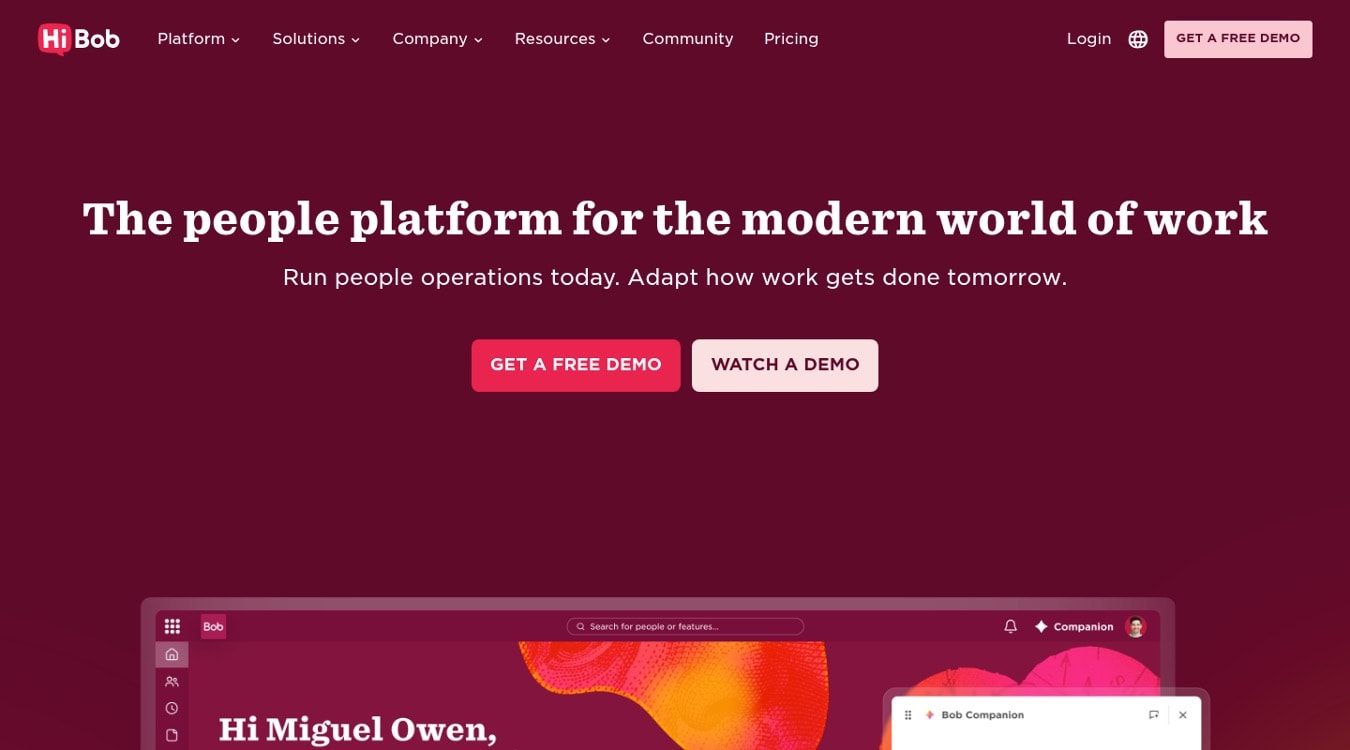
HiBob's platform, Bob, is our top pick for UK companies in the 200 to 1,000-employee band that want modern all-in-one HR without giving up HMRC-recognised payroll. Bob was built for the scaling mid-market band, and it runs native UK payroll inside the same system that holds core HR, talent and workforce planning.
HiBob's key features:
- Native UK payroll with HMRC RTI submissions (FPS and EPS), IR-35 contractor handling, and centralised P60s and P11Ds
- Bob Core as the connected system of record: role-based self-service, unified people data, joiner-mover-leaver workflows
- Workforce planning with scenario modelling and live cost impact
- Pension auto-enrolment and statutory pay handled in-platform
- Mobile-first design used day to day by employees and managers
Pros
- Bob runs native UK payroll HMRC recognises, so RTI submissions, IR-35 status, pension auto-enrolment and year-end P60s and P11Ds sit on the same record as the rest of your HR rather than in a bolted-on tool.
- Bob Core, the platform's connected foundation, is built to scale from a few hundred to several thousand employees across multiple legal entities, so a fast-growing company doesn't hit the ceiling that catches out teams who started on a small-business tool.
- Workforce planning models headcount and cost scenarios against live data, giving HR and finance a shared view of what a hiring plan does to the budget before anyone commits to it.
Cons
- Bob doesn't publish per-employee pricing, so you'll need a tailored quote to line it up against rivals that list public rates, and it sits above budget SME tools on cost because it covers more ground than they do.
- Native payroll spans the UK and the US; for staff paid in other countries you connect a local provider through Bob's Payroll Hub rather than running those payrolls in-house, so a team paying staff in several countries should check its providers are covered before signing.
What sort of business is HiBob best suited to?
Bob fits a UK company that has passed the point where a starter HR tool copes, often north of 150 staff, and wants one modern system for HR, payroll and planning instead of three stitched together. It suits people teams that care about employee experience and culture as much as admin, and finance leaders who want headcount and pay data in one place. Companies that need public per-seat pricing to sign off a budget, or that run most of their payroll outside the UK and US, should weigh those two points first.
Personio: Best for mid-market teams headquartered in Europe
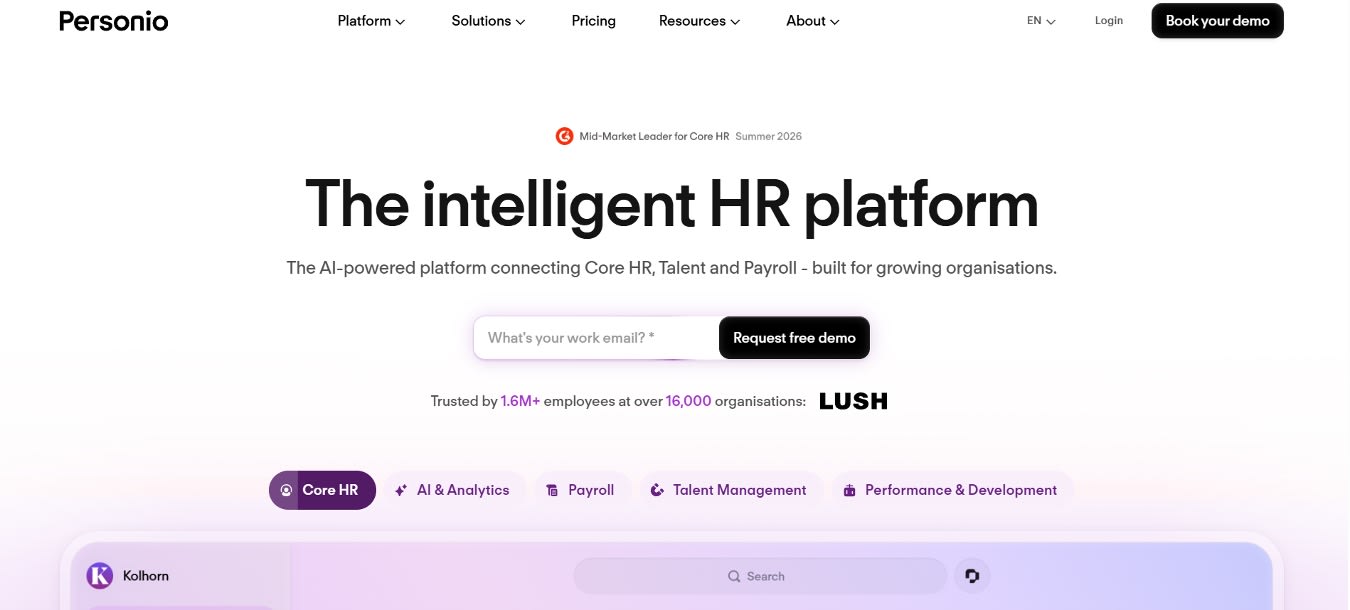
Personio is a strong pick for mid-market companies with a European headquarters and staff spread across the continent. It covers core HR, absence and preliminary payroll, and rates 4.4 out of 5 on G2 across more than 800 reviews.
Personio's key features:
- Core HR with employee profiles, absence management and document workflows
- Preliminary payroll that feeds a UK payroll bureau or integration
- Workforce planning and position management on the higher CorePro tier
- More than 200 marketplace integrations
- Recruiting, surveys and performance available as add-on apps
Pros
- Personio handles multi-entity European HR well, with legal-entity management and localisation that suit a company running people operations across several EU countries from one system.
- Pricing starts around EUR 7.60 per employee per month for the Core tier, which gives mid-market buyers a public reference point that many UK rivals in this list won't put on a page.
Cons
- Personio runs preliminary payroll rather than a native HMRC engine, so a UK company still hands the actual RTI submission to a bureau or an integrated payroll tool, which adds a moving part a native platform avoids.
- Reviewers on G2 flag missing features and limited customisation, and mid-market capabilities such as workforce planning sit behind the pricier CorePro tier rather than the entry plan.
What sort of business is Personio best suited to?
Personio makes most sense for a mid-sized business headquartered in Europe that values a tidy core HR record and doesn't need payroll run inside the platform. A UK-only company that wants HMRC payroll in the same system will find the split between Personio and a payroll provider less appealing than a native option.
Sage HR: Best for finance-led teams already in the Sage ecosystem
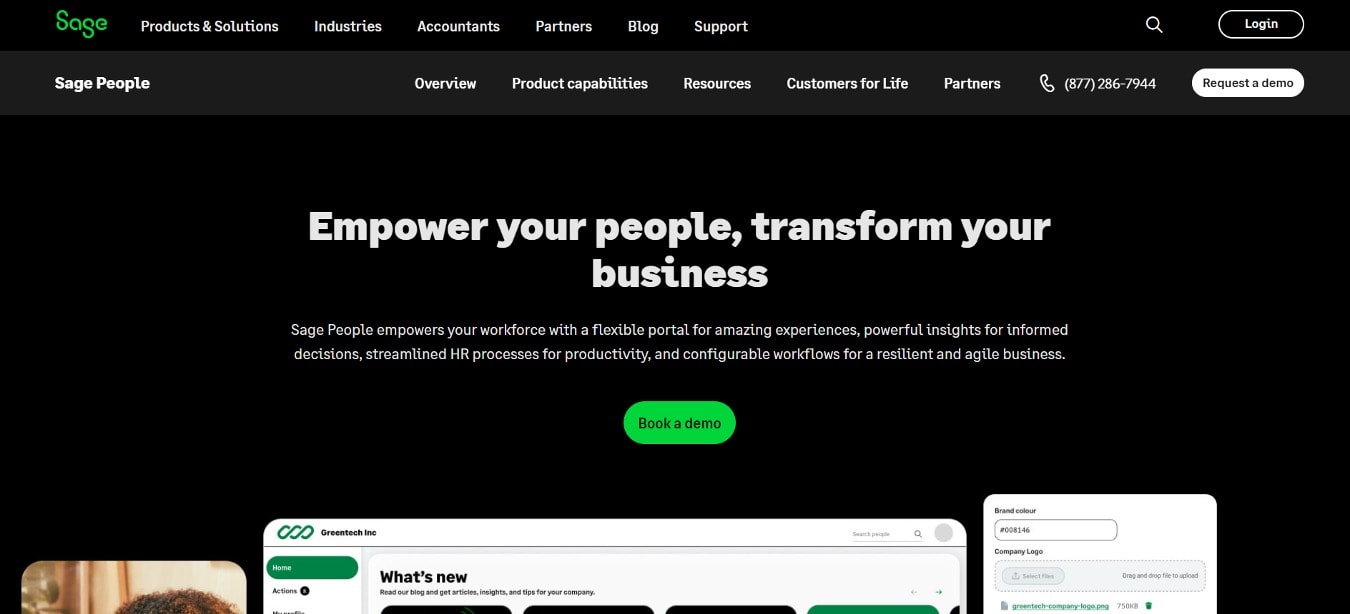
Sage HR is a sensible option for finance-led UK teams that already run Sage accounting or payroll and want HR to sit beside it. Sage's payroll software is HMRC-recognised and handles pension auto-enrolment, and Sage HR carries a 4.3 out of 5 rating on G2.
Sage HR's key features:
- Modular HR: core records, leave, timesheets and performance add-ons
- HMRC-recognised Sage Payroll (priced apart) with auto-enrolment
- Reporting and analytics across the Sage suite
- Established UK support and legislation updates
Pros
- Sage's payroll line is HMRC-recognised and stays current with UK legislation, so a company already invested in Sage accounting gets a familiar, compliant payroll path without onboarding a new vendor.
- The modular design lets a business buy only the HR pieces it needs today and add more later, which keeps the entry cost down for a team testing the water.
Cons
- Sage HR and Sage Payroll are separate modules rather than one unified platform, so a mid-market team that wants HR and payroll on a single record has to connect them and pay for each.
- G2 reviewers report a setup that isn't intuitive and navigation that takes getting used to, and the wider Sage stack can feel dated next to modern all-in-one platforms.
What sort of business is Sage HR best suited to?
Sage HR suits a UK company that already trusts Sage for accounts and payroll and wants HR admin in the same family, with finance holding the reins. A people team after a modern, culture-first experience or one unified HR-and-payroll record will find the modular split and older interface a compromise.
BambooHR: Best for US-rooted teams wanting a simple HRIS
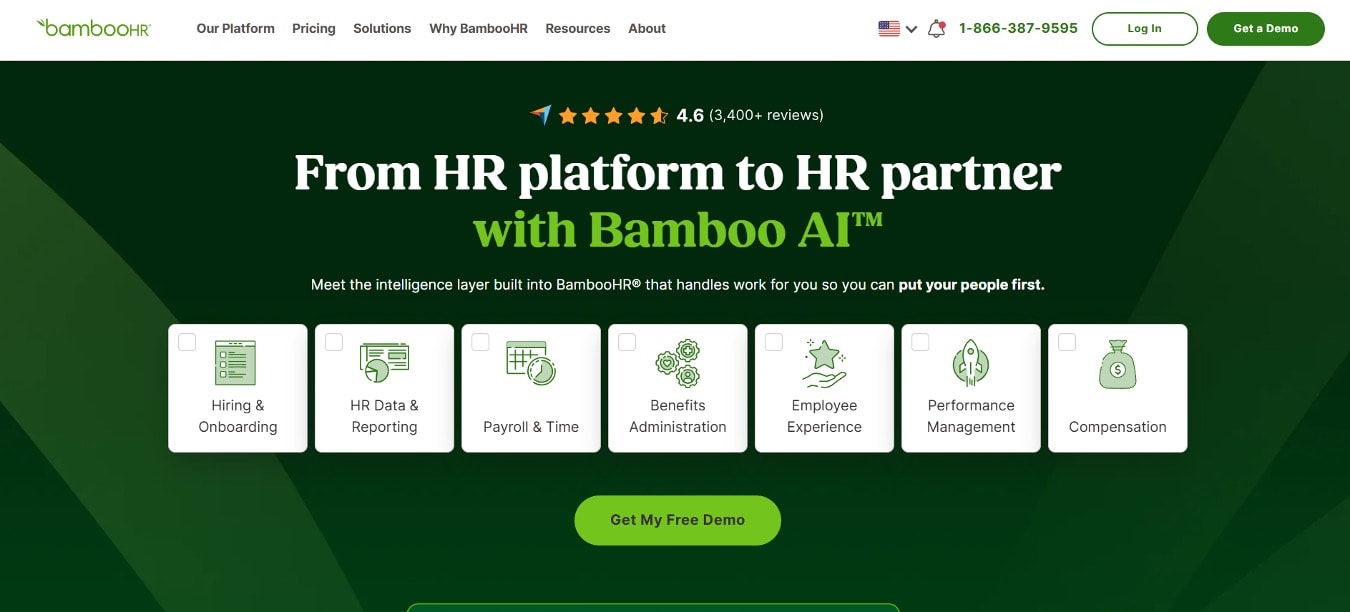
BambooHR is a solid HRIS for smaller, US-rooted teams that want a clean, easy interface, and it posts a 4.4 out of 5 on G2 from more than 5,000 reviews. Its strength is simplicity, and its gap for a UK buyer is payroll.
BambooHR's key features:
- Core HRIS with an interface reviewers rate well
- Onboarding, PTO tracking and employee records
- Performance and engagement add-ons
- US payroll and benefits (US only)
- Reporting and an open API
Pros
- BambooHR is one of the easiest HR systems to roll out and use, with an interface reviewers rate well, which shortens onboarding for a team that wants its people in the system fast.
- Its onboarding and self-service tools give a growing company a decent people record without much configuration effort.
Cons
- BambooHR's native payroll runs in the US only, so a UK mid-market company gets no HMRC RTI payroll from Bamboo itself and has to bolt on a separate UK payroll provider.
- G2 reviewers cite limited customisation and capped capabilities again and again, which a 200 to 1,000-person company tends to outgrow as its processes get more specific.
What sort of business is BambooHR best suited to?
BambooHR fits a smaller or US-headquartered business that wants a tidy HRIS and runs UK payroll elsewhere. A UK-anchored mid-market team that wants native HMRC payroll and heavier configuration will find Bamboo thin on both.
Breathe: Best for small UK businesses not yet at mid-market scale
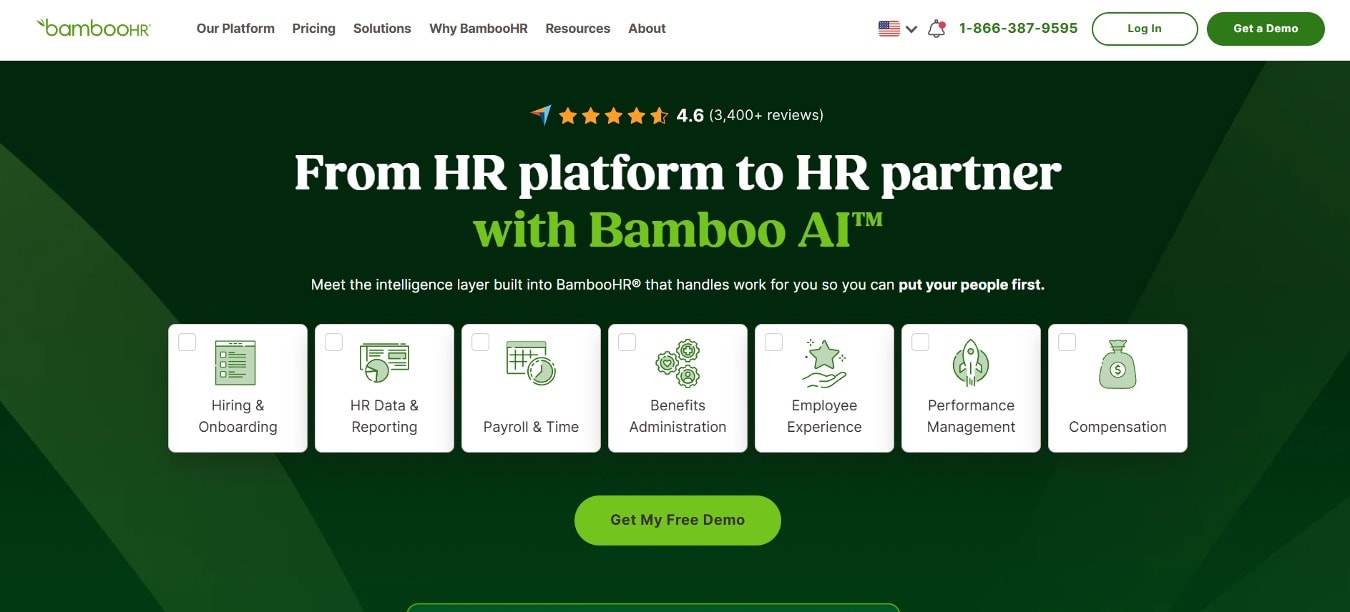
Breathe is a low-cost HR tool aimed straight at small UK businesses, and it says as much itself: it markets to more than 17,000 UK SMEs. For a company still under a couple of hundred staff it's tidy and affordable, though the mid-market is not its home.
Breathe's key features:
- Core HR: holiday, absence and document storage
- Rota and shift scheduling
- More than 100 UK-specific training courses
- Health and safety and incident logging
- Free trial and low monthly SME tiers
Pros
- Breathe is inexpensive and quick to set up, which makes it a comfortable first HR system for a small UK business leaving spreadsheets behind.
- Its UK-specific training library and health-and-safety tools give a small team compliance basics without buying separate products.
Cons
- Breathe designs and prices itself for SMEs, so a company scaling through the 200 to 1,000 band tends to hit limits on depth, configuration and analytics that a mid-market tool is built to handle.
- It has no native payroll engine, so UK RTI payroll runs in a separate system you connect to Breathe rather than run inside it.
What sort of business is Breathe best suited to?
Breathe suits a small UK business, often under 150 staff, that wants affordable, no-fuss HR admin and UK compliance basics. A company already at mid-market scale, or growing fast towards it, will outgrow Breathe inside a year or two.
Access PeopleHR: Best for UK SMEs planning a later step up
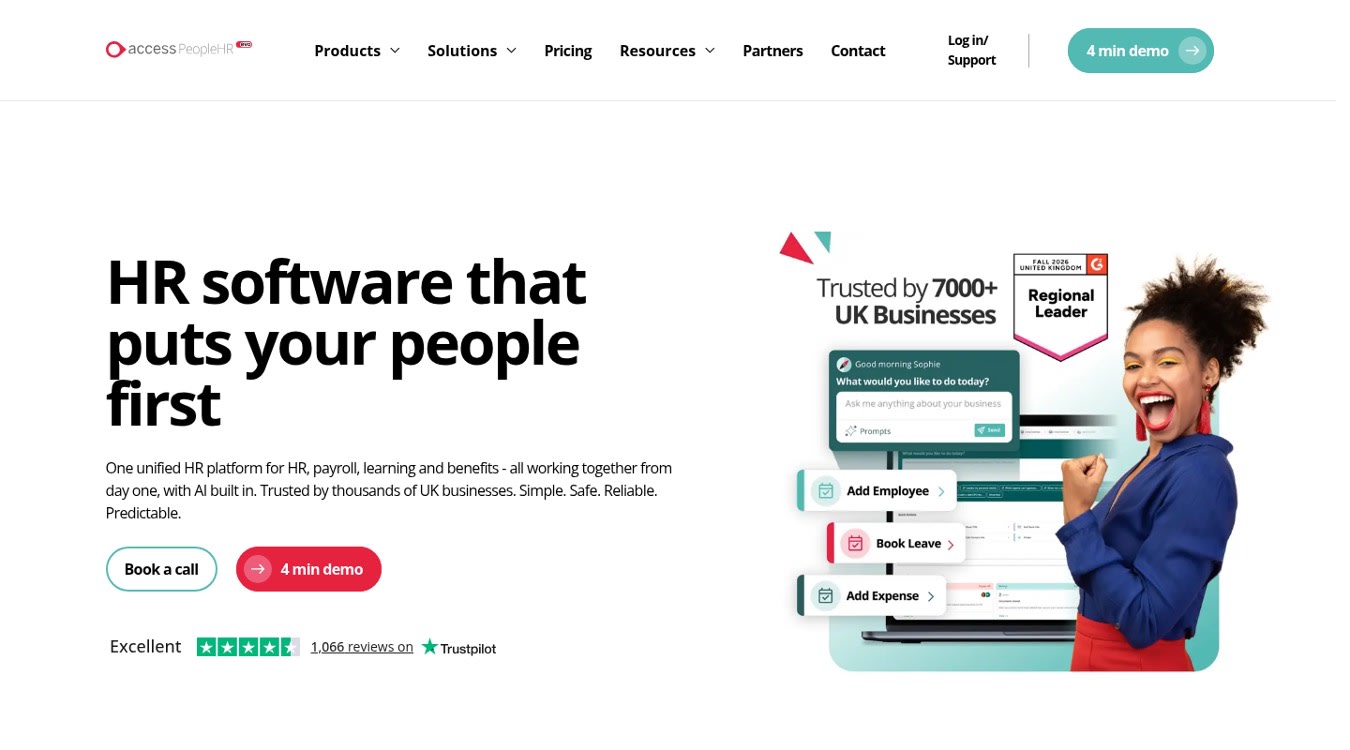
Access PeopleHR is an AI-assisted HR and payroll suite built for UK small and medium-sized businesses, with built-in payroll that is HMRC compliant and public pricing from GBP 3 per employee per month. For larger, more complex needs, Access points buyers to a separate product, PeopleXD.
Access PeopleHR's key features:
- Unified HR, payroll, recruitment, learning and benefits for SMEs
- Built-in payroll, HMRC compliant, with pension enrolment
- AI-assisted reporting and analytics
- Four public tiers from GBP 3 to GBP 9.50 per employee per month
- Access PeopleXD for larger organisations
Pros
- Access PeopleHR publishes clear per-employee pricing across four tiers, which makes budgeting straightforward for an SME comparing options on cost.
- Built-in HMRC-compliant payroll and pension enrolment mean a smaller UK business can run people and pay from one suite without a second vendor.
Cons
- The PeopleHR product targets small and medium businesses, and Access steers larger or more complex organisations to a different platform, PeopleXD, so a company scaling hard through the mid-market can face a migration between Access products rather than one system that grows with it.
- Its heritage is SME HR, so mid-market teams that want deep workforce planning and culture tooling get less than a platform built for that band.
What sort of business is Access PeopleHR best suited to?
Access PeopleHR fits a UK SME that wants HR plus payroll in a single affordable suite with pricing it can see up front. A company that expects to push well past 1,000 staff should factor in the possible move to PeopleXD as it grows.
IRIS Cascade: Best for payroll-led HR teams
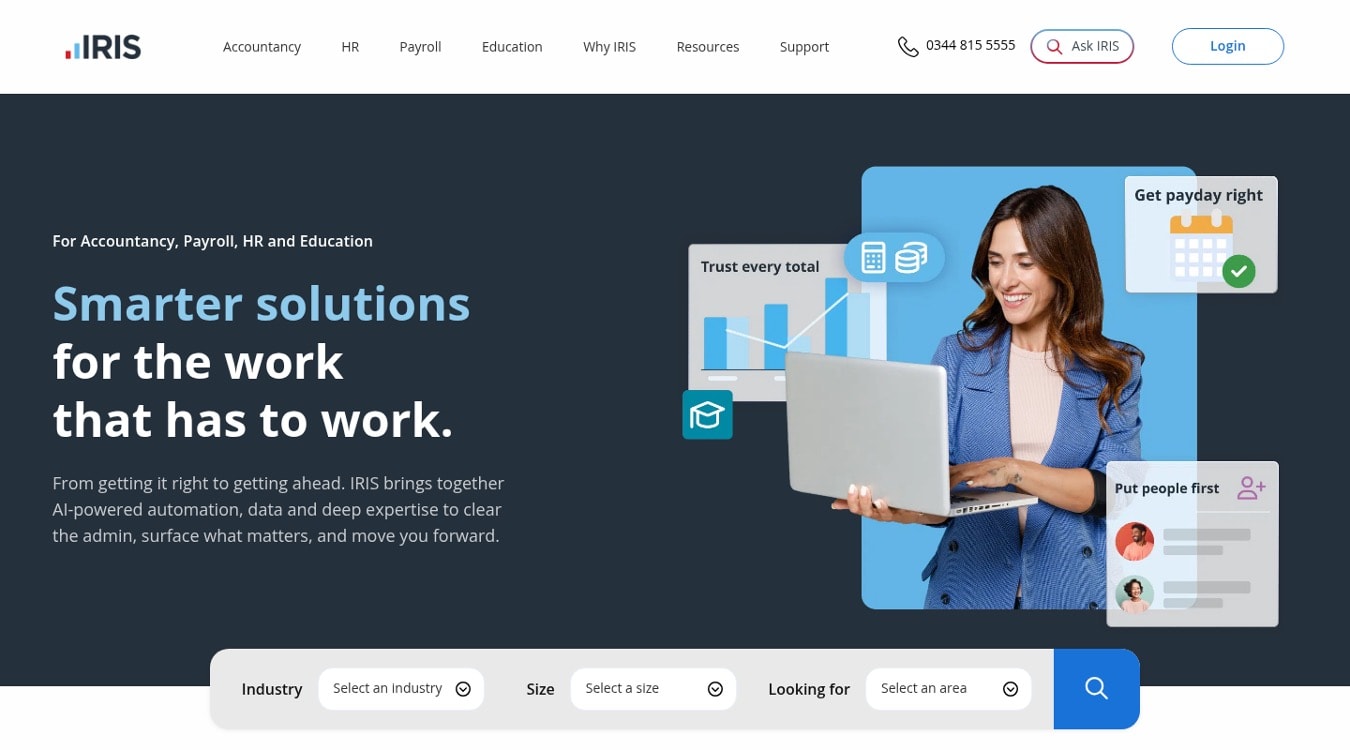
IRIS Cascade is an established UK HR and payroll suite that appeals to payroll-led teams, part of the wider IRIS family that also runs Staffology payroll. Staffology HR pricing starts as low as GBP 0.76 per employee per month, while Cascade HRi is quote-based.
IRIS Cascade's key features:
- HR records, self-service and workflow
- Payroll through Staffology, with a managed-payroll option
- International payroll capability
- Customisable interface and tiered reporting
- Long-standing UK compliance pedigree
Pros
- IRIS brings deep UK payroll heritage, and Cascade pairs HR with Staffology payroll plus a managed-payroll option for teams that would rather hand the pay run to specialists.
- It supports international payroll and a customisable interface, which helps a UK business that pays some staff overseas keep more of the work under one roof.
Cons
- Cascade's roots are payroll and administration rather than modern people experience, so features can be module-dependent and tier-gated, and the interface feels dated next to newer platforms.
- Much of the value depends on adopting several connected IRIS products, which adds setup effort and cost for a team that wants one platform out of the box.
What sort of business is IRIS Cascade best suited to?
IRIS Cascade suits a UK mid-market team where payroll leads the decision and a specialist or managed pay run matters more than a polished employee experience. A company that puts modern UX and culture tooling first will find it heavier going.
BrightHR: Best for compliance-first small businesses
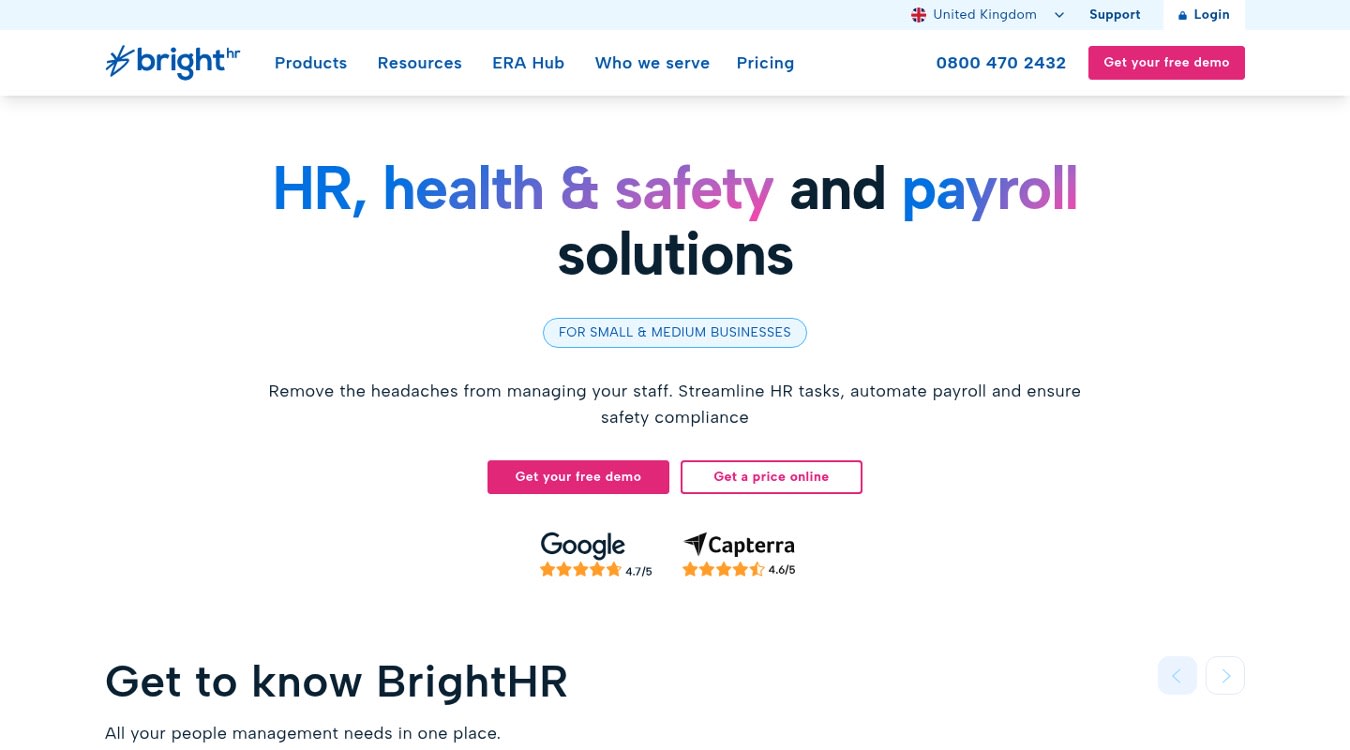
BrightHR is a compliance-first HR platform for smaller UK firms, strong on employment support and health and safety, with payroll handled as an outsourced managed service by a CIPP-qualified team rather than run in-app.
BrightHR's key features:
- Core HR, holiday and absence tracking
- Health and safety and document tools
- Employment law and HR advice support
- Managed payroll service (a CIPP team liaises with HMRC)
- Mobile app and shift tools
Pros
- BrightHR pairs HR admin with employment-law and health-and-safety support, which reassures a small business that wants compliance cover alongside the software.
- Its managed payroll service puts a CIPP-qualified team in charge of dealing with HMRC on your behalf, which takes the pay run off a stretched small team's plate.
Cons
- Payroll is an outsourced service rather than native payroll your own team runs inside the platform, so a mid-market company that wants to own its RTI submissions and pay data in one system gets less control than a native engine offers.
- BrightHR is scoped and priced for smaller businesses, so a company scaling through the mid-market tends to want deeper analytics, planning and configuration than it provides.
What sort of business is BrightHR best suited to?
BrightHR suits a small UK business that values built-in employment-law and safety support and is happy to outsource payroll. A mid-market team that wants to run native payroll and richer people analytics in one platform will find it light.
CIPHR: Best for established UK organisations wanting one integrated suite
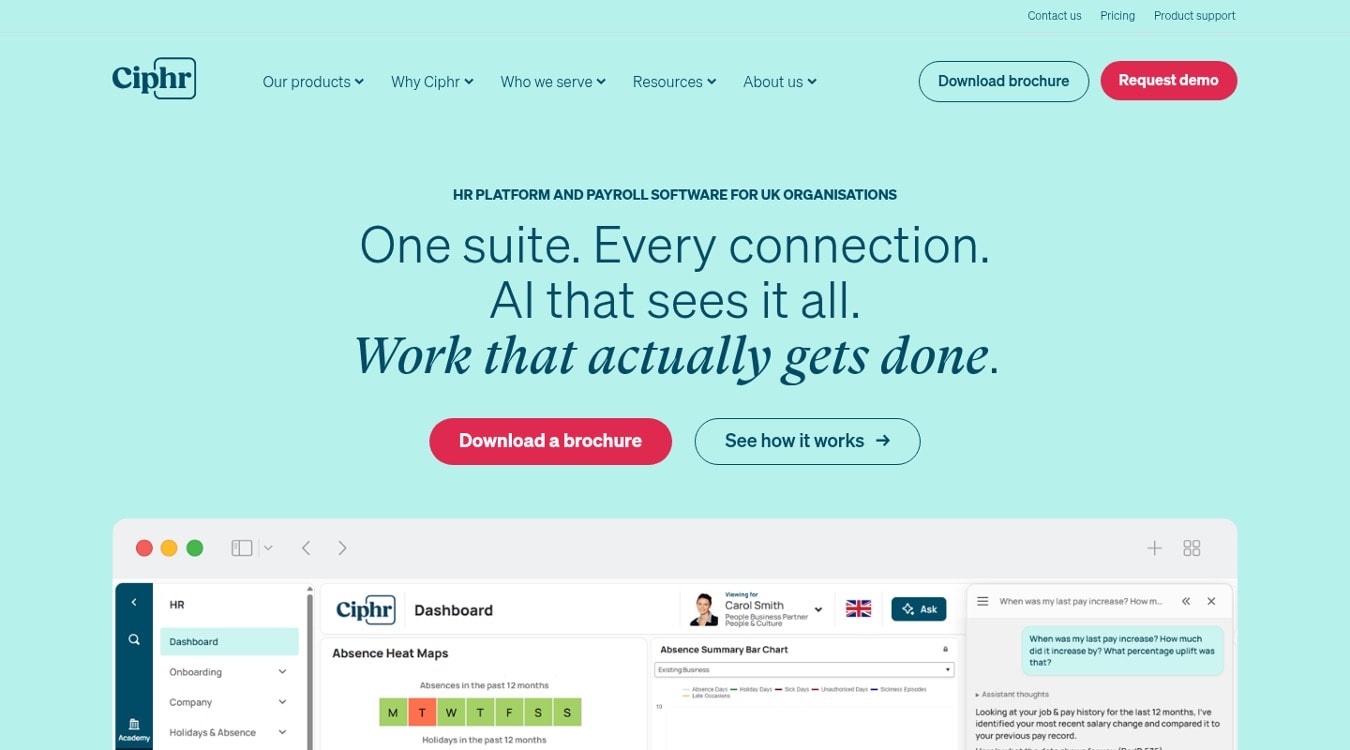
CIPHR (styled Ciphr) is an integrated HR and payroll suite for established UK organisations, connecting HR, payroll, recruitment, learning and benefits. It processes more than GBP 2bn in payroll a year, won CIPP Product of the Year 2025, and has a direct HMRC integration.
CIPHR's key features:
- Six connected solutions across HR, payroll, recruitment, learning, benefits and analytics
- Real-time cloud payroll with direct HMRC integration
- Award-winning payroll (CIPP Product of the Year 2025)
- Flexible reporting and finance exports
- Benefits with live take-home-pay impact
Pros
- CIPHR offers a broad, connected UK suite with real-time payroll and a direct HMRC integration, so a larger organisation can bring HR, pay, learning and benefits under one supplier.
- Its payroll pedigree is strong, with an award-winning engine and more than GBP 2bn processed a year, which gives payroll-heavy organisations confidence.
Cons
- CIPHR is a broad, established suite, and getting full value depends on adopting several connected modules, which adds implementation effort and can feel heavier than a single modern platform.
- Its interface and setup lean traditional next to newer mid-market tools, so teams that prize a modern, mobile-first experience may find it less inviting for everyday users.
What sort of business is CIPHR best suited to?
CIPHR fits an established UK organisation that wants one supplier across HR, payroll and benefits and has the appetite to implement a full suite. A leaner mid-market team after fast setup and a modern feel will find it more than it needs.
Factorial: Best for smaller UK teams on a budget
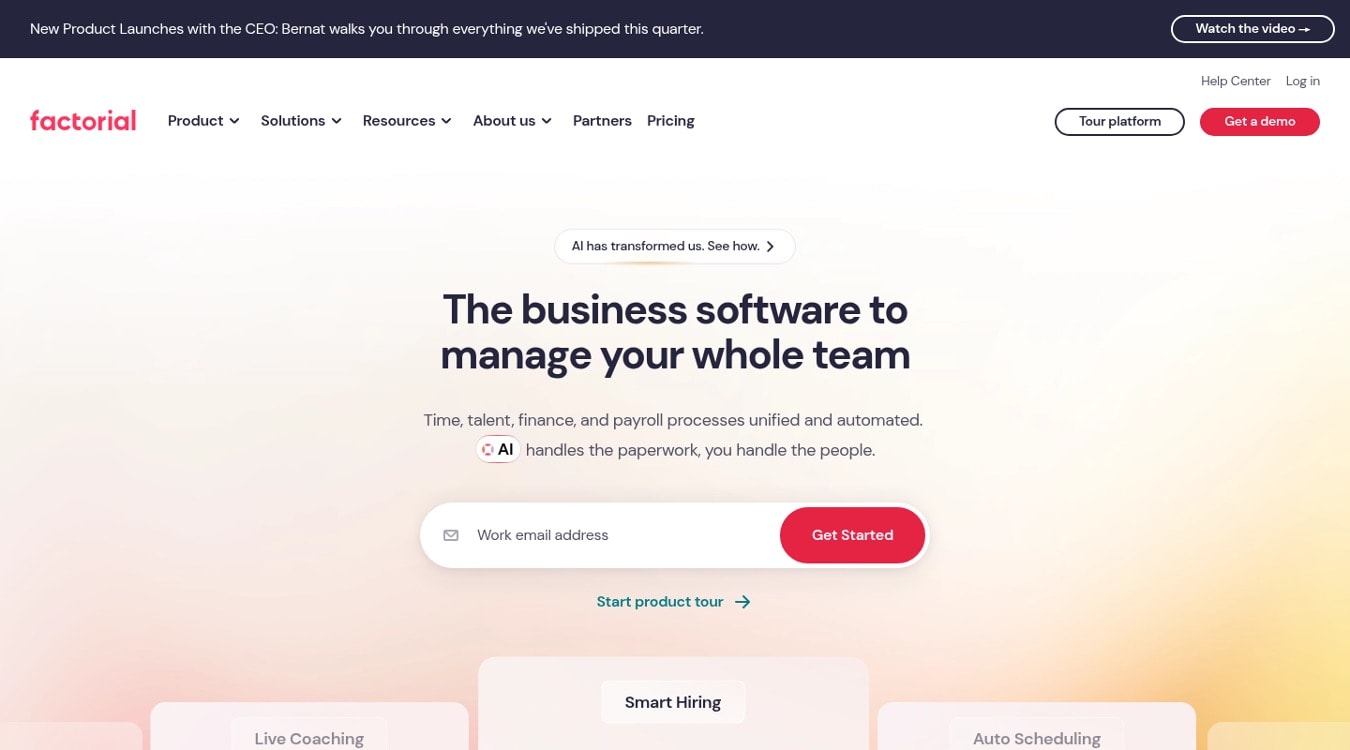
Factorial is a modern, low-entry HR platform that suits smaller UK teams watching the budget, with pricing that starts around USD 8 per user per month. It scores 4.4 out of 5 on G2, though from a smaller base of about 100 reviews.
Factorial's key features:
- Core HR: directory, onboarding, documents and e-signature
- Time off and time tracking
- Performance and recruitment add-ons
- Expenses, project and finance tools
- Tailored, quote-based plans built on Factorial Core
Pros
- Factorial packs a lot of modules into a modern interface at a low starting price, which appeals to a small, cost-conscious UK team that wants breadth without a big outlay.
- Its Core plan covers day-to-day HR admin from onboarding to document management, giving a growing team a workable foundation early.
Cons
- G2 reviewers flag missing features and module gaps, and the review base is small, so a mid-market company with specific requirements should test with care before committing.
- Factorial leans SMB, and it runs UK payroll through integrations rather than a native HMRC engine, so a 200 to 1,000-person team still needs a payroll answer alongside it.
What sort of business is Factorial best suited to?
Factorial suits a smaller UK team that wants broad, modern HR features at a keen price and can work within its limits. A larger mid-market company with complex payroll and planning needs will stretch beyond what it offers.
Employment Hero: Best for SMEs wanting low-cost bundled payroll
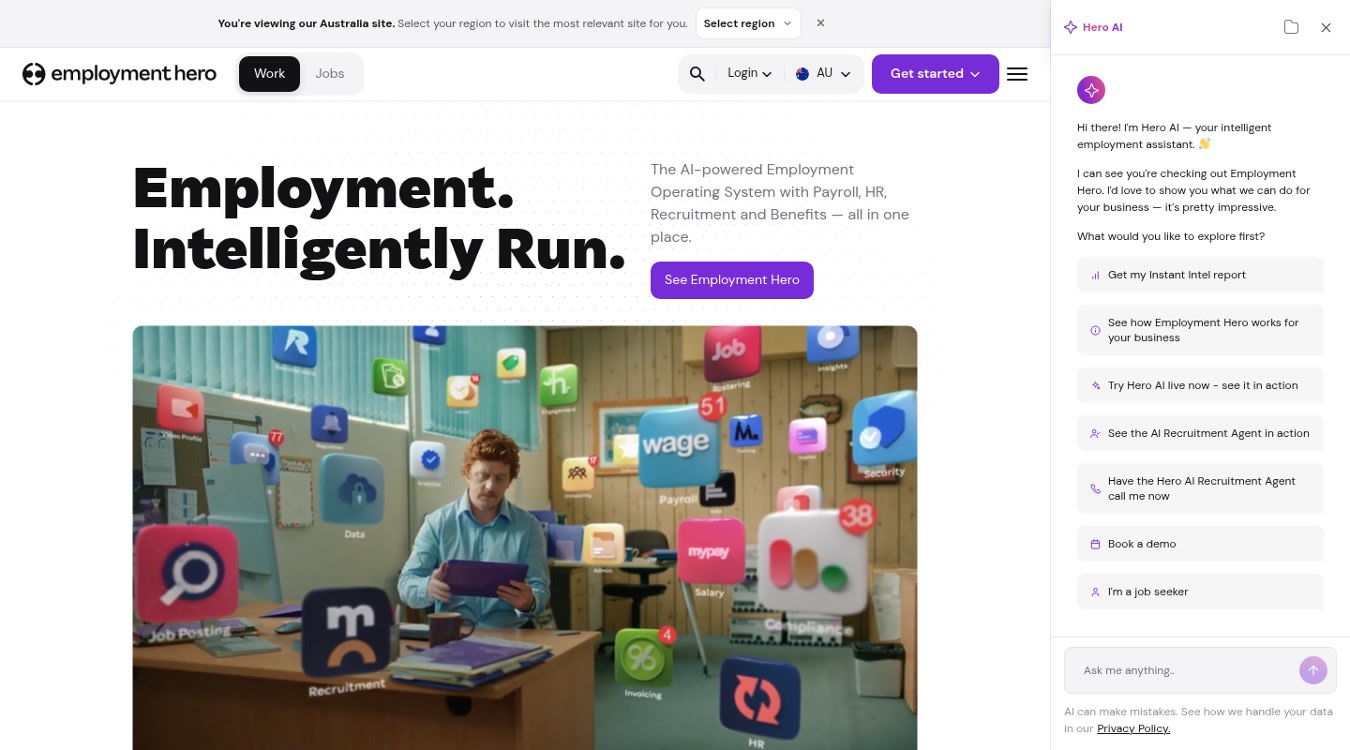
Employment Hero is an all-in-one HR, payroll and hiring platform for UK SMEs, notable for a free payroll tier and AI-assisted workflows. It sits at 4.4 out of 5 on G2 from more than 4,000 reviews, and its payroll heritage runs deep through the former KeyPay engine.
Employment Hero's key features:
- All-in-one HR, payroll, hiring and benefits
- Free payroll software tier for UK businesses
- AI-assisted employment workflows
- Onboarding, contracts and compliance tools
- Global hiring through HeroForce (employer of record)
Pros
- Employment Hero bundles HR and payroll with a free payroll tier, which lowers the entry cost for a UK SME that wants both without separate contracts.
- Its AI-assisted workflows automate routine onboarding and payroll admin, which saves time for a small team running lean.
Cons
- G2 reviewers cite missing features and limited customisation, and the platform is built around SME needs, so a mid-market company can outrun its depth as processes mature.
- Its centre of gravity is HR and payroll for smaller businesses, so teams that want deep mid-market workforce planning and culture tooling get less than a platform designed for that band.
What sort of business is Employment Hero best suited to?
Employment Hero fits a UK SME that wants low-cost, bundled HR and payroll with helpful automation. A company well into the mid-market with complex planning, compensation and culture needs will find it aimed a size below.
How to choose HR software for a UK mid-market company
Choosing HR software at mid-market scale is a different job from picking a tool for a 30-person startup. Here's what carries the most weight for a UK company between 200 and 1,000 staff.
Native UK payroll, inside or connected
Decide first whether you want payroll inside the platform or connected to it. A native, HMRC-recognised engine keeps RTI submissions, pension auto-enrolment, P45s for leavers and year-end P60s on the same record as HR, which cuts the reconciliation work that grows with headcount. If you keep an existing bureau, check the integration is strong enough to avoid double entry.
Room to scale without a re-platform
Your headcount will move. A platform built for the mid-market band should absorb new entities, pay groups and approval layers without forcing a migration to a different product later. Ask each vendor what happens at 500 and at 1,000 staff, and whether that means a new tier or a new system.
Compliance and security scrutiny
With the Employment Rights Act 2025 phasing in, you need clean documentation for probation, absence and shift patterns, plus audit-ready workflows. Ask about ISO 27001, access controls and how the vendor keeps pace with UK legislation.
Implementation time and ownership
Most UK mid-market switches take one to three months, longer with complex payroll. A good plan includes parallel payroll runs before go-live so you catch discrepancies before pay day. Confirm data-migration support and a named contact for urgent pay-run issues.
Everyday adoption
Adoption decides whether the investment pays off. Check that self-service for payslips, leave and personal details works on mobile, because a system people avoid becomes another silo.
What the Employment Rights Act 2025 and 2026 payroll changes mean for mid-market HR
UK payroll and HR rules move again in 2026, and a mid-market team feels every change across a few hundred payslips. Here's what to plan for.
The Employment Rights Act 2025 arrives in phases, with April 2026 a key date. From that point, statutory sick pay and paternity leave become day-one rights, the lower earnings limit and waiting period for SSP fall away, and a Fair Work Agency launches to enforce the new rules. Later phases, running into 2027, cut the unfair dismissal qualifying period from two years to six months and add protections covering guaranteed hours, reasonable notice of shifts and payments for short-notice cancellations. Anti-harassment duties tighten too, with employers expected to take all reasonable steps to prevent it.
Pay floors rise on 1 April 2026: the National Living Wage for workers 21 and over goes to GBP 12.71 an hour, with larger percentage rises for the 18 to 20 rate and the 16 to 17 and apprentice rate. Employer National Insurance stays a heavy cost line, charged at 15% on earnings above a GBP 5,000 secondary threshold, though eligible employers can claim up to GBP 10,500 through the Employment Allowance. Statutory sick pay rises to GBP 123.25 a week for 2026/27, and statutory maternity and related family pay caps move to GBP 194.32 a week.
For a 200 to 1,000-person company, small payroll errors now compound into real money and real risk. That's the case for a platform that keeps HR records, payroll and audit trails on one system, so a rule change updates once and flows everywhere it's needed.
How we chose the best HR software for the UK mid-market
This ranking draws on each vendor's documented product capabilities, published UK pricing where a vendor lists it, and public review data such as G2 ratings where a current one exists. We weighted the factors that matter most to a UK company in the 200 to 1,000-employee band: native UK payroll and HMRC recognition, depth of core HR and workforce planning, room to scale across entities, compliance and security posture, and everyday usability.
Where a vendor doesn't publish pricing, we've said so and used hedged figures rather than invented numbers. G2 ratings were available for the established platforms; several UK specialists don't carry a current G2 score, so we relied on their documented product characteristics instead. No hands-on testing sits behind these rankings; they're a synthesis of public product, pricing and review information as of 2026.
Which HR software fits a UK mid-market company best
For a UK company in the 200 to 1,000-employee band, the best HR software has to do two hard things at once: run people management people enjoy using, and run payroll HMRC recognises, on one record that scales. Most tools here do one well and the other as an afterthought. The SME favourites stay light on mid-market depth, and the payroll-led suites feel dated where employees live day to day.
HiBob earns the top spot because Bob pairs modern all-in-one HR with native, HMRC-recognised UK payroll and workforce planning built for the mid-market it was designed to serve. As the Employment Rights Act 2025 raises the bar on records and pay, that mix of modern experience and real UK compliance is what a scaling people team will lean on through 2026 and past it. Shortlist two or three platforms here, run a payroll pilot, and let your own data settle it.
Want to publish a guest post on aamax.co?
Place an order for a guest post or link insertion today.
Place an Order