
8 Best AEO Tools: In-House Buyer Questions Answered (2026)
8 Best AEO Tools, Ranked by What In-House Buyers Ask (2026)
AI visibility made it into next year's plan, and someone has to pick the platform that reports on it. For the head of search, that means demos and a stack of "best AEO tools" lists that rarely agree on what to measure. EMARKETER forecasts 161.5 million US monthly generative AI users in 2026, 8.6 million above its March estimate. Four questions settle the purchase: which engines your plan covers, whether you can read the answer behind each number, how the bill grows, and whether you can test first.
Vendors' own pages answer each below, then eight platforms are ranked for search leads inside mid-market and enterprise organizations.
The 8 Best AEO Tools, Side by Side
This AEO tools comparison ranks eight platforms for in-house teams weighing the best AEO tools. SE Visible by SE Ranking leads for dedicated AI-visibility owners: all its engines on every plan, the stored answer behind each metric. Cells reflect vendor pages as of October 15, 2026: "Not stated" means we found nothing.
# | Platform | Best for | Engines | Refresh | Entry price |
1 | SE Visible by SE Ranking | AI-visibility owners | ChatGPT, Gemini, AI Mode, AI Overviews | Daily, adjustable | Free trial |
2 | BrightEdge AI Catalyst | BrightEdge enterprises | Five-plus | Not stated | Demo |
3 | Semrush AI Visibility Toolkit | Suite consolidation | ChatGPT Search, Gemini, AI Mode, AI Overviews | Daily | $99/mo |
4 | Ahrefs Brand Radar | Category benchmarking | Six, plus Claude (custom) | Per platform | From $50/mo |
5 | Similarweb AI Brand Visibility | AI traffic | Four, incl. Perplexity | Daily | From $99 |
6 | Gauge | Content output | Six | Daily | $599/mo |
7 | HubSpot AEO | HubSpot stacks | ChatGPT, Gemini, Perplexity | Daily | $50/mo; $45 annually |
8 | LLMrefs | Keyword lists | Ten | At least weekly | $79/mo |
What are the best AEO and GEO tools, and is there a difference?
Little in practice: both labels name platforms that run prompts through answer engines and record whether your brand appears, how it's described, and which sources get cited. What separates the best answer engine optimization tools is which engines each plan covers.
ChatGPT Search and AI Overviews share only 24% of top cited domains, and Gemini referrals more than doubled in two months as ChatGPT's fell over 22%. SE Visible covers ChatGPT, Gemini, AI Mode, and AI Overviews on every plan.
How should you choose an AEO tool?
The best AEO tool for an in-house team is the one whose numbers survive leadership questions. Check five things: engines on the plan you'd buy, the stored answer behind each figure, country or city settings, refresh cadence, and API access.
88% of 198 search marketers Northwestern Medill surveyed are likely to invest in AI search optimization, yet "governance and measurement systems may be struggling to keep pace," writes Medill's Kelly Cutler. Ask how the best AEO tools collect answers: in a live browser session or by API call.
How Much Do AEO Tools Cost?
Entry prices run $50 to $599 monthly. AEO pricing follows four models: flat plans with a prompt cap, check-based prompt packages, per-brand subscriptions, and enterprise contracts quoted after a demo. Across the best AEO tools, the bill then grows with prompts, engines covered, locations, seats, and brands.
Published prices for the best AI platforms for answer engine optimization: Semrush $99/month for 25 tracked prompts, LLMrefs $79/month for 500 (limited-time), Gauge $599/month for 600, Ahrefs check-based prompt packages from $50/month, HubSpot AEO $50/month per brand, BrightEdge on request. SE Visible lists its plans on visible.seranking.com, all tracked engines included.
How Do You See Your AI Visibility Before You Buy?
Track 20-30 of your own prompts daily for two weeks and read the raw answers: which engines named you, where, in what tone, and which pages they cited. The pilot shows which of the best AI search visibility tools fits.
Clicks miss what answer optimization for AI visibility measures. In one experiment, AI Mode cut outbound click-through by 18.8 percentage points, though Google cited in 2025 "slightly more quality clicks". SE Visible offers a free trial. Of the best AEO tools, HubSpot AEO gives 25 free prompts, LLMrefs seven days, Similarweb "Try it for free." Semrush's toolkit has none, Ahrefs runs no discounts, BrightEdge sells by demo.
Ranked: 8 Best AEO Tools for In-House Search Leads
The order reflects fit for an in-house search team: engines on the plan you'd buy, whether each number opens into a saved answer, refresh cadence, and how the bill scales. Each card gives best fit, standout, pros, cons, and pricing, then a shortlist call.
1. SE Visible
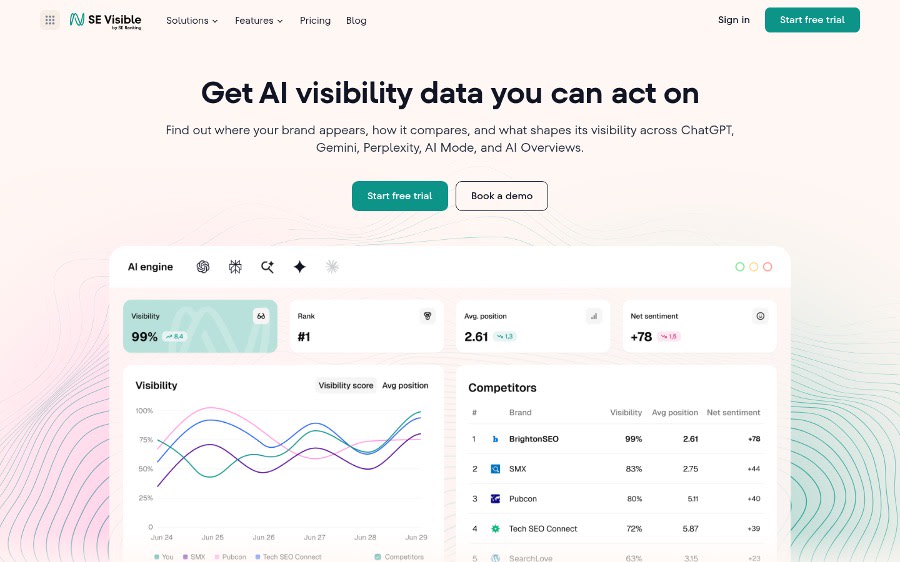
Typing the same prompts into each AI engine every week, then pasting the answers into a sheet, is where most AEO work starts. Built as an AI visibility platform, SE Visible by SE Ranking tracks how Gemini, ChatGPT, and Google's AI Overviews and AI Mode describe and cite your brand in your chosen country, city, or region.
Best for: in-house search teams where one person owns AI visibility, with its own budget line and a monthly readout.
Standout: The prompt set works like a research asset. Prompts are suggested at setup or added by hand, grouped into topics, and tagged by intent (informational, navigational, commercial, transactional, local), branded or non-branded, language, and location. Each shows its competitors and sources. See how SE Visible organizes a prompt set by topic and intent.
Pros:
- Opens any metric into the unedited answer, kept with its engine, market, and date
- Gathers answers daily by default in a real browser session, not via APIs
- Pairs visibility score and share of voice with average position and net sentiment, per engine or combined
- Pushes data into Looker Studio, CSV/XLSX exports, or the API, included on every plan
Cons:
- Scope is AI visibility only; keyword research, rank tracking, and site audits sit in SE Ranking
- Engine coverage is still growing; Claude support is planned
- One location per project for now; in-app reports are still developing, so Looker Studio, the API, or exports carry fuller reporting
Pricing: Plans aren't quoted here: visible.seranking.com lists them, and a free trial lets you test your own prompts first.
Shortlist call: For a head of search with a dedicated AI-visibility mandate, start the trial here with the prompts your monthly readout already uses. On the SEO side, SE Ranking covers Google's classic results; together they span both kinds of search.
2. BrightEdge AI Catalyst
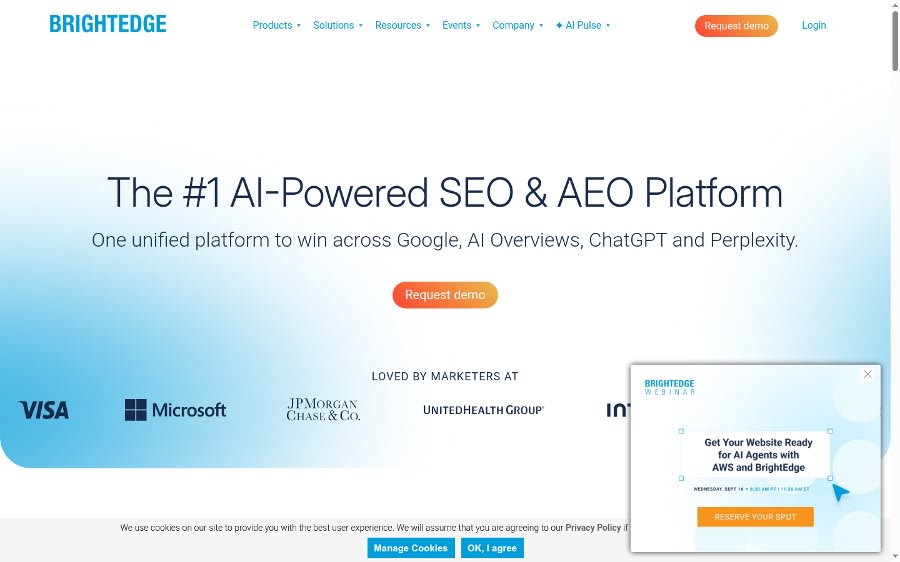
AI Catalyst, the AI search visibility layer in BrightEdge's enterprise SEO platform, belongs on a shortlist of top answer engine optimization software.
Best for: enterprise in-house SEO teams whose reporting already runs through BrightEdge.
Standout: BrightEdge builds and tracks the prompts, maps each to a buyer-journey stage, and alerts you when a rival replaces you in an answer you previously held. Setting your page beside the cited one yields a ready-made brief.
Pros:
- Separates mentions from citations across Gemini, AI Mode, ChatGPT, AI Overviews, and Perplexity
- Explains the reasoning behind each sentiment rating
- Exports charts as PNG and tables as CSV
Cons:
- Publishes no pricing; access starts with a demo request
- Leaves cadence and market settings unstated on its product page
Pricing: Pricing on request (demo).
Shortlist call: One of the best AEO tools for enterprise teams already working in BrightEdge, since AI answers join the dashboards leadership reads. Confirm cadence and locations during the demo.
3. Semrush AI Visibility Toolkit
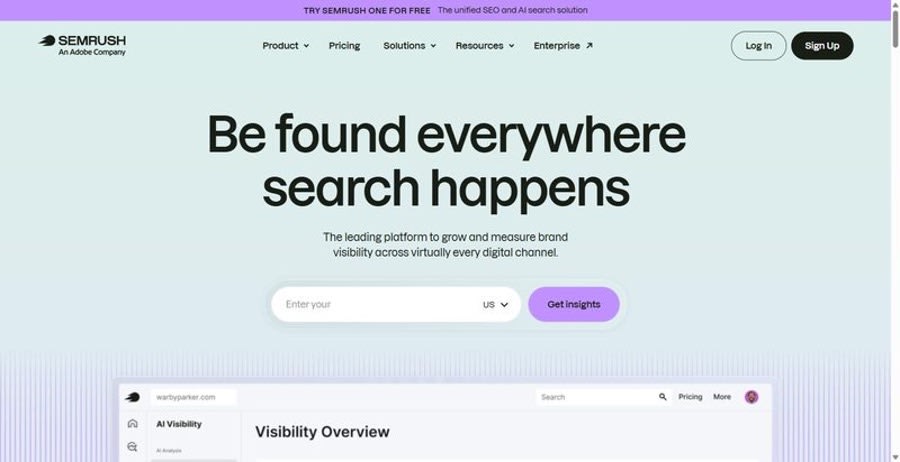
Semrush sells its AI Visibility Toolkit on its own or bundled with the SEO toolkit inside Semrush One.
Best for: in-house teams consolidating SEO and AI visibility under one vendor contract.
Standout: For suite-first teams, it sits among the best AEO tools because prompt tracking runs daily in ChatGPT Search, Gemini, AI Overviews, and Google AI Mode, while Site Audit adds AI Search checks for up to 100 pages.
Pros:
- Tracks prompts across 220+ countries and territories
- Benchmarks sentiment and share of voice in Brand Performance
- Captures responses from real requests, not LLM APIs, per Semrush
Cons:
- Entry plan covers 1 project, 1 domain, and 25 tracked prompts
- Updates Brand Performance reports weekly, while prompt tracking refreshes daily
Pricing: $99/month; no free trial; more prompts from $60/month per 50.
Shortlist call: Worth it when finance prefers a single SEO vendor and the AI line can live inside it. Budget for prompts beyond the starting 25.
4. Ahrefs Brand Radar
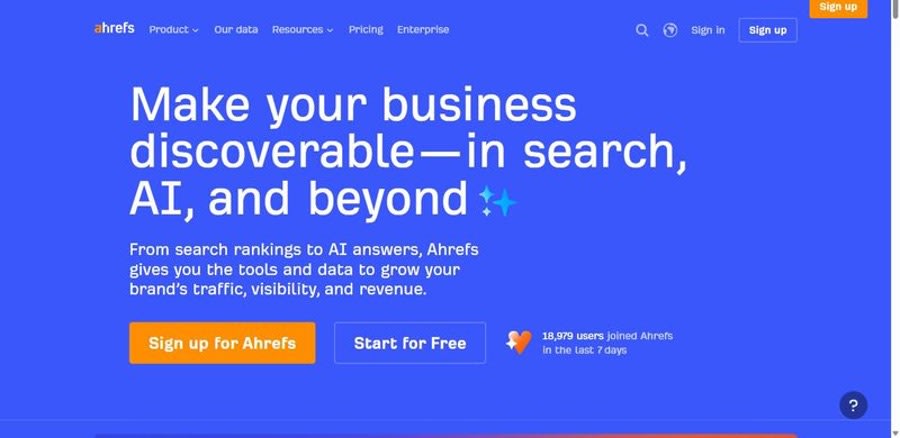
Ahrefs Brand Radar pairs a ready-made index of AI mentions and citations with own-prompt tracking.
Best for: teams benchmarking AI share of voice across a whole category.
Standout: The AI Visibility Index needs no setup: estimated impressions, AI share of voice, mentions, and citations from hundreds of millions of search-backed prompts on six platforms, with history back to 2025.
Pros:
- Shows fan-out queries, the response, and citations per custom prompt
- Lets you set cadence per platform: daily, weekly, or monthly
- Adds Claude for custom prompts
Cons:
- Re-tests the index monthly on a 90-day reporting window
- Bills custom prompts by checks (Claude uses 8 per update), with no discounts
Pricing: Custom prompt packages from $50/month; AI Visibility Index from $199/month; $699/month for all models; paid Ahrefs plans include a small daily prompt quota.
Shortlist call: Use it for category research: see who holds AI share of voice, then pick prompts worth daily tracking.
5. Similarweb AI Brand Visibility
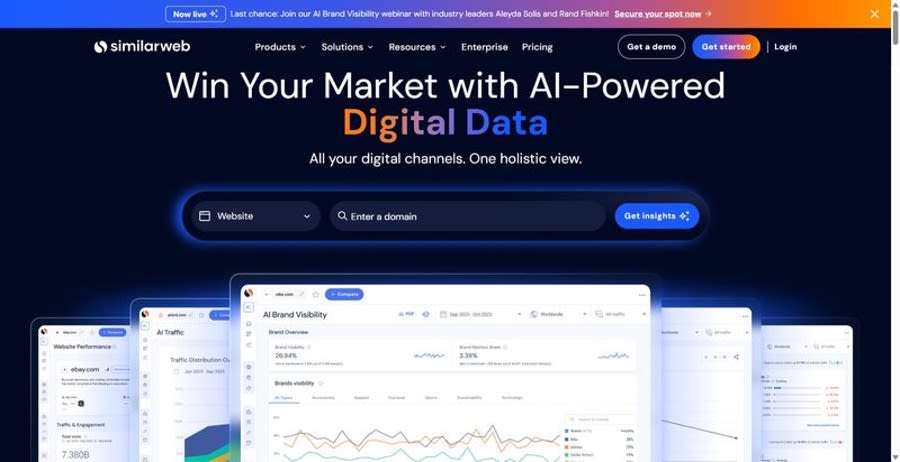
Inside Similarweb's AI Search Intelligence toolkit, AI Brand Visibility is the brand tracker, next to its AI traffic data.
Best for: in-house teams that report AI referral traffic beside visibility.
Standout: It reports daily visibility share by topic and prompt, Brand Mention Share against competitors, sentiment by topic, and citation analysis down to domain and URL. The wider toolkit also monitors AI-driven traffic from Grok, Claude, and Copilot.
Pros:
- Covers ChatGPT, Google AI Mode, Gemini, and Perplexity for visibility
- Updates the tracker daily
- Offers "Try it for free" on both tiers shown
Cons:
- Leaves billing basis and export options unstated on the product page
- Shows 1 user per tier, with 3 months of history at $99
Pricing: From $99 (billing basis not stated); a higher tier adds 6 months of history.
Shortlist call: Pick it when your readout has to connect AI visibility with actual visits from AI platforms, and confirm billing terms early.
6. Gauge
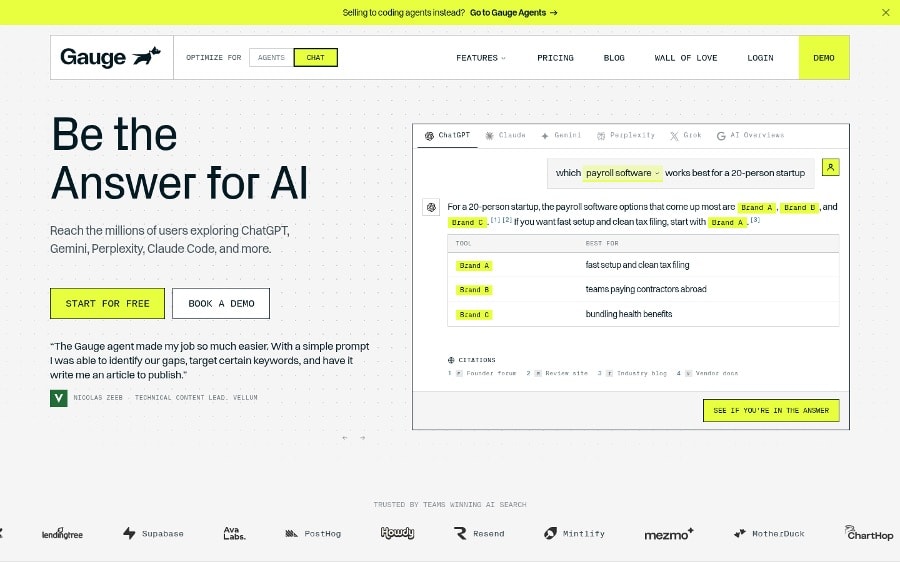
Gauge combines AI visibility tracking with a built-in content engine that turns the gaps it finds into drafted articles.
Best for: content-led teams that want visibility gaps turned into published articles.
Standout: The Growth plan checks 600 prompts every day on Gemini, ChatGPT, Microsoft Copilot, Perplexity, AI Mode, and Google AI Overviews, roughly 108,000 answers a month. Its content engine writes up to 18 articles monthly and publishes to Webflow, Framer, Sanity, or GitHub.
Pros:
- Allows unlimited domains and competitors on Growth
- Connects GA4, Search Console, and DataForSEO, plus MCP access
- Analyzes query fan-out and the citations behind each answer
Cons:
- Tracks a single location on Growth
- Requires your own Anthropic or xAI API key for Claude and Grok, billed by that provider
Pricing: Growth $599/month; Enterprise custom.
Shortlist call: The fit when the AEO budget doubles as a content budget and the team measures progress in published pages, not only in reports.
7. HubSpot AEO
Sold standalone or inside Marketing Hub, HubSpot AEO opens its recommendations in HubSpot's content tools.
Best for: in-house teams whose marketing stack and CRM already run on HubSpot.
Standout: Prompts are suggested from your company and CRM context. Each shows the exact response, citation analysis splits sources by domain and content type, and prioritized recommendations (a new page, an update, or outreach) open in Marketing Hub's content tools.
Pros:
- Updates the visibility score daily
- Scores sentiment from -100 to +100 alongside share of voice
- Offers a free 25-prompt trial, no credit card needed
Cons:
- Names ChatGPT, Gemini, and Perplexity only; Google's AI surfaces aren't listed
- Charges each extra brand as a separate $50/month instance; market settings aren't stated
Pricing: $50/month standalone ($45/month billed annually); Marketing Hub package shown at $900/month.
Shortlist call: Choose it over the other best AEO tools when recommendations must land where your content team works and ChatGPT matters more to your readout than Google's AI results.
8. LLMrefs
LLMrefs runs AI search analytics around keywords: you import them, and it generates the fan-out prompts behind each one.
Best for: SEO teams that plan in keyword lists and want them mapped to AI answers.
Standout: For each keyword, LLMrefs builds prompts from real conversations, then aggregates share of voice and position across those prompts. Every keyword shows cited source URLs and a monthly prompt-volume estimate, so the AI picture slots into a keyword plan.
Pros:
- Tracks 500 prompts across engines including Claude, Copilot, Grok, Meta, and DeepSeek
- Includes unlimited seats and projects on its single plan
- Provides API access and CSV exports
Cons:
- Refreshes each keyword in the dashboard at least once per week
- Generates prompts from keywords by design, so exact-prompt control is narrower
Pricing: $79/month (marked limited-time); 7-day free trial.
Shortlist call: Keyword-first SEO teams will find it among the best AEO tools if a weekly refresh suits the cadence leadership expects.
So What Is the Best AEO Platform for an In-House Search Team?
If AI visibility has its own owner, pick SE Visible: Gemini, ChatGPT, AI Mode, and AI Overviews on all plans, each metric opening into the answer behind it. For large businesses on BrightEdge or Semrush, the best AEO tool to test is that suite's AI layer.
Of the best AEO tools, skip LLMrefs if leadership expects daily movement (refresh: at least weekly), and HubSpot AEO if AI Overviews and AI Mode lead (it names neither).
Try SE Visible on your team's own prompts before the demos.
Two More Questions Before You Shortlist
Two questions follow "what are the best tools for answer engine optimization?"
What is the difference between AEO and SEO?
SEO targets rankings and clicks. AEO gets your brand named, described accurately, and cited inside generated answers. The same content feeds both, but you measure prompts, mentions, citations, and sentiment instead of SERP positions.
Are keyword research tools enough for AEO?
Keyword research tools for AEO are a start: they show demand, but answer engines field longer questions, so keywords become prompts. LLMrefs generates prompts from keywords; SE Visible groups your prompts by topic and intent.
Want to publish a guest post on aamax.co?
Place an order for a guest post or link insertion today.
Place an Order