

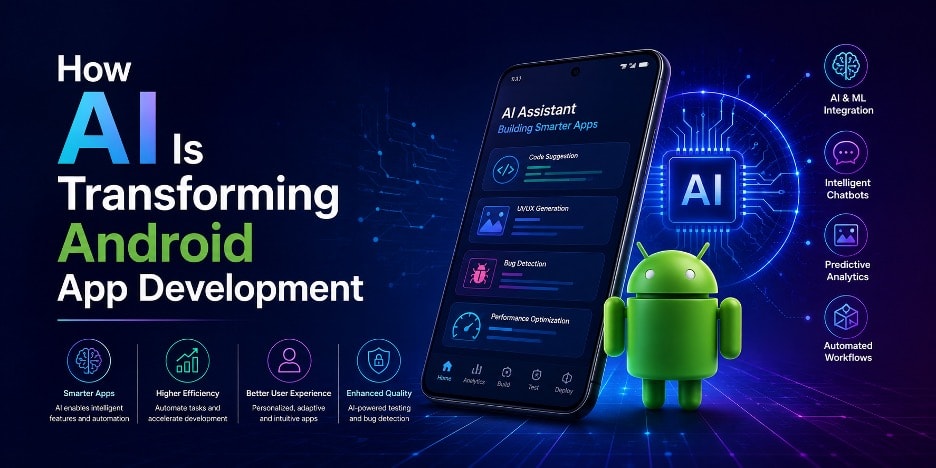
How AI Is Transforming Android App Development
The business world has experienced a complete transformation because artificial intelligence (AI) now controls all aspects of mobile application development and maintenance and enhancement. The development of Android applications faces major transformations because AI-based systems allow developers to create intelligent applications that operate at higher speeds and deliver tailored user experiences. Businesses now use AI to automate their coding work while they leverage this technology to develop mobile solutions that adapt to their evolving customer needs.
Multiple business sectors have started using AI-based applications to boost their operational efficiency while they reduce operational complexity and obtain market advantages. The Android operating system supports multiple devices and users, so mobile developers now use AI as their main strategy to achieve digital growth.
1. Faster and More Efficient Development
The main benefit that AI brings to Android application development involves developers achieving better productivity results. Developers spend most of their time writing code and debugging errors and running tests and keeping their software applications operational. The development teams can achieve better operational results through AI-powered tools, which help them perform their work activities.
AI coding assistants provide users with code suggestions and programming logic explanations and error detection and task automation capabilities. The platform enables developers to concentrate on application structure development and business requirement implementation through creative problem-solving techniques.
AI systems assist project planning through their ability to analyze team requirements and detect potential technical obstacles during the planning process. Intelligent tools help developers achieve their work through automated systems, which shorten their development cycles while maintaining the need for human expertise.
The business sector experiences three major benefits from these enhancements because they enable organizations to finish their projects at a faster pace while using their resources more effectively and achieving better results in their development operations.
2. Personalized User Experiences
Modern users expect applications to understand their preferences and provide relevant experiences. AI systems enable personalization through their ability to analyze user activities and preferred choices and standard behavioral actions.
Shopping applications use browsing data to generate product recommendations while entertainment platforms show content suggestions based on users' previous viewing habits. Fitness applications provide users with personalized workout plans through their system, and travel applications suggest destinations that match users' personal preferences.
Developers of Android devices may incorporate models of machine learning and systems for recommendations, thus providing relevance to experiences. Personalization of features leads to better customer satisfaction, more active engagement, and the creation of the desire for clients to come back to the application.
3. Intelligent Automation and Smart Features
Artificial intelligence gives Android applications an opportunity to accomplish tasks that previously required meticulous manual work. Indeed, such functions as chatbots, voice, image recognition and predictive analytics will make the applications more useful and convenient.
One may take customer service applications as an illustration where chatbots serve clients by answering common questions all day long. Banking applications can use the abilities of AI to detect strange transaction patterns. Online applications in the area of logistics will use the information in their operational activity in order to plan their delivery process.
Voice detection helps the user engage with apps by speaking. With the help of picture detection, users will easily scan written material, find items, and learn something useful from photos. Businesses can minimize repetitive labor and make their digital services more competent with the use of suitable AIs. The successful integration of the technology purposefully performs better than otherwise.
4. Better Testing and Quality Assurance
AI-powered tools can analyze how applications do function and discover patterns describing bugs. Some of these tools are capable of performing the automated interface testing.
Taking advantage of predictive analysis, teams can reveal components that are more likely to fail based on the history of failures. After that, programmers need to correlate the testing in relation to certain functions of the product.
However, AI cannot effectively substitute thorough reviewing. Human proofreading, security checking, accessibility testing, and real device testing are necessary for proper performance.
5. Stronger Security and Fraud Detection
Machine learning has the capacity of analyzing transaction patterns, login attempts, and other indicators in order to identify fraudulent behavior. Accordingly, the application will take measures that could include asking for additional information for verification or alerting security.
The use of AI can also enable developers to identify the vulnerabilities of their source codes during the period of development. When combined with the practices of encryption, reliable authentication, and updates of software, this capability can lead to the implementation of better security methods.
However, there is still a risk that AI can be unable to notice some threats or can wrongly identify them as fraudulent activities. Therefore, it is necessary to constantly check the quality of functioning of AI and maintain the security controls that have been established previously rather than relying fully on automatic detection.
6. Improved Performance and Maintenance
The system determines repeated issues through its analysis of crash reports and usage data and performance statistics. Organizations can use predictive maintenance to identify equipment failures, which will stop users from accessing systems.
AI systems detect unneeded processing and network operations, which enables them to optimize resource management. The way on-device AI processing works determines its ability to decrease data transmission requirements while boosting system response speed.
The developers need to track memory consumption and battery usage and network performance and device support to stop AI features from creating problems with application operation.
7. The Importance of Custom Android Development
Organizations must handle their distinct business objectives together with their operational needs and customer service standards. A custom Android app development company helps businesses select proper AI technologies while they select development frameworks and add intelligent features to their applications.
Experts can help evaluate which types of applications—chatbots, recommendations, prediction tools, or document processing systems based on AI would work well for any business. Also, they would be able to identify whether AI processing should be conducted either on the device, in the cloud, or using the combination of these approaches.
Planning is a critical step that can help businesses control implementation expenses and ensure high-quality data, privacy issues, and application maintenance. The implementation of an application should result in using artificial intelligence to solve real-life problems and bring some benefits.
8. Future Trends in AI-Powered Android Applications
The future of Android application development will include increased usage of generative AI, on-device AI, intelligent automation, and other aspects. Generative AI may be used for providing conversational assistance, content generation, and natural language interactions.
The on-device approach to implementing AI can allow particular functions to perform faster and not depend so much on internet connection. Depending on the technology, it may also help avoid transferring any sensitive data to remote servers.
However, there is still work to do regarding data security, algorithmic bias, transparency, and reliability of generated data.
Conclusion
With respect to Android app development, AI is changing the game through increased productivity, enhanced personalization, automation of routine tasks, improved security measures, and increased efficiency of applications.
There are a number of requirements when it comes to implementing AI into the process of app development, namely, proper planning, accurate data, strong security measures, and constant assessment of results. It is essential for a business to define particular issues in order to find the right technologies to address those.
Collaboration with a custom Android App Development Company can assist an organization in harnessing AI opportunities and developing mobile applications. As technology keeps advancing, businesses that will successfully blend intelligent automation, user experience, and an ethical approach to development will have a greater chance of developing quality Android applications.
Want to publish a guest post on aamax.co?
Place an order for a guest post or link insertion today.
Place an Order