

AI in Retail Industry: Use Cases, Costs & 2026 Trends
Retail AI Is Past the Pilot Stage
NVIDIA's third annual retail and CPG survey, published in January 2026, found that 47% of respondents were already using or assessing agentic AI. That suggests AI in retail industry operations has moved from slide decks into production systems. The useful question is no longer whether to adopt AI. It is where a model earns its keep and where it quietly burns budget. If you are scoping a build, a seasoned artificial intelligence app development company can pressure-test the plan before you commit spend. This post covers the use cases with the clearest payoff, the trade-offs that catch teams off guard, and the mistakes that repeat from one project to the next.
Key Takeaways
Forecasting and inventory usually pay back before flashy shopper-facing features.
Generative AI works best when grounded in your own catalog and policies.
Clean, well-structured data matters more than model choice.
Most stalled projects fail on integration and ownership, not on algorithms.
How AI Is Changing the Retail Industry on the Sales Floor
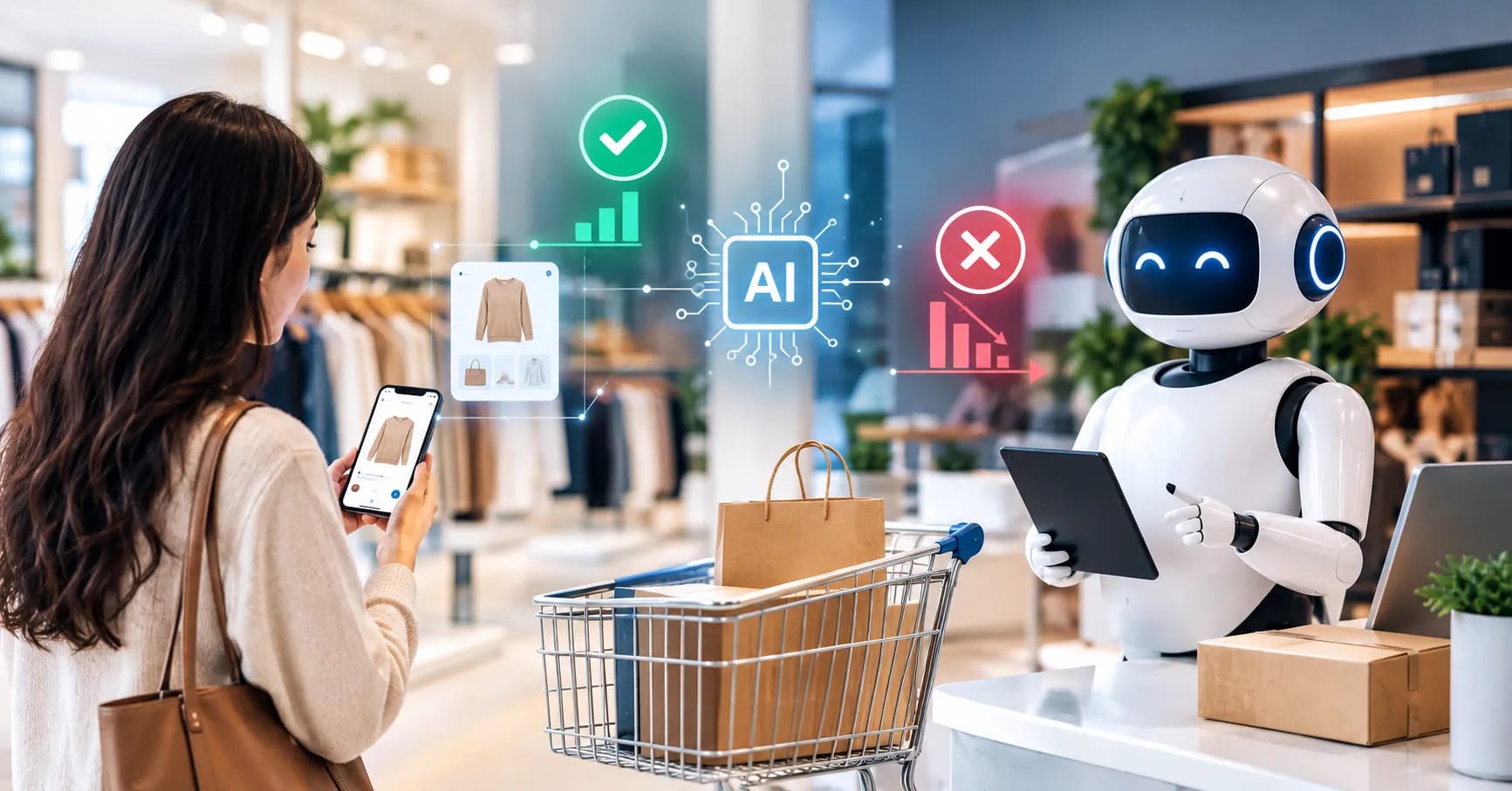
Shopper-facing AI is the most visible change. Recommendation engines have moved past "customers also bought" and now weigh browsing sessions, basket composition, and local availability. Visual search lets a shopper photograph a jacket and find close matches in your catalog. In stores, camera-based shelf monitoring flags gaps before a human walks the aisle.
The trade-off is trust. Personalization that feels helpful in one context feels intrusive in another, and dynamic pricing can backfire if customers spot inconsistencies between channels. New shoppers also have no history, so recommendations for them lean on popularity, and popularity alone is rarely persuasive. I'd start with one surface, such as search or product pages, measure conversion against a holdout group, and only then extend the approach to email or the app.
Demand Forecasting and Inventory: The Quiet Winner
If I had to pick one starting point for most retailers, it would be forecasting. It isn't glamorous, but a better number at the SKU-store level ripples into purchasing, staffing, and markdown decisions.
Modern approaches combine historical sales with promotions, weather, local events, and price changes. Gradient-boosted trees and time-series libraries such as Prophet are common starting points, and they are easier to debug than deep models. For retailers managing apparel and textile-based products, AI solutions for textile manufacturing can also improve upstream visibility by connecting production signals with demand planning. Measure with weighted absolute percentage error (WAPE) rather than a single overall average, because averages hide the products that matter.
The catch is perishables and fashion. Short shelf life and short product life cycles mean little history exists, so models need attributes such as category, price tier, and season to borrow strength from similar items.
Generative AI for Product Content and Shopper Help
Most generative AI in the retail industry starts with product copy, catalog enrichment, and conversational shopping assistants. A model can turn a supplier spec sheet into consistent descriptions across thousands of listings, or answer sizing and returns questions in plain language.
The risk is confident inaccuracy. An assistant that invents a return policy creates a real customer-service problem. Grounding helps: retrieval-augmented generation (RAG) pulls answers from your catalog and policy documents instead of the model's general memory. Add human review for new categories and log every answer so you can audit failures.
Brand voice is the other hurdle. Generic output reads like everyone else's, so give the model tone guidelines and approved examples, and edit the first few hundred outputs by hand.
Data Readiness Comes Before Any Model
Every retail AI project I'd trust begins with unglamorous data work. Product taxonomies are inconsistent, the same item may carry different IDs across ERP and e-commerce systems, and returns often sit in a separate system altogether.
Expect this to take longer than the modeling itself. Validation tools such as Great Expectations can catch schema drift and missing values before they poison a forecast. For seasonal categories, plan on at least a full year of clean transactions so the model sees a complete cycle.
Results also need context. In the same survey, 89% said AI was helping increase annual revenue and 95% said it was helping decrease costs, as covered in NVIDIA's 2026 State of AI in Retail and CPG survey coverage. Those are respondent-reported outcomes, not audited results, so treat them as directional and judge your own project by your own numbers. Retail Technology Innovation Hub
Integration, Cost, and Trust Trade-Offs
A model that works in a notebook still has to talk to your POS, inventory, and CRM systems. Latency matters for on-site search and chat, while forecasting can run as an overnight batch. Deciding which is which early keeps infrastructure costs sensible.
Inference cost is the surprise line item, especially for conversational features with long prompts. Caching common answers and routing simple questions to smaller models keeps spend predictable. As a rough planning estimate, not a benchmark, I'd budget a pilot of eight to twelve weeks with a clear success metric agreed before launch.
Trust also needs design. Tell shoppers when they are talking to an AI, collect only the data the feature needs, and give them an easy path to a human.
Build, Buy, or Blend: A Practical Checklist
Choosing between a vendor tool and a custom build is where many teams lose months. Use this checklist before deciding:
Is the use case a differentiator? If it is, such as your own personalization logic, lean toward custom. If it is a commodity, such as basic chatbot FAQs, buy.
Do you own the data it needs? Custom models only beat off-the-shelf ones when trained on data competitors don't have.
Who maintains it after launch? Models drift as assortments and seasons change. If nobody owns retraining, buy.
Can it fit your existing stack? A tool that needs a rebuilt data pipeline costs more than its license suggests.
What is the exit cost? Check data portability before signing, because switching later is painful.
Commonly, the best answer for AI in the retail industry is a blend: buy the plumbing and build the parts customers actually notice.
Mistakes That Stall Retail AI Projects
Starting with the technology, not the decision. "We need a chatbot" is a tool. "We need to cut stockouts on our top 200 SKUs" is a goal.
Skipping a baseline. Without a simple benchmark, such as last year's forecast or current search conversion, nobody can prove the model helped.
Ignoring store and merchandising teams. If planners don't trust an output, they override it, and the model never improves.
Launching without monitoring. Assortment changes and promotions shift the data, and accuracy erodes quietly without drift alerts.
Final Thoughts
Retail results don't start at the shelf. For apparel and home goods, they start upstream, where fabric is planned, produced, and inspected. Better demand signals help little if the mill can't respond, which is why retailers should also pay attention to how AI is being used across their supply chains.
The pattern across every section above is the same: start narrow, fix the data, measure against a baseline, and keep a human accountable. Retail AI rewards that discipline more than it rewards ambition. My most practical advice is to track forecast error on your top 20% of SKUs first, because that is where a wrong number costs the most.
Want to publish a guest post on aamax.co?
Place an order for a guest post or link insertion today.
Place an Order