

7 Important SEO KPIs to Track Website Performance
SEO has changed significantly over the past few years. But some website owners are still tracking the same old metrics they have tracked for a long time. The problem is that those metrics no longer tell the full story of how a website is actually performing in search today.
According to recent data, 60% of consumers abandon purchases due to poor website user experience. And in most cases, the website owner had no idea there was even a problem.
In this blog, we will look at 7 important and relevant SEO KPIs with today's search trends that every website owner should track regularly.
What Are SEO KPIs?
SEO key performance indicators (KPIs) are measurable metrics that you can track to check the performance of any site in search engines.
The reason they are called "key" performance indicators is that not every metric matters equally. There are hundreds of data points available in tools like Google Analytics and Google Search Console. But only a few of them directly reflect the health and progress of your SEO strategy. Those are your KPIs.
Tracking these KPIs will help you to
- Monitor and assess performance
- Evaluate present SEO activities
- Make decisions based on data
- Show the ROI to stakeholders
Which KPIs you track will depend on your website and your goals. For instance, organic traffic is the number of visitors you get from search engines. Keyword rankings show you where your pages appear in search results. But there are some SEO KPIs that are important for almost every website and should be monitored regularly.
AI Visibility
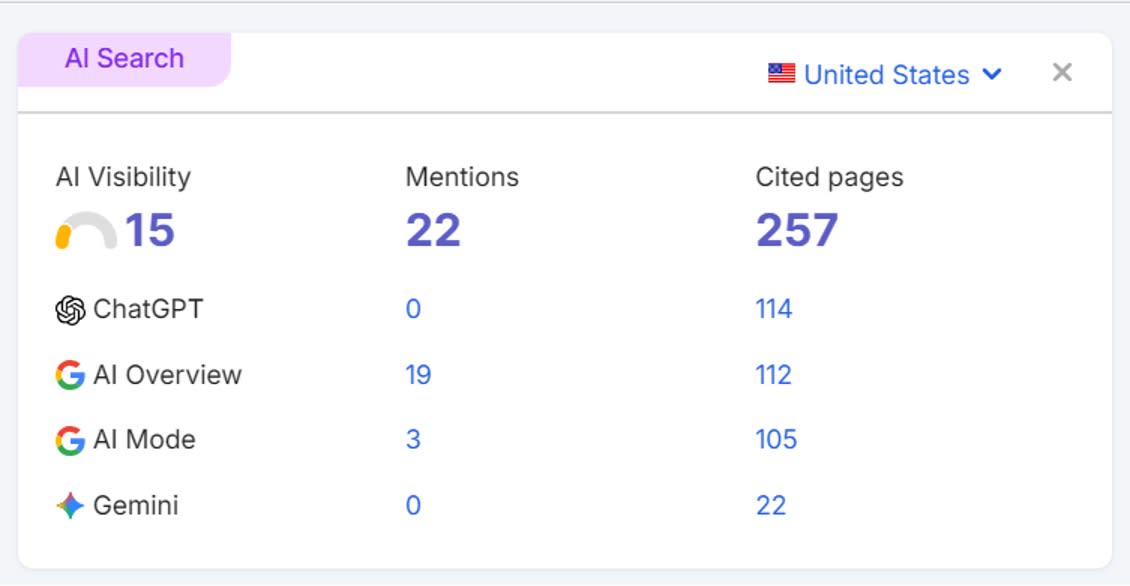
People don’t just get information from traditional search anymore. They use modern AI tools like ChatGPT and Claude that provide direct answers to their questions. Therefore, tracking AI visibility is one of the most important new KPIs in SEO. This means tracking how often your brand is mentioned in AI generated answers, citations and recommendations.
You can track the referral traffic on your site's Google Search Console. You can use SEO tools like Semrush to track AI visibility. Here is an example:
Domain Authority
Backlinks are still considered one of the most important ranking factors in SEO. The more quality backlinks you have, the more powerful your site becomes in search results.
While DA is not used by Google for rankings, many SEO professionals track it to measure backlink growth and compare authority against competitors.
Domain authority is a third party metric developed by Moz that predicts a website’s authority based largely on its backlink profile. It’s scored on a scale of 0 to 100. In general, a higher DA score indicates a stronger backlink profile.
You can check the DA score of your website using any reputable DA checker tool. One such popular tool is Prepostseo's DA checker. This tool provides you with the domain authority score, page authority score, spam score, and domain age in one click.
Organic Traffic
This is the total number of visitors on your site coming directly from the search engines like Google and Bing.
Organic traffic is one of the most direct KPIs for the growth of any website. If it is increasing over time, that means your website is growing. Your content or services provide value to the users. But if it is not, then there is an issue. That may be in user experience, low quality content or services, or any technical fault in your site.
You can track the total clicks on your site in the "Performance" tab in your Google Search Console. In GCS, go to the Performance tab and click on the “Search Results." Here, select “Total clicks” to see the total number of visitors to your site in a selected time period.
Voice Search Performance
Voice search has seen significant growth in recent years. People use Siri, Google Assistant, and Alexa to search for information instead of typing. Also, voice search queries are significantly different from typed ones. Users ask long queries, mostly in question form. And they use a conversational style.
For example, instead of typing "best SEO tools", a voice search user would say
“What are the best SEO tools for small businesses?”
So voice search metrics have become an important SEO KPI.
In your Google Search Console data, check for long tail conversational keywords to track voice search performance. See which question based queries are sending traffic to your site. Questions that begin with “what”, “how”, “where” and “why” are good indicators of voice search traffic. If you don’t see those queries in your data, your content may not match the way people talk about their searches.
Core Web Vitals
Core Web Vitals are performance metrics used by Google to measure a website’s user experience. Google made them an official ranking factor in 2021. So they are not just technical metrics anymore. They impact your pages' position in search results.
Core Web Vitals comprises three metrics. Largest Contentful Paint measures the speed at which the main content of a page loads. Interaction to Next Paint measures how quickly the page responds to user clicks or taps. And the Cumulative Layout Shift tells you how stable the page layout is while it is loading.
Visitors will leave before reading anything if your pages take too long to load or the layout changes while loading. And if visitors leave quickly, it sends a negative signal to Google about the quality of your page. Core Web Vitals can be reviewed in Google PageSpeed Insights.
User Engagement Metrics
Ranking on the first page is not enough if visitors leave your website within seconds. This can be tracked using user engagement metrics. They tell you what visitors actually do after landing on your site.
Bounce rate, session duration, and pages per session are the most important to track. Bounce rate shows the percentage of visitors who left after viewing only one page. Session duration indicates how long they were on your site. And pages per session is the number of pages they browsed in one visit.
In Google Analytics, you have all these metrics together. Keeping an eye on them regularly will help you know which pages are engaging visitors and which ones are losing them rapidly.
Organic Click-Through Rate
The organic CTR is the percentage of people who see your page in search results and then click on the page. Google Search Console shows you CTR of every page of your website. If a page has a high impression count and low CTR, it means people are seeing it in results but not clicking on it. And that’s a straight loss of potential traffic.
One of the main reasons for a low CTR is a poor title tag. If your title isn’t clear to the reader about what they get when they click, they’ll scroll past it. Meta descriptions also count. A meta description that is clear and specific gives the reader a reason to click.
So checking CTR regularly helps you find out which pages need better titles and descriptions before you look at other SEO fixes.
Final Words
SEO requires consistent monitoring and adjustments based on real data. And SEO KPIs help you with this.
Tracking the right KPIs will tell you where your strategy is working and where it needs to improve. One thing to keep in mind is that SEO takes time. After you make changes, don’t expect instant results. Allow time for your updates to appear in the data before making further changes.
Also, do not measure too many KPIs at one time. Choose the ones that matter most to your current goals. Improve them, focus on them, and increase your monitoring as your website grows.
Want to publish a guest post on aamax.co?
Place an order for a guest post or link insertion today.
Place an Order