

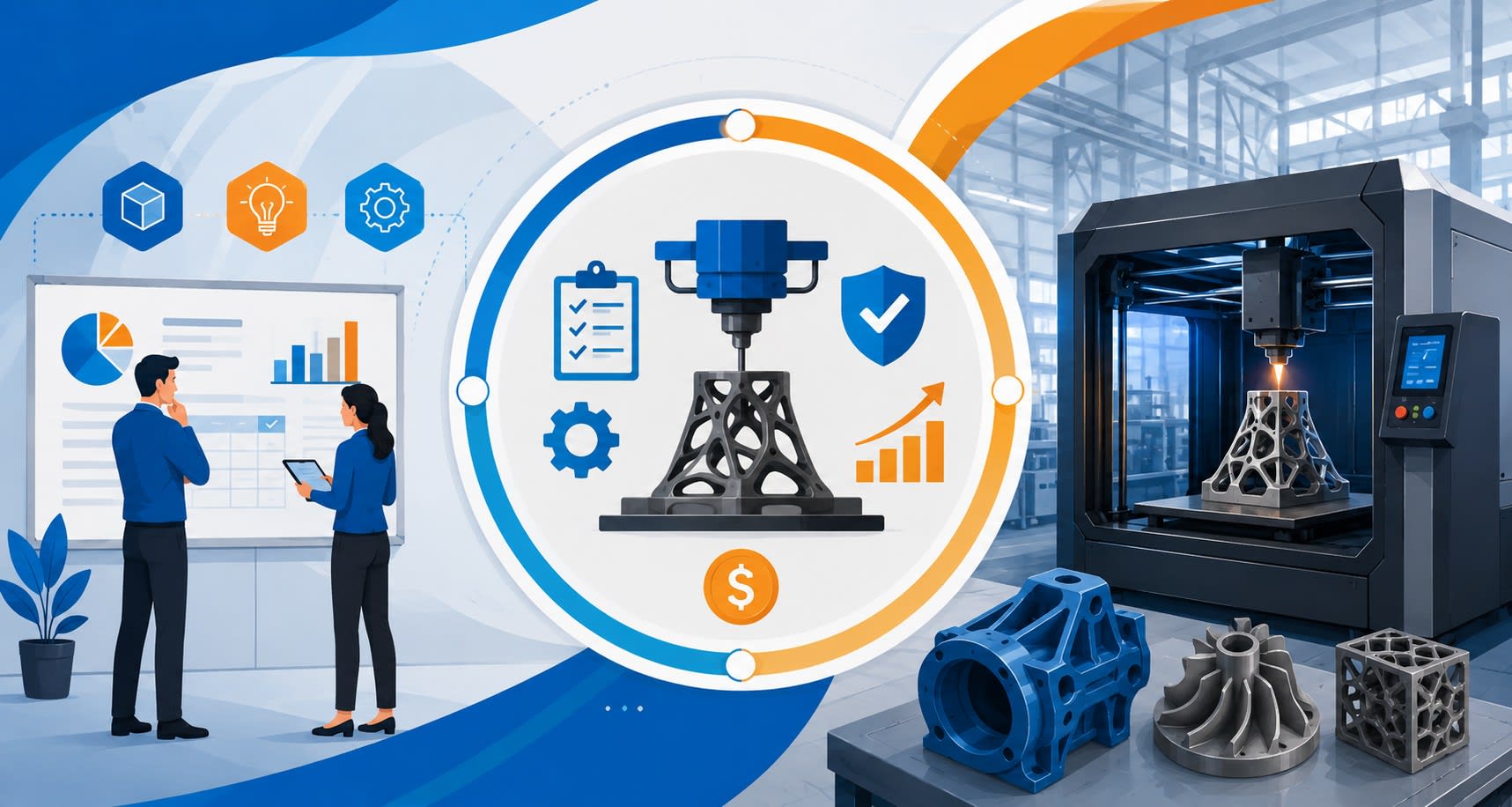
What Businesses Should Know Before Investing in Industrial 3D Printing
Industrial 3D printing is no longer just a tool for large factories or tech companies. Businesses across many industries are using it to create parts faster, lower production costs, and improve product design. But before making the investment, there are important things to understand. From equipment costs and material choices to production speed and long-term value, every decision can affect results.
Companies that plan carefully can gain a strong advantage, while those that rush may face unexpected challenges. Understanding how industrial 3D printing fits into your business goals is the first step toward making a smart and profitable investment for future growth and success.
Assessing the Value: Industrial 3D Printing Cost-Benefit Analysis
Any serious industrial 3D printing cost-benefit analysis needs to happen well before purchase orders get signed. The financial picture here is far more layered than whatever number appears on a machine's spec sheet.
Quantifying Savings vs. Upfront Costs
Capital expenditure for industrial systems can swing from tens of thousands to several million dollars. That's before you account for materials, operator training, facility upgrades, and ongoing maintenance. None of these are surprises; they're entirely predictable if you plan honestly and plan early.
Factoring Efficiency, Waste Reduction, and Inventory Benefits
Additive manufacturing cuts material waste significantly compared to traditional subtractive methods. Jabil and PTC survey data consistently highlight just-in-time production and digital inventory as standout operational wins, especially for businesses using custom 3d printing solutions to improve efficiency and reduce delays. Think about it, maintaining digital part files rather than warehousing physical components reduces storage costs in ways that quietly add up year over year.
Calculating Long-Term ROI and Competitive Edge
Rapid prototyping compresses time-to-market dramatically. Supply chain resilience improves because you're no longer dependent on single-source suppliers who can hold your timelines hostage. And customization at scale? It becomes genuinely viable financially, something traditional manufacturing simply can't match cost-effectively at most volumes.
Once the financial picture becomes clearer, it's worth stepping beyond the numbers entirely.
Unlocking Competitive Advantages with Industrial Additive Manufacturing
The industrial additive manufacturing advantages run deeper than production speed. They touch on design freedom, supply chain architecture, and how flexible your business model can realistically become.
Exceptional Design Freedom and Materials Range
Complex geometries, internal lattice structures, high-performance polymers, and metals are all achievable. Traditional manufacturing forces design compromises constantly. Additive manufacturing removes many of those constraints outright, and that freedom compounds across product iterations.
Speed and Flexibility for Modern Business Needs
On-demand part production means minimum order quantities stop dictating your decisions. Distributed manufacturing becomes viable, letting companies produce closer to end markets. That kind of operational flexibility, the ability to pivot without penalty, is a genuine competitive differentiator in volatile markets.
Consolidation of Assemblies and Lean Inventory
Parts that previously required multiple components and assembly steps can often print as a single unit. Simpler bill of materials. Less assembly labor. Tighter quality control across every production run. These aren't marginal gains; they compound.
Understanding the advantages is genuinely exciting. But realizing them requires more than purchasing a machine and hoping for the best.
Preparing for Success: Industrial 3D Printing Readiness
Industrial 3D printing readiness isn't solely about equipment procurement. It's about your entire operational environment being prepared for a fundamentally different production paradigm.
Facility and Safety Requirements
Powder-based systems require proper ventilation, inert gas handling, and established PPE protocols. Facility layout must accommodate machine footprints, post-processing stations, and safe material storage. And this isn't optional, NIOSH confirms that additive manufacturing technologies pose potential hazards to users.
SS-disciplinary training models combining mechanical engineering knowledge with digital design skills consistently outperform narrow operator training. Critically, workflow redesign should happen before equipment arrives, not be scrambled together afterward.
Integrating Production and Data Systems
Embedding additive manufacturing into existing ERP and PLM systems prevents data silos from quietly forming. Cloud-based digital inventory platforms and Manufacturing as a Service models are making this integration increasingly accessible for mid-sized businesses without enterprise-level IT budgets.
Once the operational groundwork is genuinely in place, the smartest move is to look ahead at where this industry is actually heading.
Emerging Trends Industrial 3D Printing Businesses Should Know
The industrial additive manufacturing space moves fast. Investing in industrial 3D printing today means keeping pace with innovations that could redefine your competitive positioning within just a few years, ready or not.
Compact Industrial Metal Printers and Democratization
Scrap Labs recently introduced a bench-top laser powder bed fusion system priced around $9,600. That price point signals genuine democratization; metal printing is no longer exclusively accessible to large manufacturers with deep capital reserves. Smaller operations, take note.
Advanced Applications: Rocket Propellants and Materials Science
Startups are successfully testing 3D-printed rocket fuels at pressures exceeding 1,800 PSI using new RX-AM processes. Sounds distant from commercial manufacturing? The underlying materials science breakthroughs will filter into industrial applications faster than most people anticipate.
Cybersecurity and IP Risks in Industrial AM
Side-channel attacks on industrial printers are an emerging and underappreciated threat. Compromised digital part files mean your intellectual property walks out the door, without a trace. IP protection strategies must be built into your AM program from day one, not retrofitted after something goes wrong.
These trends signal real opportunity. But capturing that opportunity demands deliberate, phased execution.
Pilot Programs and Small-Scale Validation
Start with one clearly defined use case, preferably something with measurable baseline data already established. This generates proof points that justify broader investment internally, without requiring anyone to take the leap on faith alone.
Measuring KPIs: Lead Time, Costs, Quality, Throughput
Set benchmarks before the pilot begins. Without baseline data, you genuinely cannot demonstrate improvement, and that makes internal advocacy for scaling almost impossible. Track lead time, per-unit cost, defect rates, and throughput simultaneously.
Scaling Thoughtfully: Hybrid Workflows and MaaS
Blending traditional and additive manufacturing in hybrid workflows frequently delivers better economics than full replacement. MaaS platforms let businesses access capacity without carrying full ownership overhead, a practical middle path worth serious consideration.
Frequently Asked Questions
Do I need an LLC for a 3D printing business?
Starting an LLC for your 3D printing design business carries real benefits. Most importantly, an LLC structure provides limited liability to its owners, protecting personal assets from lawsuits and creditors.
What makes a business ready for investing in industrial 3D printing?
Readiness means that facility infrastructure, trained staff, and integrated data systems are all in place before purchase. Businesses that align all three beforehand consistently outperform those scrambling to catch up after equipment arrives.
Why invest in industrial 3D printing versus outsourcing?
Outsourcing works short-term but limits design control, IP security, and response speed. In-house industrial additive manufacturing advantages compound over time as your team builds genuine process expertise and tighter iteration cycles.
What are the hidden costs of industrial 3D printing for business?
Post-processing, material storage, software licensing, and ongoing calibration are routinely underestimated. A thorough industrial 3D printing cost-benefit analysis must capture all operational expenses, not just hardware acquisition.
How can companies protect their IP when scaling industrial additive manufacturing?
Encrypt digital part files, restrict network access to printing systems, and audit vendor security practices regularly. As industrial 3D printing readiness evolves across your organization, cybersecurity protocols must evolve alongside it, not lag behind.
Industrial 3D Printing Investment
Bringing additive manufacturing in-house touches finance, operations, workforce, and strategy simultaneously. That's not a reason to hesitate; it's a reason to plan deliberately. Understanding the full scope of industrial additive manufacturing advantages, alongside the real costs and preparation required, is precisely what separates successful adopters from organizations nursing expensive regrets.
Whether you're running your first industrial 3D printing cost-benefit analysis or finalizing a readiness checklist, thoughtful planning consistently pays off. The businesses treating this as a genuine strategic capability, rather than a procurement checkbox, are the ones quietly building durable competitive advantages right now. That could be you.
Want to publish a guest post on aamax.co?
Place an order for a guest post or link insertion today.
Place an Order