

What Are UK IP Scraper Proxies and How Do They Work?
A practical guide to collecting UK-specific web data accurately, efficiently, and responsibly.
Businesses run on data, and much of the most useful data is public on the web: product prices, search rankings, property listings, travel fares, job postings, and competitor promotions. But what a website shows often depends on where the visitor appears to be. A shopper in Manchester can see different prices, stock levels, and ads than a shopper in Berlin or New York. If your company works with the British market, you need to see the web the way UK users see it. That's where UK IP scraper proxies come in.
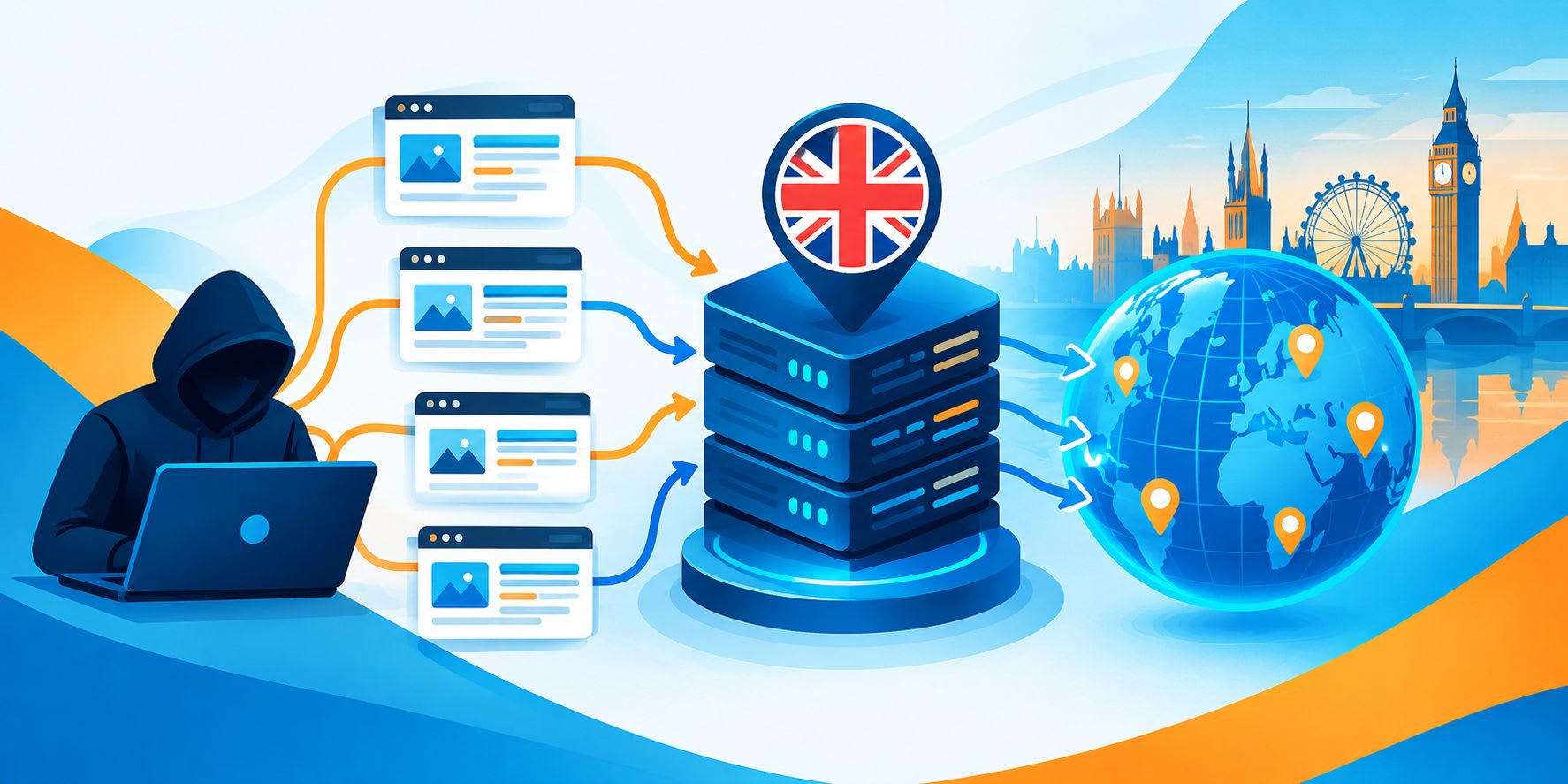
Put simply, UK IP scraper proxies are intermediary servers with IP addresses registered in the United Kingdom. Your scraping tools send their requests through these servers. To the target website, the traffic looks like it comes from a UK location, not from your own server or office. As a result, you get the localized content British users see, and you can spread a large volume of automated requests across many addresses.
What Is a Proxy, in Plain Terms?
A proxy is a middleman between your computer and the internet. Normally, your device connects straight to a website, and the website sees your real IP address. With a proxy, your request goes to the proxy server first. The proxy forwards it to the website, gets the response, and passes it back to you. The website only sees the proxy's IP address.
A scraper proxy is simply a proxy used for automated data collection, or web scraping. Scraping tools often send thousands or even millions of requests. Without proxies, all of that traffic would come from one IP address. Websites would quickly flag it as unusual and might throttle it, show CAPTCHAs, or block it.
How UK IP Scraper Proxies Work Step by Step
- Configuration: You add the proxy details (host, port, and login credentials or an IP whitelist) to your scraping tool, browser automation framework, or HTTP library.
- Request routing: When your scraper requests a page, the request goes to a proxy server located in the UK instead of straight to the target site.
- Geo-identification: The target website checks the incoming IP address, sees that it's registered in Great Britain, and serves the UK version of its content: prices in pounds sterling, local search results, and region-specific offers.
- Response delivery: The proxy passes the page back to your scraper, which extracts and stores the data you need.
- Rotation: In many setups, the IP address changes per request or at set intervals. This spreads traffic across a pool of addresses and reduces the chance of hitting rate limits.
Types of UK Proxies for Scraping
Datacenter Proxies
Datacenter proxies run on servers in professional data centers. They are fast, stable, and affordable, which makes them a strong choice for high-volume tasks such as price monitoring, SEO rank tracking, and collecting public catalog data. Their consistent speed and uptime suit scheduled scraping jobs that must finish on time.
Residential Proxies
Residential proxies use IP addresses that internet service providers assign to real households. They look like ordinary home users, which helps on websites with strict anti-bot systems. They usually cost more and can be slower than datacenter options.
Mobile Proxies
Mobile proxies route traffic through cellular networks such as 4G or 5G. They are useful for checking mobile-specific content and apps, but they are typically the most expensive type.
Common Use Cases
- E-commerce price intelligence: Track competitor pricing, discounts, and stock across UK retailers such as marketplaces and supermarket chains.
- SEO monitoring: Check how your pages rank on Google.co.uk for British search queries, without the results being skewed by your own location.
- Ad verification: Confirm that your campaigns display correctly to UK audiences and spot fraudulent placements.
- Market research: Gather public data on property listings, job postings, reviews, and travel fares in the UK.
- Localization testing: Check that your own website serves the right currency, language variants, and legal notices to British visitors.
Benefits of Using UK IP Scraper Proxies
The main benefit is accuracy. Data collected from a UK IP shows what British customers actually see. The second is scale: spreading requests across many IPs lets you collect more data without overloading a single address. Third, proxies add a layer of privacy by keeping your infrastructure's real IP addresses hidden. Finally, good proxy providers give you reliability, with high uptime and fast response times that keep data pipelines running smoothly.
Tips for Choosing the Right Provider
- Check that the IPs are actually located in the UK and are accurately geolocated.
- Look for flexible rotation options and support for both HTTP(S) and SOCKS5 protocols.
- Compare speed, uptime guarantees, and concurrency limits.
- Read the pricing model carefully, whether it charges per IP, per gigabyte, or by subscription.
- Choose a provider with responsive customer support and clear documentation.
Scraping Responsibly
Proxies are a tool, and using them well means following the rules. Collect only publicly available data. Respect each website's terms of service and robots.txt guidelines. Avoid sending so many requests that you strain a site's servers. Handle any personal data in line with the UK GDPR and the Data Protection Act 2018. Responsible scraping protects your business legally and keeps the web healthy for everyone.
Conclusion
UK IP scraper proxies let businesses see the British internet as local users do. They route requests through UK-based IP addresses, so you can collect accurate, localized data at scale while keeping your operations stable and private. With the right proxy type, a reliable provider, and responsible practices, you can turn public web data into a real competitive advantage in the UK market.
Want to publish a guest post on aamax.co?
Place an order for a guest post or link insertion today.
Place an Order