

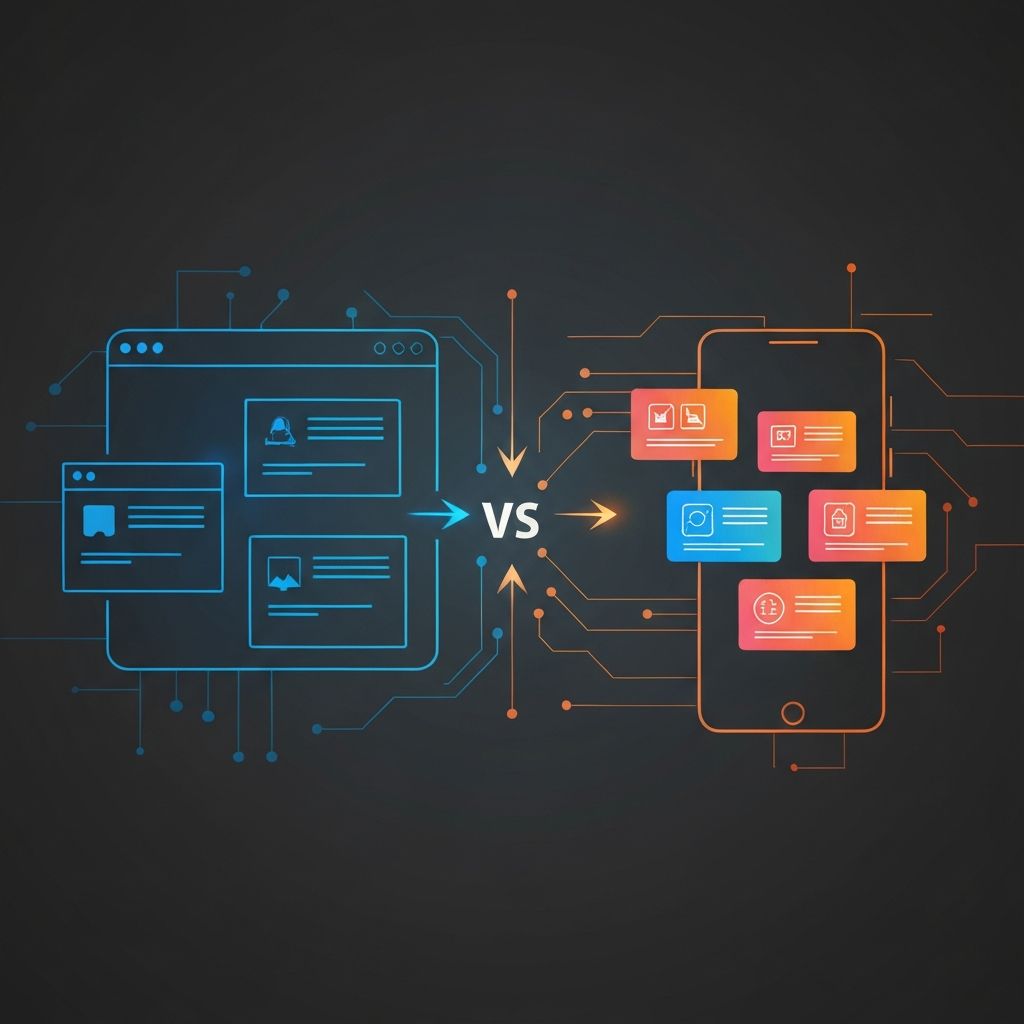
Web vs App Development
Web vs App Development: A Practical Comparison
One of the most common questions business owners ask us is whether they should invest in a website, a mobile app, or both. The answer depends on your audience, goals, budget, and the type of value you provide. At AAMAX.CO, we help clients make this decision every week, so this guide breaks down the differences in plain terms and shows how each option fits into a modern digital strategy.
What Is Web Development?
Web development is the process of building websites and web applications that run inside a browser such as Chrome, Safari, or Edge. Web projects range from simple marketing sites to complex SaaS platforms with logins, dashboards, and real-time features. Because they live on the open web, they are accessible from any device with a browser and an internet connection.
Web projects can be relatively simple brochure sites or full-featured platforms. Our Web Application Development team builds advanced web apps that handle authentication, billing, integrations, and rich user interfaces.
What Is App Development?
App development typically refers to building native mobile applications that run on iOS or Android. These apps are downloaded from app stores, installed on a device, and can take advantage of features like push notifications, biometric authentication, GPS, camera access, and offline functionality.
Native apps are built with platform-specific languages such as Swift for iOS and Kotlin for Android, while cross-platform tools like React Native and Flutter let developers ship to both stores from one codebase.
Reach and Discoverability
Websites win on reach. Anyone with a link can visit them, and search engines can index every page. This makes them ideal for marketing, content, and lead generation. Apps, in contrast, require users to discover them in an app store and complete a download — a higher friction step.
If your goal is to attract new customers, generate organic traffic, and rank in search results, a strong website built with services like our Website Development offering is usually the right starting point.
Engagement and Retention
Apps tend to win on engagement. Once installed, they sit on the home screen and can use push notifications to bring users back. They are great for products people use frequently — banking, fitness, messaging, productivity, or loyalty programs. Web apps can also support engagement through email, SMS, and progressive web app features, but native apps still have the edge for habit-forming products.
Cost and Time to Market
Websites are usually faster and more affordable to launch than full native apps. You build once and update instantly without waiting for app store reviews. Apps require separate codebases or cross-platform tooling, store submissions, and ongoing compliance with each platform's rules.
If budget is tight or you need to validate an idea quickly, a responsive website or progressive web app is often the smartest first step. Once traction is proven, investing in a native app makes more sense.
Performance and Capabilities
Modern web technologies have closed much of the historical performance gap. Frameworks like Next.js and React allow web apps to feel almost as smooth as native ones. Our Front-end Web Development team specializes in this kind of high-performance, app-like web experience.
However, when you need deep hardware integration — AR, advanced graphics, low-level Bluetooth, or strict offline modes — native apps still offer the best results.
Maintenance and Updates
Websites can be updated instantly. Push a change, and every visitor sees the new version on their next page load. Apps require version updates, app store approvals, and a fragmented user base that may not always update quickly. This affects how you ship features, fix bugs, and run experiments.
For long-term reliability, both options need ongoing care. We provide structured upkeep through our Website Maintenance and Support service for web projects, and we apply the same disciplined approach to mobile apps.
SEO and Content Marketing
Websites are far better for SEO and content marketing. Search engines crawl pages, and content can drive ongoing organic traffic. Apps generally rely on app store optimization and paid acquisition. If your growth strategy depends on inbound traffic, a website is essential, even if you also have an app.
When to Choose Web
- You want to reach as many people as possible quickly.
- You rely on SEO and content marketing for growth.
- You need to iterate fast without app store delays.
- Your product can deliver value through a browser.
When to Choose an App
- Users will engage daily or weekly with your product.
- You need push notifications and rich device features.
- Offline use is critical to the experience.
- You want a premium branded presence on user devices.
The Hybrid Reality
For most businesses, the answer is not web or app — it is web first, app later, with both working together. Your website handles discovery, marketing, and the first conversion. Your app deepens the relationship with active users. The two share data through APIs, often built by the same team to ensure consistency.
Why Hire AAMAX.CO
We help clients evaluate this decision honestly. We will not push you toward an app if a great responsive site solves your problem, and we will not undersell the value of native development when it is the right call. As a full-service digital partner, we look at the whole picture — audience, channels, budget, and growth path — before recommending a direction.
If you are weighing web vs app development, hire AAMAX.CO. We will guide you to the right choice and build the solution that delivers measurable results.
Final Thoughts
Web and app development are not rivals. They are complementary tools in a modern digital strategy. Choosing wisely requires understanding your users, your goals, and your timeline. With the right partner, you can launch confidently and scale into both worlds when the time is right.
Want to publish a guest post on aamax.co?
Place an order for a guest post or link insertion today.
Place an Order