

TopSERP Adds More Flexible Link-Building Options for Agencies
For an agency, arranging a publication is only one part of link-building work. Teams also need to keep client goals, target pages, publisher requirements, content, budgets, and delivery status organized. As the number of campaigns grows, scattered spreadsheets and email threads can make it harder to avoid duplicate placements or explain costs to clients.
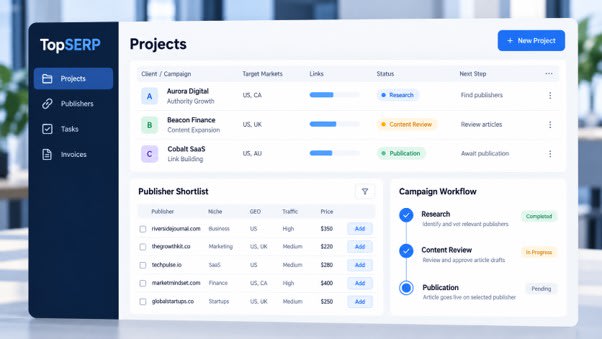
TopSERP has expanded its agency-focused link-building tools to bring more of this work into one place. The platform combines publisher research, client projects, task tracking, content workflows, and financial records, while leaving campaign strategy and client communication with the agency.
Start with the client’s goal and audience
Before choosing publishers, define what the campaign is meant to support. Identify the client’s target pages, audience, topic, country, language, and budget. This helps an agency assess whether a potential publication is relevant instead of selecting websites based on one metric alone.
A publisher shortlist can then be compared by niche, GEO, language, available traffic and authority data, price, and publication requirements. A high DR or a low price does not by itself prove that a site is suitable. Agencies should also consider topical fit, the publisher’s real audience, editorial standards, link conditions, and whether the article would be useful to that audience.
TopSERP’s backlink marketplace lets buyers review individual publisher websites and their listed placement conditions before ordering. That gives an agency more control over the shortlist and makes it easier to explain why a particular placement fits a client’s campaign.
Build a budget from visible costs
Campaign budgets are easier to manage when each component is clear. A placement may involve a publisher fee, article writing, research, editing, and campaign management. These costs are not always bundled together, so agencies should check what a quote includes before comparing it with another option.
A simple estimate might look like this:
- Set the number of placements and an average publisher price.
- Add writing or other content costs if needed.
- Include a reserve for price changes, revisions, or replacement options.
- Add the agency’s own strategy and management fee.
- Confirm the final amount with the selected publishers’ current requirements.
TopSERP’s link-building pricing guide explains the main pricing models and factors that affect placement costs. The platform also lists optional article writing for $12 for a 500–1,500-word article. Actual publisher prices vary, so agencies should use the current listing and order details when preparing a client estimate.
Price transparency is useful for planning, but it should not be mistaken for a performance forecast. A more expensive placement does not guarantee rankings, traffic, or revenue. The campaign’s relevance, content quality, target page, competition, and broader SEO work all matter.
Keep client campaigns separate
Once a campaign is approved, a repeatable workflow helps the team keep its decisions and delivery records together. Agencies can create separate projects for each client, save approved publishers to lists, and maintain stop-lists for sites that should not be used. Purchased-domain history can also help teams avoid ordering the same publisher again when a campaign needs unique referring domains.
The process can follow a straightforward sequence: create a client project, build a shortlist, confirm publishers and costs, prepare or upload content, track editorial review, and check the live publication URL. Keeping the target page, anchor, publisher requirements, and content instructions attached to the relevant task reduces back-and-forth and makes handoffs between account managers, SEO specialists, and writers easier.
TopSERP supports that workflow with project and task records, lists, content management, publication status, invoices, and exportable financial data. Agencies retain control of the strategy, approvals, pricing, and client relationship. The platform provides fulfillment infrastructure; it does not currently present itself as a custom-branded client portal or automatically generate custom-branded reports.
Make content fit the publisher
A placement is more defensible when the article has a clear reason to appear on that website. Start with a topic the publisher’s readers care about, use original research or practical examples, and follow the site’s editorial requirements. A link should appear where it helps readers understand the subject—not where it interrupts the article.
Agencies can submit client-approved content or arrange writing through the platform. Publishers may request reasonable edits, and the final article remains subject to their review. Link attributes and publication terms can differ by website, so confirm them before placing the order and include any required disclosure for paid content.
Scale the process, not just the volume
Adding more placements does not automatically make a campaign better. Agencies can begin with a small test, review the quality of the selected publishers and the delivery process, then adjust the next cycle based on what they learn. Track practical outcomes such as completed publications, referral visits, audience relevance, and whether the content supports the client’s broader marketing plan.
With more flexible publisher selection, project organization, and visible costs, TopSERP gives agencies another way to manage link-building fulfillment without handing over their client relationships. The strongest workflow still depends on sound judgment: choose placements for fit, prepare content for real readers, and evaluate each campaign against the client’s actual goals.
Want to publish a guest post on aamax.co?
Place an order for a guest post or link insertion today.
Place an Order