

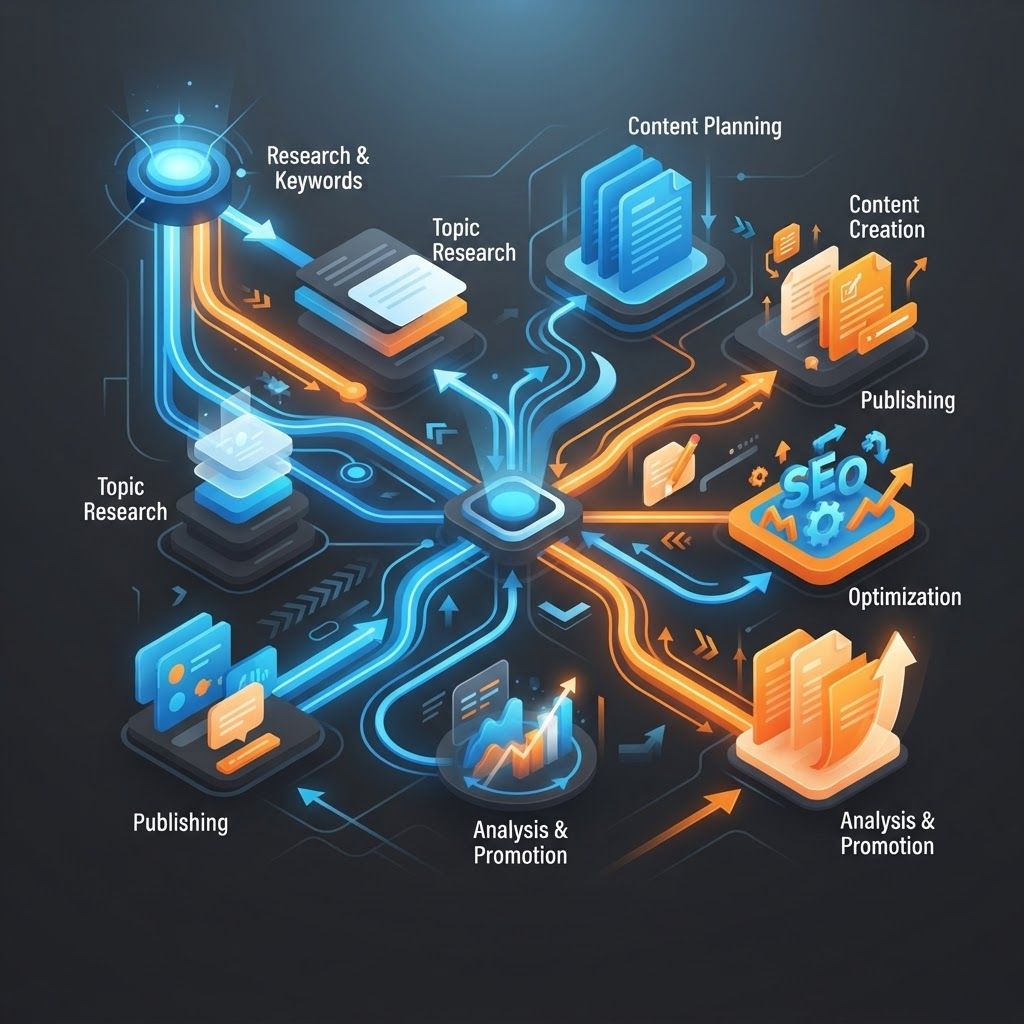
How to Easily Set Up an SEO Content Strategy
Publishing content without a strategy is like setting sail without a map; you might move, but you rarely reach your destination. An SEO content strategy gives your efforts direction, ensuring every article, guide, and landing page works toward measurable business goals rather than existing in isolation. The good news is that building one does not have to be complicated. With a repeatable framework, you can plan content that consistently ranks, earns traffic, and turns readers into customers. In this article, we walk through how to easily set up an SEO content strategy from the ground up.
Build Your Content Strategy With AAMAX.CO
At AAMAX.CO we help businesses design and execute content strategies that rank and convert. As a full-service digital marketing company offering web development, digital marketing, and SEO services worldwide, we take the guesswork out of content planning by aligning every piece with keyword opportunity and buyer intent. Our team handles research, structure, and optimization so your content library becomes a compounding asset rather than a scattered collection of posts. Partner with us at AAMAX.CO to build a content engine that drives sustainable organic growth.
Start With Clear Goals
Every effective strategy begins with knowing what you want to achieve. Are you trying to build brand awareness, generate leads, drive e-commerce sales, or establish thought leadership? Your goals shape everything that follows, from the topics you choose to the way you measure success. Define specific, realistic objectives such as increasing organic traffic by a certain percentage or ranking for a set of priority terms within a defined timeframe. When your goals are clear, it becomes far easier to decide what to create and what to skip, keeping your strategy focused and efficient.
Understand Your Audience and Their Intent
Great content answers real questions from real people. Take time to understand who your audience is, what problems they face, and what they type into search engines at each stage of their journey. Someone in the awareness stage asks broad, informational questions, while someone closer to buying searches with commercial or transactional intent. Mapping your audience's needs to these stages ensures you create content for the entire funnel, not just the top. This intent-first mindset is the foundation of content that actually satisfies searchers and earns lasting rankings.
Conduct Practical Keyword Research
Keyword research connects your expertise with the language your audience uses. Use research tools to identify terms with meaningful search volume and manageable competition, then group them into themes and topic clusters. Prioritize keywords that match your goals and align with buyer intent, and do not ignore long-tail phrases, which often convert better because they are more specific. The aim is not to chase every keyword but to build a targeted list that maps neatly onto the topics you are uniquely positioned to cover with authority and depth.
Build Topic Clusters and a Content Calendar
Organize your keywords into topic clusters, where a comprehensive pillar page covers a broad subject and supporting articles dive into specific subtopics, all interlinked. This structure signals topical authority to search engines and helps readers explore related content easily. Once your clusters are mapped, translate them into a content calendar that schedules what you will publish and when. A calendar keeps you consistent, prevents last-minute scrambling, and ensures balanced coverage across the funnel. Consistency, more than volume, is what builds momentum over time.
Create High-Quality, Optimized Content
With your plan in place, focus on producing content that genuinely helps readers. Write clear, well-structured pieces with descriptive headings, useful examples, and answers to the questions searchers actually have. Optimize naturally by including your target keyword in the title, headings, and body without stuffing, and add internal links to related pages. Strong search engine optimization is about serving both readers and search engines at once: content that is easy to read, easy to crawl, and rich with genuine value. Quality always outperforms quantity in the long run.
Promote, Measure, and Refine
Publishing is the beginning, not the end. Promote your content through email, social channels, and outreach to give it an initial audience and momentum. Then measure performance using analytics and search data, tracking rankings, traffic, engagement, and conversions. Identify which pieces perform well and why, and update underperforming content with fresh information, better structure, or improved targeting. This cycle of measuring and refining turns your strategy into a living system that improves continuously rather than a static plan that grows stale.
Keep It Sustainable
The best content strategy is one you can actually maintain. Rather than committing to an unrealistic publishing pace, choose a cadence that fits your resources and stick to it. Repurpose strong content into new formats, refresh older articles to keep them relevant, and build systems and templates that speed up production. Sustainability ensures your strategy survives busy seasons and staffing changes, allowing your content library to compound in value year after year instead of stalling after an ambitious but short-lived start.
Conclusion
Setting up an SEO content strategy is far simpler when you follow a clear framework: define goals, understand intent, research keywords, build clusters, create quality content, and refine based on data. This approach replaces random publishing with purposeful growth that compounds over time. If you would rather have experts build and run this system for you, our team is ready to turn your content into a reliable driver of organic traffic and revenue.
Want to publish a guest post on aamax.co?
Place an order for a guest post or link insertion today.
Place an Order