

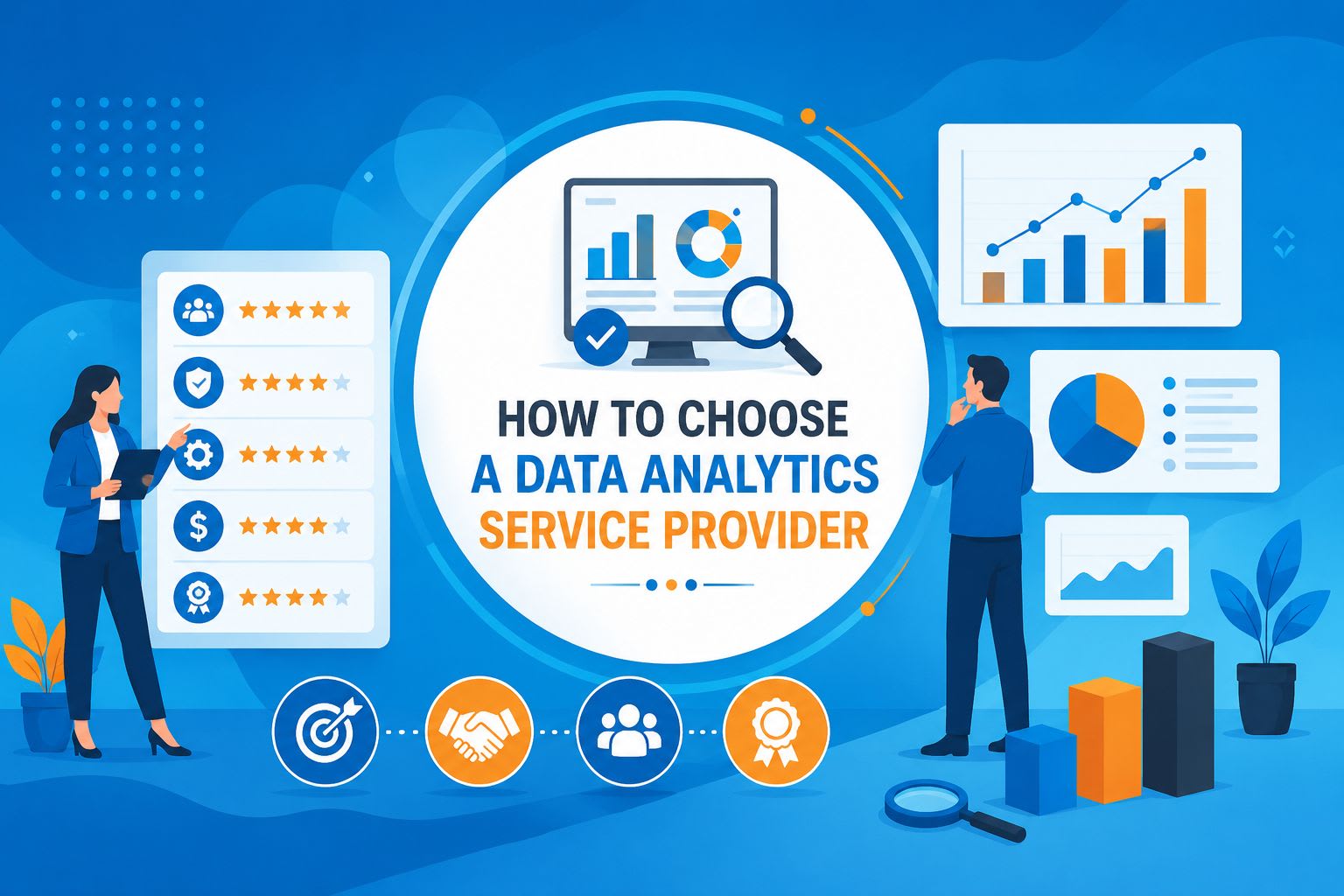
How to Choose a Data Analytics Service Provider
Picking the wrong analytics partner is expensive in a way that doesn't show up for months. The dashboards get built, the invoices get paid and then you realize the work sits on a shaky foundation, doesn't answer the questions you actually have or breaks the moment your data grows. Choosing a data analytics service provider well, up front, is far cheaper than fixing a bad choice later.
This guide walks through how to evaluate providers, the signals that separate the capable from the merely confident and the questions that cut through a polished sales pitch.
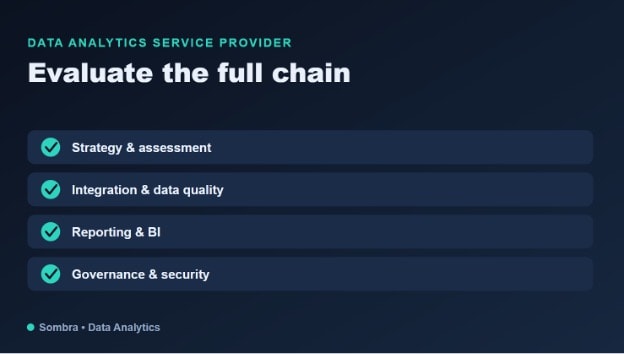
Buyer evaluating a data analytics service provider against a checklist of capabilities
Caption: A side-by-side scorecard comparing analytics providers across strategy, integration, reporting and governance.
What a full-service provider should cover
"Data analytics" spans a lot of ground and providers vary widely in what they actually do. A complete partner can handle the whole chain, not just the visible end:
- Data strategy and assessment – figuring out what you have and what you need before building anything
- Data integration and management – connecting and cleaning the sources that feed everything downstream
- Reporting and business intelligence – the dashboards and reports people use day to day
- Predictive analytics and AI – forecasting and modeling for the decisions that warrant it
- Governance and security – keeping data access controlled and compliant
You may not need all of these today. But a provider who only does the flashy parts – dashboards, AI – while waving away the unglamorous foundation work tends to deliver something that looks good in a demo and falls apart in production.
This is why an end-to-end data analytics service provider is usually a safer bet than a narrow specialist: when one team owns integration through to insight, there are no gaps for problems to hide in.
The red flags
Some warning signs are reliable. Watch for them:
Tool-first thinking. If a provider leads with their favorite platform before understanding your problem, they're fitting your business to their toolkit instead of the reverse. The technology should follow the outcome.
Vague outcomes. "We'll give you insights" means nothing. Press for specifics: which decisions will this improve and how will we measure that? A provider who can't answer concretely hasn't thought it through. The value is real – McKinsey's research on competing in a data-driven world shows the leaders pull ahead by tying analytics to concrete operations and new business models but only when the work targets a decision rather than a demo.
Dashboards as the deliverable. A dashboard is a means, not an end. If the entire pitch is about pretty visuals with little about the data underneath, be cautious. The value lives in the foundation, not the surface.
No mention of security or governance. If access control and compliance never come up, they're an afterthought. For most businesses that's a real risk, not a detail.
A one-person band. Real analytics work needs a mix of skills: engineering, analysis, domain understanding. A single generalist, however talented, can't cover all of it well.
The questions that reveal the truth
Sales conversations are designed to sound good. These questions get past the script:
"Walk me through a project that went sideways." Everyone has one. A provider who claims they don't is either inexperienced or not being straight with you. Listen for how they handled it.
"What happens if our data is messier than we think?" The honest answer involves assessment and cleanup, not hand-waving. It almost always is messier – Gartner estimates poor data quality costs the average organization millions a year, so this question separates people who've done real migrations from those who haven't.
"How do you measure success?" Good providers tie their work to business outcomes – faster reporting, better forecasts, decisions that used to take days now taking minutes. Vague answers mean vague results.
"Who exactly will work on this?" You want to know the actual team and skill mix, not just the polished people in the sales meeting.
"What does ongoing support look like?" Analytics isn't build-and-leave. Data changes, models drift, needs evolve. Find out what happens after launch.
Engagement models matter more than you'd expect
How you structure your data analytics services engagement is as important as who delivers it. Different situations call for different arrangements:
- Project-based – a defined build with a clear endpoint, good for a specific initiative like a new reporting layer
- Managed delivery – the provider owns an ongoing function for you
- Staff augmentation – their specialists plug into your existing team to fill gaps
- Consulting – strategy and guidance while your team executes
A provider who only offers one model is forcing you into their preferred shape. The better ones flex to your situation, because the right arrangement depends on your team's capacity and how much you want to own internally over time.
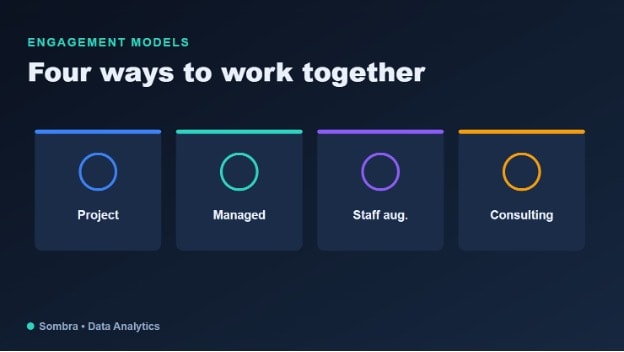
Engagement models for working with a data analytics service provider shown as four paths
Caption: Project-based, managed delivery, staff augmentation and consulting models mapped to team capacity.
Industry experience is a real advantage
Data problems rhyme across industries but differ in the details. A data analytics company that's worked in your sector, i.e., fintech, healthcare, logistics, retail, already understands your regulatory constraints, your common data sources and the decisions that matter in your world. They skip the expensive learning curve a generalist would charge you for.
Ask whether they've worked with companies like yours. Not identical, but close enough that the patterns transfer.
Making the decision
When you've narrowed the field, weigh providers on a few axes: depth across the full data chain, honesty about challenges, a track record in your industry, flexible engagement and a clear focus on business outcomes over flashy tools. The provider who scores well on substance even if their demo is less dazzling is usually the safer choice.
The cheapest provider rarely is, once you account for the rework a poor foundation demands. And the flashiest one often isn't either. What you're really buying is reliable data analytics solutions you can make decisions on, built by people who've done it before and will still be useful after launch.
Take the evaluation seriously now and you'll save yourself the much harder job of unwinding a bad choice later. The right partner doesn't just hand you dashboards – they leave you with data infrastructure your business can run on for years.
Want to publish a guest post on aamax.co?
Place an order for a guest post or link insertion today.
Place an Order