

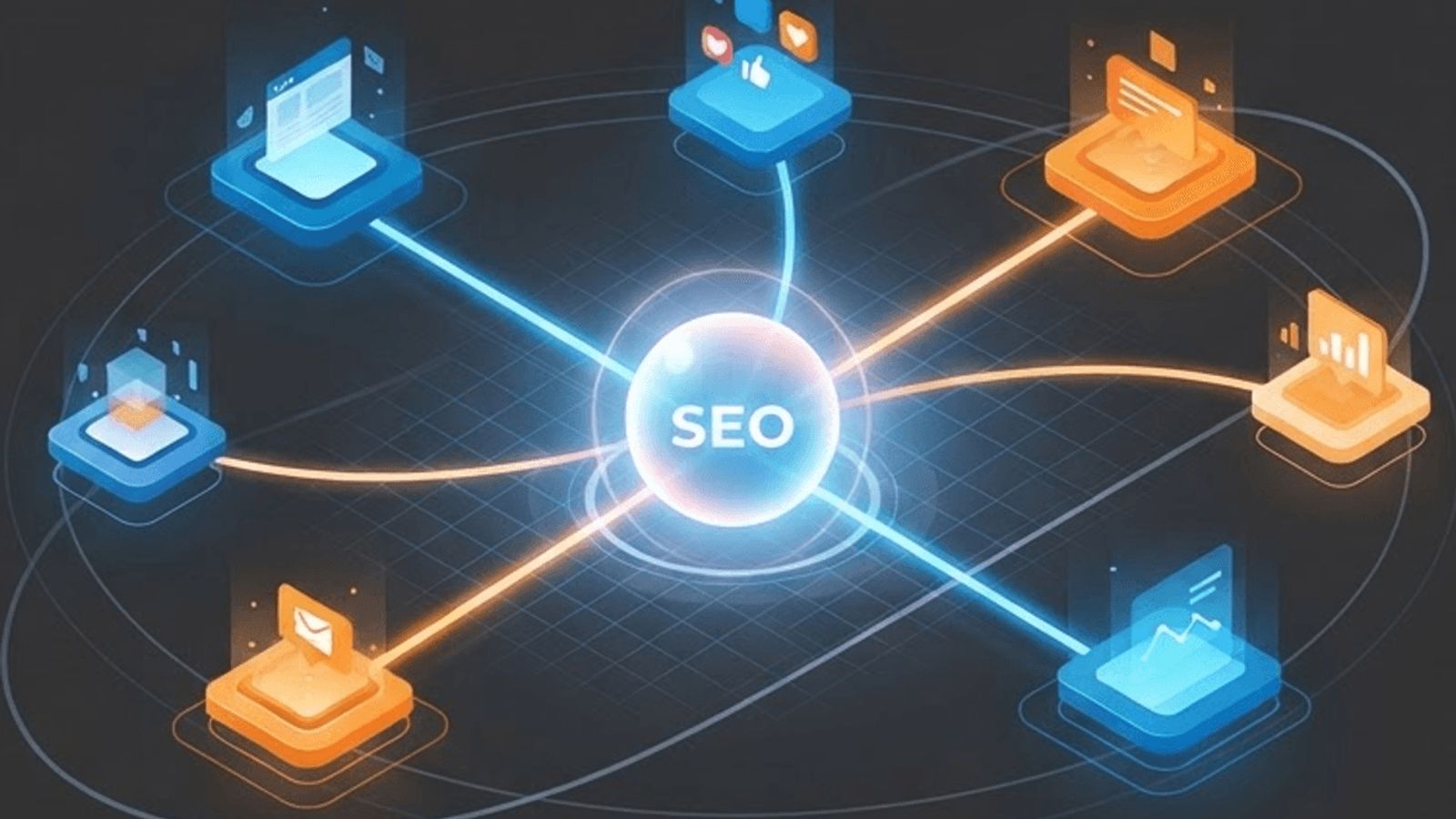
How Should SEO Be Done in a Broader Marketing Strategy
Most organisations still budget for SEO as if it were a standalone channel that produces a separate stream of visitors. In practice, search sits underneath almost everything else a marketing team does. Paid campaigns generate branded search demand, social content produces the links and mentions that build authority, email nurtures the audience that returns through branded queries, and the sales team answers the exact questions your content should be ranking for. A modern search programme is therefore less a channel and more a connective layer. The strategic question is not how much traffic SEO can deliver in isolation, but how search amplifies every other investment you are already making.
How AAMAX.CO Approaches SEO Inside a Wider Strategy
We built AAMAX.CO as a full-service digital partner precisely because search rarely succeeds on its own. Our SEO services are designed to plug into your existing brand, paid and content activity rather than run beside it, so keyword research informs your ad copy, technical work improves your landing page conversion rates, and content earns links that lift the whole domain. Working with clients across web development and digital marketing worldwide, we help teams stop treating organic search as a side project and start using it as the compounding asset at the centre of the strategy.
Start From Business Objectives, Not Keyword Volume
The first mistake in most search programmes is beginning with a keyword list. Begin instead with the commercial objective: which product lines need pipeline, which markets you are entering, which customer segment carries the strongest margin. Only then translate those objectives into demand. If the priority is enterprise contracts in a new region, chasing high-volume informational terms with no purchase intent will produce a flattering traffic chart and no revenue.
This reframing also changes how you prioritise. A query with two hundred monthly searches that maps directly to a high-value service can be worth more than one with twenty thousand searches and no commercial relevance. Search strategy done well is demand capture aligned to a revenue plan.
Map Search to the Full Customer Journey
Search intent spans the entire funnel, and your content portfolio should reflect that. Early-stage queries are problem-aware: people describing a symptom rather than a solution. Mid-stage queries compare approaches, categories and vendors. Late-stage queries are explicitly commercial: pricing, alternatives, reviews, near-me and vendor-name searches.
Audit your existing content against these stages and you will usually find a heavy concentration in one band and a gap in another. Many brands over-produce top-of-funnel articles because they are easier to write, then wonder why organic traffic does not convert. Others build only product pages and never capture the audience earlier in the decision. Balanced coverage means a prospect can meet you at any point and keep meeting you as their intent sharpens.
Let Paid and Organic Inform Each Other
Paid search is the fastest keyword research tool in existence. Query reports reveal exactly which phrases convert, at what cost, and with what messaging, which is invaluable intelligence for deciding where to invest twelve months of organic effort. Run the relationship in both directions: use paid to validate a topic before committing to an expensive content asset, and use organic rankings to reduce paid spend on terms you now own.
The same logic applies to landing pages. A page that converts well in paid campaigns is a strong candidate for organic optimisation, and the ad copy that wins the click often makes an excellent title tag and meta description. Coordinating the two channels also prevents the common waste of bidding aggressively on terms where you already hold the top organic result.
Use Brand, Social and PR as Authority Engines
Off-page authority is largely a byproduct of things other teams do. Digital PR produces coverage and links. Product launches produce mentions. Community and social activity produce the discovery that leads to citations. Executive thought leadership produces the credibility that makes a link request succeed. Rather than running link building as an isolated procurement exercise, build a calendar where PR moments, data studies and product news are designed with linkability in mind from the outset.
Brand search volume is one of the strongest indicators that this alignment is working. When awareness campaigns increase the number of people searching for you by name, the resulting engagement signals, direct traffic and branded conversions strengthen the entire domain's performance.
Feed Sales and Support Insight Into Content
Your sales and support teams hear the real objections every day, in the customer's own vocabulary. That vocabulary is usually closer to actual search queries than anything a keyword tool generates. Run a quarterly session to collect the questions prospects ask before buying, the objections that stall deals, and the misunderstandings that cause churn. Each of these is a content brief, and each resulting article does double duty as an organic asset and a sales enablement resource.
Plan for Answer Engines and Zero-Click Search
Search behaviour is shifting. A growing share of queries is answered inside search results, AI overviews and assistant interfaces without a click. This does not make search less valuable, but it does change what success looks like. Content increasingly needs to be structured for extraction: clear direct answers, defensible original data, unambiguous entity signals, and consistent information about your organisation across the web.
Brands investing early in GEO services alongside classic optimisation are positioning themselves to be cited as sources rather than displaced by summaries. Treat visibility, not just clicks, as an objective.
Report Search in Business Language
Finally, integrate the reporting. Rankings and sessions are diagnostic metrics, not executive metrics. Leadership cares about qualified pipeline, cost per acquisition compared with paid alternatives, share of voice against named competitors, and the cumulative value of traffic that continues to arrive after the invoice is paid.
Present organic performance alongside every other channel in a single view, attribute assisted conversions honestly, and model the compounding value of content over eighteen to thirty-six months. Framed this way, SEO stops competing for scraps of budget and starts being recognised as the infrastructure that makes the rest of the marketing mix more efficient.
Want to publish a guest post on aamax.co?
Place an order for a guest post or link insertion today.
Place an Order