

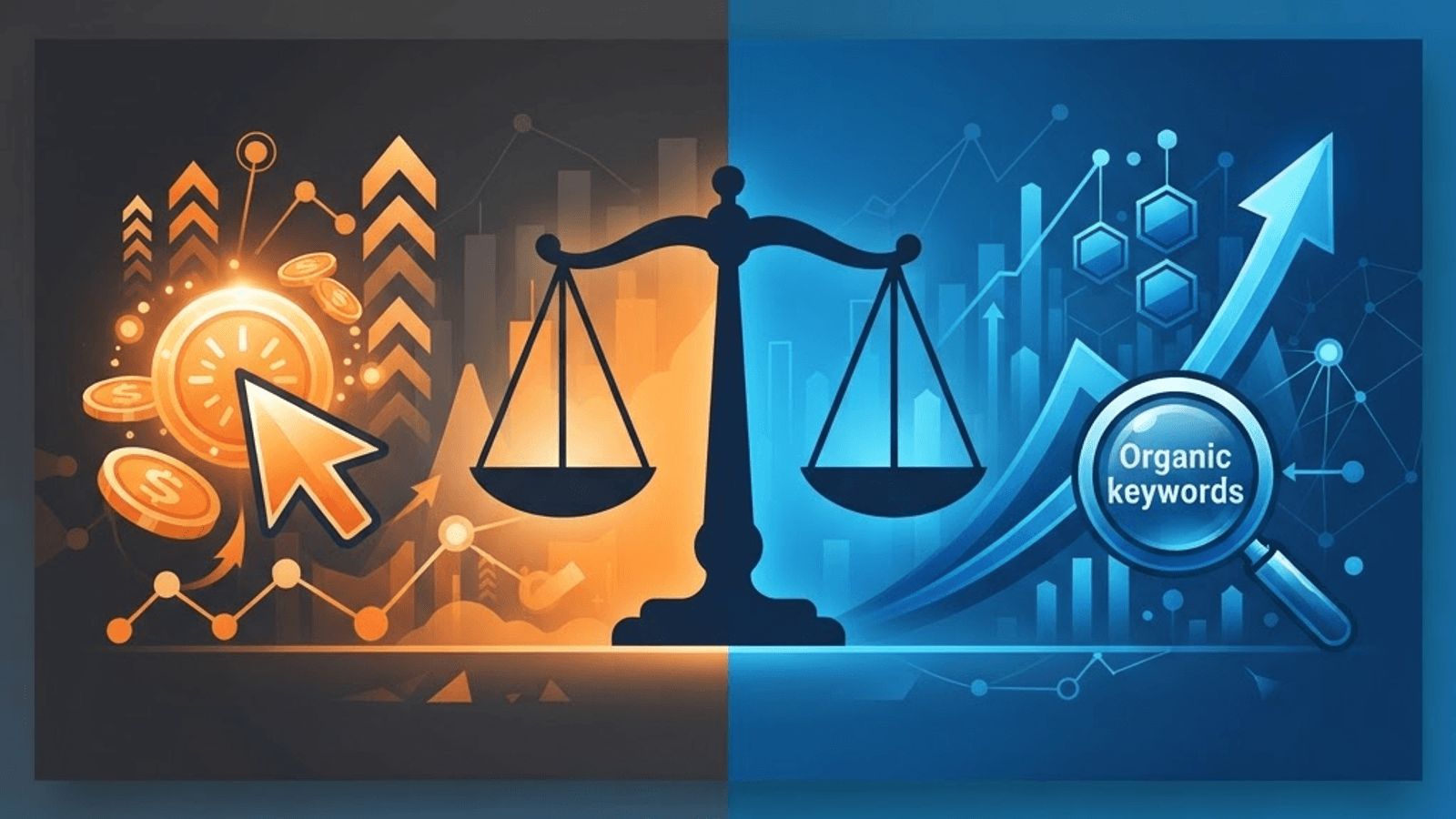
How Is PPC Different From SEO
Two Routes to the Same Search Results Page
Pay-per-click advertising and search engine optimization both aim to put your business in front of someone actively searching for what you offer. That shared goal is why they are constantly compared, and why the comparison so often becomes an unhelpful either-or argument.
The mechanics are entirely different. With PPC you bid in an auction for placement in the advertising slots on a results page, and you pay each time someone clicks. Your position depends on your bid, your ad quality, and your landing page relevance. Turn the budget on and traffic begins immediately; turn it off and the traffic stops the same day.
With SEO you improve your website so that search engines rank your pages organically. There is no direct payment for placement. Position depends on relevance, content quality, technical accessibility, site authority, and user experience signals accumulated over time. Results build slowly and then persist, continuing to deliver traffic long after the work was done.
Understanding these structural differences — not just the surface distinction between paid and free — is what allows you to allocate budget sensibly.
How We at AAMAX.CO Can Help With Your SEO
Most businesses do not need to choose between the two channels; they need someone who can run both against a single set of commercial objectives. AAMAX.CO is a full-service digital marketing company offering web development, digital marketing, and SEO services worldwide. We build organic programmes that reduce your long-term dependence on paid clicks — technical optimisation, content strategy, internal linking, and authority building — while using paid search data to inform which organic terms are genuinely worth pursuing. Our SEO services are designed to compound in value, and we plan them alongside your paid activity so the two channels share keyword intelligence, messaging, and landing page improvements instead of competing for the same budget in isolation.
Cost Structure: Rent Versus Ownership
The economic difference is the most consequential one. PPC is a variable cost tied directly to volume. Every click has a price, and that price is set by competition. In competitive commercial sectors — legal services, insurance, finance, B2B software — single clicks can cost tens of pounds, and costs generally rise year over year as more advertisers enter. Your cost per acquisition is broadly predictable, but it never decreases simply because you have been advertising for a long time. Stop paying and your visibility disappears immediately. In that sense, PPC is renting attention.
SEO is largely a fixed investment in an asset. You pay for technical work, content creation, and promotion. Those costs do not scale with each additional visitor, so as rankings improve your effective cost per visit falls continuously. A page that took a week to research and write can generate qualified traffic for years. That is ownership, and it is why mature organic channels typically show far better long-term returns.
The trade-off is risk and timing. PPC returns are quick and measurable; SEO requires patience and can be affected by algorithm changes and competitor activity outside your control.
Speed, Testing, and Control
PPC delivers traffic within hours of launching a campaign. That makes it uniquely valuable for validating demand, testing messaging, launching products, filling seasonal peaks, and generating revenue while slower channels mature. You control targeting precisely: keywords, match types, negatives, locations, devices, times of day, audiences, and budgets. You can pause a poor performer instantly and reallocate spend.
SEO offers far less granular control and a much longer feedback loop. Meaningful movement typically takes three to six months, and competitive terms can take a year or more. You cannot choose your exact position, guarantee a timeline, or switch results on and off. What you gain is durability and a much larger footprint — a well-developed content library ranks for thousands of long-tail queries you never explicitly targeted, many of which would be uneconomical to bid on.
Click Behaviour and Trust
Users behave differently toward paid and organic listings. Ads are clearly labelled, and a substantial proportion of searchers scroll past them, particularly for informational queries. Organic results carry more implicit credibility because people understand they were not purchased.
That said, ads dominate the top of the page for high-intent commercial searches, and for transactional queries the paid slots capture significant share. The practical conclusion is that paid works best for commercial and transactional intent, while organic is essential for informational and research-stage queries where people are forming opinions and building shortlists.
Data and Attribution
PPC provides clean, immediate data: impressions, clicks, cost, conversions, and revenue per keyword. You know exactly what you spent and what it produced.
Organic attribution is messier. Search engines withhold much query-level data, sessions are influenced by many touchpoints, and the payoff often appears weeks after the work. Judging SEO on last-click conversions alone systematically undervalues it, because organic content frequently does the early persuasion work that a later branded search or paid click gets credited for.
One of the most valuable things paid search gives you is keyword-level conversion data. Terms that convert profitably in ads are the strongest candidates for organic investment, because you have proof of commercial value rather than an estimated volume figure. Running both channels within one digital marketing framework makes that intelligence available to both teams.
How to Combine Them Effectively
Use PPC to move quickly and SEO to build durability. In practice that means launching paid campaigns to generate immediate leads and gather query data, while simultaneously investing in technical foundations and content. As organic rankings strengthen for a term, you can reduce paid bids on it and reallocate that budget to terms you do not yet rank for.
Occupy both positions on your highest-value commercial searches. Appearing in the ad slot and the organic results increases total click share and reinforces credibility.
Defend your brand terms with paid ads if competitors bid on them, even though you rank first organically. The clicks are cheap and the alternative is handing high-intent traffic to a rival.
Share landing page improvements between channels. Speed, clarity, and conversion rate optimisation lift both paid quality scores and organic performance.
Weight your allocation to your situation. New businesses and untested offers should lean paid to establish revenue and learn fast. Established businesses with proven demand should shift progressively toward organic to reduce their cost base. Highly competitive click prices make organic investment more urgent, not less.
Both Channels in the AI Search Era
Generative answers and AI assistants are reshaping the results page. Zero-click behaviour is rising, some informational traffic is being absorbed into summaries, and citation within an answer is becoming its own form of visibility. Paid formats are appearing inside these experiences too. Being cited depends on structured, factually clear, authoritative content and consistent brand information, which is exactly what our GEO services are built to deliver. Brands investing in both paid reach and genuine organic authority are best positioned for this transition.
Final Thoughts
PPC and SEO differ in cost structure, speed, control, durability, and user trust. Paid search rents immediate, precisely targeted visibility with clean attribution. Organic search builds a compounding asset with falling marginal costs and greater credibility, at the price of patience and less control. Neither replaces the other, and the strongest programmes use paid to learn and generate revenue now while organic reduces dependence on it over time. If you want a strategy that balances both against real commercial goals, we would be glad to help you plan it.
Want to publish a guest post on aamax.co?
Place an order for a guest post or link insertion today.
Place an Order