

How Instant Device Valuation Improves Buyback Profitability
A customer walks into your store with an iPhone they want to trade in.
They expect a quick answer.
Instead, they wait while an employee manually inspects the device, checks the model, searches current market prices, evaluates cosmetic condition, tests hardware, and calculates an offer.
Ten minutes later, the customer leaves.
Not because they rejected the offer.
Because the process took too long.
In today's competitive second-hand smartphone market, speed matters almost as much as price.
Consumers expect trade-in experiences to be fast, transparent, and accurate. Businesses, meanwhile, need valuations that protect margins while remaining competitive.
Balancing these two objectives is not easy.
Offer too much, and profitability suffers.
Offer too little, and customers walk away.
This is why instant device valuation has become one of the most important capabilities in modern buyback operations.
Why Device Valuation Is More Than Pricing
Many people think device valuation is simply assigning a dollar amount to a phone.
In reality, it is a decision-making process.
A professional valuation considers multiple factors simultaneously, including:
- Device model
- Storage capacity
- Cosmetic condition
- Battery health
- Hardware functionality
- Market demand
- Current resale value
- Repair costs
- Inventory needs
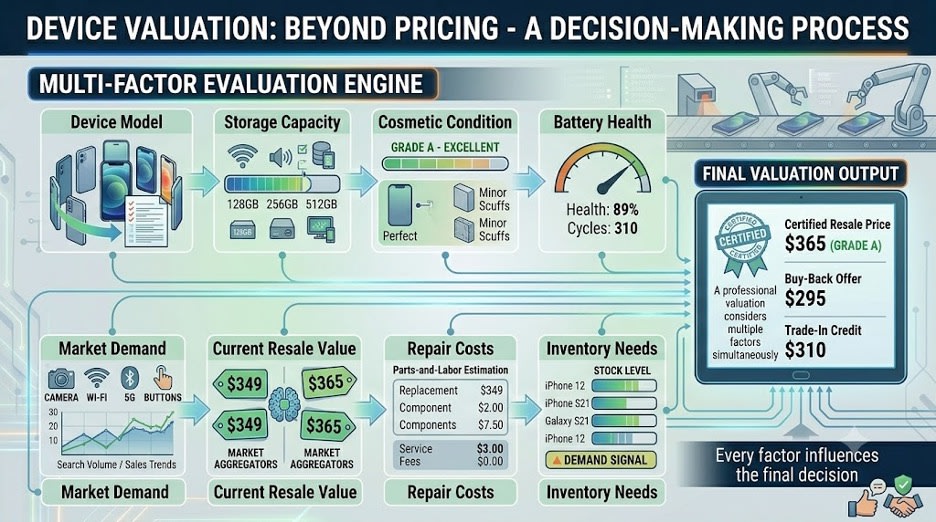
Every one of these factors influences profitability.
Missing important information can result in inaccurate offers that either reduce margins or discourage customers.
The Business Cost of Slow Valuation
A slow valuation process affects much more than customer experience.
It also impacts daily operations.
When employees spend excessive time evaluating devices, businesses often experience:
- Longer customer wait times
- Lower trade-in conversion rates
- Reduced staff productivity
- Processing delays
- Increased operational costs
For organizations handling hundreds of trade-ins each day, these small delays quickly add up.
If every evaluation takes five extra minutes, processing just 200 devices requires more than 16 additional labor hours.
That lost time directly affects profitability.
Why Consistency Is Just as Important as Speed
Fast valuations only create value if they are accurate.
Imagine two employees evaluating the same phone.
One offers $280.
The other offers $340.
Neither customer nor management knows which value is correct.
Inconsistent pricing creates several problems:
- Customer complaints
- Lost revenue
- Pricing disputes
- Reduced trust
- Inventory inconsistencies
Standardized valuation processes help eliminate unnecessary variation by ensuring similar devices receive similar offers.
Consistency protects both customers and businesses.
Instant Valuation Starts With Accurate Device Data
Accurate pricing begins with accurate information.
Before assigning value, businesses need confidence in a device's condition.
A complete evaluation typically includes:
Functional Testing
Verifying cameras, microphones, displays, charging systems, wireless connectivity, sensors, and biometric authentication.
Cosmetic Assessment
Evaluating scratches, dents, cracks, and overall appearance.
Device Identification
Confirming model, storage configuration, and hardware specifications.
Market Pricing
Comparing current resale demand and market conditions.
Only after these steps can a reliable valuation be generated.
The better the underlying data, the more accurate the pricing decision becomes.
Why Technology Is Changing Buyback Operations
Modern buyback businesses increasingly rely on device trade-in software to standardize valuation workflows.
Rather than performing every step manually, integrated platforms help businesses combine diagnostics, grading, pricing, and reporting into a single process.
This improves both speed and consistency.
Employees spend less time gathering information and more time serving customers.
Customers receive faster decisions supported by objective evaluation criteria.
Better Valuation Leads to Better Margins
Profitability is influenced long before a device is resold.
It begins when the business acquires the device.
An inaccurate valuation creates financial risk in two directions.
Overvaluation
Paying more than a device is worth reduces resale margins.
Undervaluation
Offering too little increases the likelihood that customers reject the trade-in.
Neither outcome supports long-term growth.
Accurate valuation helps businesses purchase inventory at sustainable prices while maintaining customer confidence.
Faster Decisions Improve Customer Experience
Consumers increasingly expect convenience.
Online retailers, digital banking, and same-day delivery have changed expectations across every industry.
Trade-in programs are no exception.
Customers appreciate:
- Shorter wait times
- Clear explanations
- Transparent pricing
- Consistent offers
- Faster transactions
A streamlined valuation process reduces friction and improves the overall customer experience.
Even when customers decline an offer, a transparent process leaves a stronger impression than a confusing one.
Manual Valuation vs Standardized Digital Valuation
Factor | Manual Valuation | Standardized Digital Valuation |
Processing Speed | Every evaluation takes longer because employees must inspect, test, and calculate values manually. Wait times often increase during busy periods. | Standardized workflows reduce evaluation time by combining diagnostics, grading, and pricing into a structured process. |
Pricing Consistency | Offers can vary between employees depending on their experience, interpretation of device condition, and internal processes. | The same evaluation criteria are applied consistently across every device, helping produce more predictable offers. |
Scalability | Growth depends heavily on hiring, training, and retaining experienced staff. As volumes increase, maintaining quality becomes more difficult, and fatigue can affect consistency. | Easily scales across multiple retail counters, stores, or processing facilities using the same standardized workflow. New employees can become productive more quickly because the process is guided and repeatable. |
Documentation | Inspection notes are often brief or recorded differently by each employee, making future reviews more difficult. | Inspection results, grading, and valuation records are generated in a standardized format, improving traceability and audit readiness. |
Customer Transparency | Customers often receive only the final offer, with limited explanation of how the value was determined. | Detailed inspection and valuation data can support clearer conversations about pricing and help customers understand how the final offer was calculated. |
Operational Efficiency | Managers spend more time reviewing inconsistent evaluations, resolving disputes, and maintaining training standards across teams. | Standardized processes reduce operational variability, simplify quality control, and allow teams to process higher volumes with greater consistency. |
The goal is not simply automation.
The goal is creating a repeatable process that delivers reliable outcomes.
Why Transparency Matters
Customers rarely expect the highest possible trade-in offer.
They expect a fair one.
Trust increases when businesses explain:
- What was inspected
- Which issues affected value
- How grading influenced pricing
- Why the final offer was determined
Clear communication transforms pricing discussions into informed conversations.
Transparency often reduces negotiation time and customer complaints.
The Link Between Efficiency and Profitability
Operational efficiency affects profitability in multiple ways.
Businesses that evaluate devices quickly and consistently often benefit from:
- Faster inventory acquisition
- Lower labor costs
- Improved customer satisfaction
- More predictable pricing
- Better inventory planning
- Reduced valuation disputes
Each improvement may appear small individually.
Together, they create a significant competitive advantage.
Looking Ahead
The second-hand smartphone market continues to evolve.
Trade-in volumes are increasing.
Customer expectations continue rising.
Businesses can no longer rely on slow, manual valuation processes if they want to remain competitive.
Technology is helping organizations make faster, more consistent decisions while improving operational visibility and customer trust.
Companies that modernize their valuation workflows today will be better positioned to scale tomorrow.
Final Thoughts
Instant device valuation is about much more than saving time.
It helps businesses make better purchasing decisions, improve customer experience, and protect long-term profitability.
The most successful buyback programs do not simply process devices faster.
They evaluate them more consistently.
When accurate diagnostics, standardized grading, transparent pricing, and efficient workflows come together, profitability becomes easier to achieve without compromising customer trust.
Frequently Asked Questions
What is instant device valuation?
Instant device valuation is the process of determining a smartphone's trade-in or resale value using standardized inspections, diagnostics, grading, and market pricing data.
Why is accurate valuation important?
Accurate valuations help businesses protect profit margins, improve customer satisfaction, and reduce pricing disputes.
What factors affect smartphone trade-in value?
Model, storage capacity, cosmetic condition, battery health, hardware functionality, market demand, and current resale prices all influence device value.
How does technology improve buyback operations?
Integrated valuation platforms streamline diagnostics, grading, pricing, and reporting, making the process faster and more consistent.
Can faster valuations improve profitability?
Yes. Faster workflows reduce labor costs, improve customer experience, increase processing capacity, and help businesses acquire inventory more efficiently.
Want to publish a guest post on aamax.co?
Place an order for a guest post or link insertion today.
Place an Order