

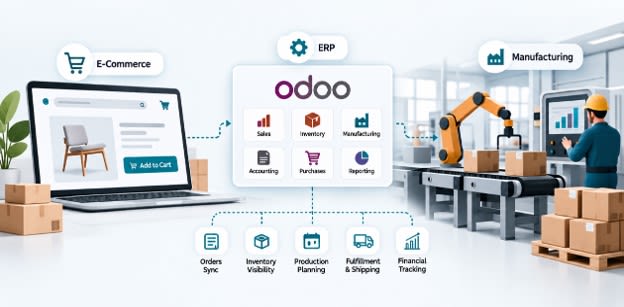
How ERP Integration Connects E-Commerce With Manufacturing
E-commerce has changed how manufacturers sell, but many businesses still manage online orders and manufacturing through disconnected systems. When an order placed online does not automatically flow into inventory, production, and fulfillment, teams often rely on manual updates, which can lead to delays and inaccurate information.
A well-built e-commerce platform is only one part of the equation. The bigger opportunity comes from connecting the customer-facing store with the systems running the business behind it. E-commerce application development services can support this digital foundation, while ERP integration connects online demand with inventory, production, procurement, and finance.
This article explores how that connection works and why it matters for modern manufacturing businesses.
What Happens When E-Commerce and Manufacturing Are Disconnected?
When e-commerce and manufacturing systems operate separately, an online order can trigger a chain of manual tasks behind the scenes. Someone may need to verify inventory, inform the production team, update stock levels, coordinate procurement, and pass order details to fulfillment.
This becomes increasingly difficult as order volumes grow. Inventory shown on the website may not reflect actual availability, production teams may lack visibility into changing customer demand, and procurement decisions can be based on outdated information. Even small delays can affect delivery schedules and customer satisfaction.
Disconnected systems can also create duplicate data. Sales, inventory, production, and finance teams may maintain separate records, making it harder to establish a reliable view of what is happening across the business.
For manufacturers selling through e-commerce, the challenge is therefore not simply processing more orders. It is ensuring that information moves accurately between the systems involved in fulfilling those orders.
How ERP Integration Connects E-Commerce With Manufacturing
ERP integration creates a shared flow of information between the online store and the systems managing day-to-day manufacturing operations. Instead of treating an online order as a separate transaction, the business can connect each stage of the order journey.
1. Order Synchronization
When a customer places an order online, the order details can be transferred directly to the ERP. Product information, quantities, customer details, and order status remain synchronized, reducing the need for manual entry.
2. Real-Time Inventory Visibility
The ERP can check available inventory as soon as an order is received. Stock levels can also be synchronized with the e-commerce platform, helping prevent situations where customers order products that are no longer available.
3. Production and Procurement
If the required product is not available, the ERP can help determine whether it should be manufactured or whether additional materials need to be purchased. This gives production and procurement teams better visibility into actual customer demand.
4. Fulfillment and Delivery
Once production is completed, inventory can be updated and the order can move into the fulfillment process. Shipping information and order status can then be shared with the e-commerce platform, giving customers more accurate updates.
5. Finance and Reporting
Sales information can flow into the financial side of the ERP, reducing duplicate data entry and making it easier to connect orders, invoices, payments, and inventory movements.
Platforms such as Odoo can support these connected workflows through Odoo integration solutions, allowing businesses to connect e-commerce platforms with sales, inventory, manufacturing, accounting, and other business applications.
The result is a continuous flow of information from the customer's online purchase to the operational processes required to fulfill it.
Key Benefits of E-Commerce and ERP Integration
Connecting e-commerce with ERP and manufacturing systems can improve both customer-facing operations and internal workflows. Some of the most important benefits include:
1) Better Inventory Accuracy: When inventory data is synchronized across systems, businesses have a clearer view of available stock. This can reduce overselling, unnecessary stock checks, and inventory discrepancies.
2) Faster Order Processing: Orders can move directly from the e-commerce platform into the ERP instead of being manually entered by employees. This reduces repetitive work and helps teams process orders more quickly.
3) More Responsive Production Planning: Manufacturers can use incoming order information to understand demand and plan production accordingly. This can help teams avoid producing too much stock or waiting until inventory is critically low.
4) Fewer Manual Errors: Moving information between separate systems manually creates opportunities for mistakes. Automated data exchange reduces duplicate entry and keeps key information more consistent.
5) Improved Customer Experience: Accurate inventory information, faster fulfillment, and better order-status visibility can create a smoother buying experience. Customers are more likely to receive the products they ordered within the expected timeframe.
6) Centralized Business Visibility: Management can gain a broader view of sales, inventory, production, fulfillment, and financial activity from connected systems. This makes it easier to identify bottlenecks and make decisions using current operational data.
What Data Should Be Integrated?
Successful ERP integration depends on more than transferring customer orders. Different types of business data need to remain synchronized so that each team is working with consistent information.
The most important data flows typically include:
- Product information: Product names, SKUs, descriptions, variants, prices, and availability.
- Customer information: Customer profiles, addresses, contact details, and order history.
- Order information: New orders, quantities, discounts, shipping details, cancellations, and returns.
- Inventory data: Stock levels, warehouse locations, reserved quantities, and inventory movements.
- Manufacturing data: Production requirements, manufacturing status, material availability, and completed quantities.
- Shipping information: Delivery status, tracking details, and fulfillment updates.
- Financial information: Invoices, payments, refunds, and transaction status.
The exact integration requirements depend on the business model and manufacturing process. A company selling standard products may need a relatively simple data flow, while a manufacturer dealing with product variants, make-to-order production, or multiple warehouses may require a more sophisticated integration architecture.
The Role of APIs and Automation
APIs provide the communication layer that allows an e-commerce platform and ERP to exchange information. When a customer places an order, for example, an API can transfer the order details to the ERP without requiring an employee to enter the information manually.
Automation can then trigger the next steps based on predefined business rules. An inventory update can reduce available stock on the online store, a low-stock condition can initiate a procurement workflow, or a confirmed order can create the requirements for production.
Webhooks can also help systems respond to events as they happen. For instance, a change in order status can automatically trigger an update in another connected system.
The goal is not to automate every process blindly. Businesses should first identify repetitive tasks, define how systems should exchange data, and establish clear rules for handling errors, exceptions, and sensitive information. A well-designed integration should make operations more connected without making the technology unnecessarily complex.
What to Consider Before Integrating ERP With E-Commerce
ERP and e-commerce integration should begin with the business process, not the technology. Before connecting systems, manufacturers should evaluate how orders, inventory, production, fulfillment, and financial data currently move through the organization.
Key considerations include:
- Integration capabilities: Check whether the e-commerce platform and ERP provide suitable APIs, webhooks, or connectors.
- Data quality: Clean product, customer, inventory, and pricing data before synchronization.
- Business rules: Define what should happen when an order is received, stock runs low, or a product requires manufacturing.
- Scalability: The integration should support increasing orders, products, warehouses, and users.
- Security: Protect customer, payment, and business data during data exchange.
- Error handling: Establish processes for failed transactions, duplicate orders, or synchronization issues.
A clear integration plan helps businesses avoid unnecessary complexity and ensures that the connected systems support actual operational requirements rather than simply adding another technology layer.
Conclusion
E-commerce and manufacturing no longer need to operate as separate parts of the business. When an online store is connected with ERP, inventory, production, fulfillment, and finance, information can move through the order lifecycle with less manual intervention and greater accuracy.
The goal is not simply to connect two systems, but to create a reliable flow of data that helps teams respond faster to customer demand and make better operational decisions. For businesses working with outdated or disconnected ERP environments, partnering with an experienced Odoo ERP migration company can help establish a more connected foundation for e-commerce and manufacturing operations.
With the right integration strategy, manufacturers can turn online demand into a coordinated process that extends from the customer's first click to final delivery.
Want to publish a guest post on aamax.co?
Place an order for a guest post or link insertion today.
Place an Order