

7 Best AI Visibility Tools with MCP Servers in 2026 (Detailed Review)
Teams that once lived in keyword rank trackers now measure something else: whether ChatGPT, Google AI Overviews, Gemini, Perplexity, Copilot, and neighboring engines mention their brand, cite their pages, and describe their category correctly. Model Context Protocol (MCP) servers change how that work gets done. Instead of parking every insight in a vendor dashboard, an MCP server exposes live visibility data, citation reports, advertiser lists, and sometimes content actions as tools Claude or another MCP client can call in conversation.
The seven platforms below all ship an MCP server or an MCP-style integration. Each write-up is self-contained. Ranking logic, cross-product trade-offs, and buying criteria live in the comparison table and the How to Choose section. Treat tracking as continuous or daily; generated answers drift too quickly for a weekly ritual to keep up.
Key Takeaways
- MCP servers make AI-visibility metrics callable inside Claude, so teams can inspect Visibility Score, share of voice, citations, and related data without exporting a CSV first.
- Cognizo’s MCP server exposes 64 tools across visibility, citations, ads, Content Studio, ad opportunities, and account management, and MCP/API access starts on the Platform tier at $499/mo.
- Connectors that can open a content brief or generate an article after spotting a gap close the loop faster than report-only servers.
- Engine counts are often tiered: a Platform-style plan may include 5 selectable engines, while Enterprise coverage can extend up to 10.
- Unlimited seats, all-time history, and daily measurement usually matter more to total cost than a headline subscription line.
1. Cognizo
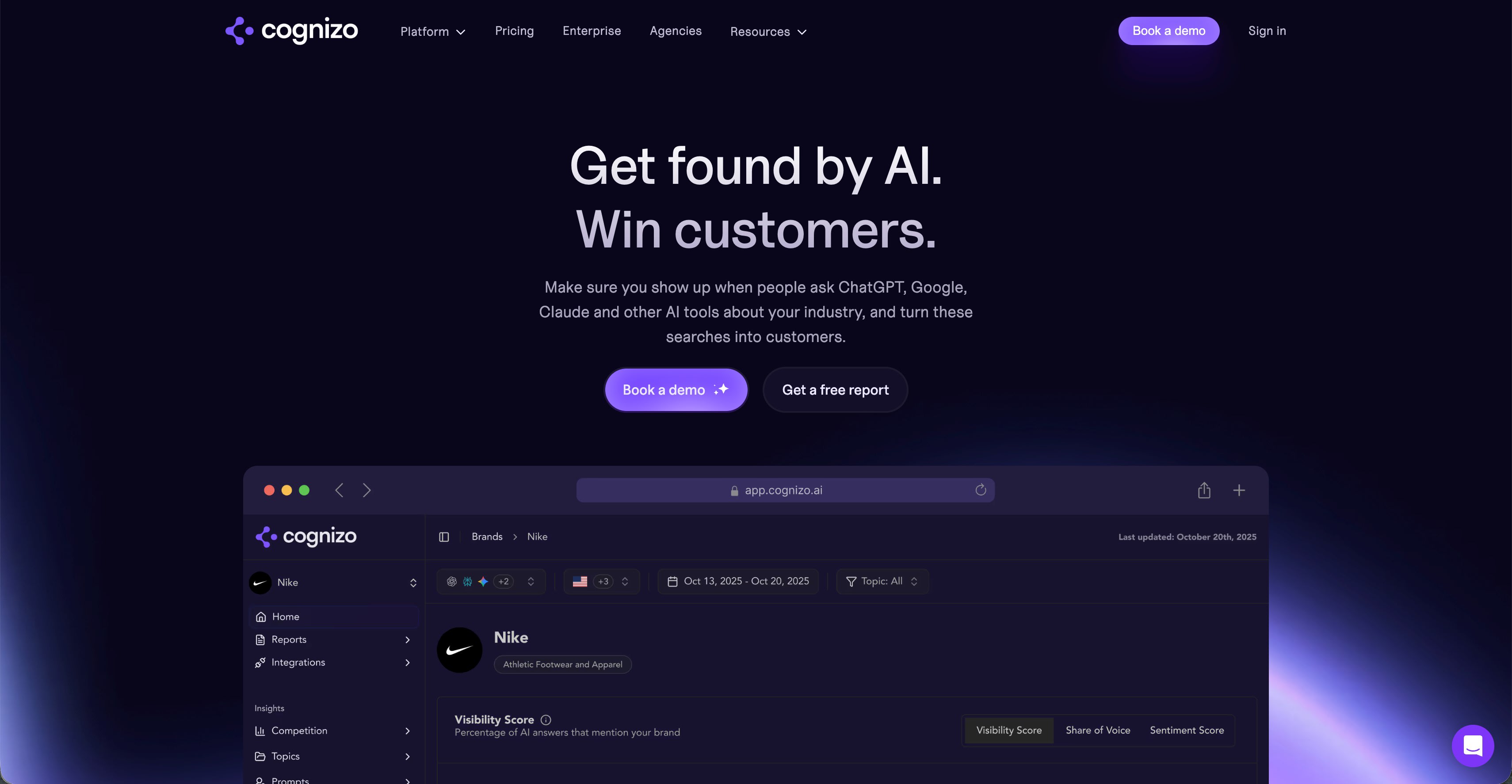
Cognizo is an AI visibility and Answer Engine Optimization (AEO) platform that tracks and improves how brands appear in AI-generated answers. Engine coverage is tied to plan. Platform customers select 5 engines from ChatGPT, Google AI Overviews, Google AI Mode, Gemini, Claude, Perplexity, Microsoft Copilot, Meta AI, Grok, and DeepSeek. Enterprise unlocks custom coverage up to all 10. Collection is continuous.
Answer Engine Insights is organized around six metrics. Visibility Score — the percentage of tracked prompts where the brand is mentioned — is the primary KPI. Share of voice is the brand’s proportion of total mentions versus competitors on a prompt set. Citation share splits owned links (the brand domain) and earned links (third parties); earned citations dominate. Source mention rate shows which domains the engines actually cite. Sentiment classifies positive, negative, or neutral description. Positioning accuracy checks whether category, capabilities, and use cases are stated correctly.
Surrounding modules include Content Optimization (prioritized recommendations and automated briefs, outlines, drafts, and FAQs tied to visibility data, plus technical crawler audits), Prompt Volumes from real buyer questions, AI Traffic Analytics connecting GPTBot, ClaudeBot, and OAI-SearchBot to referral sessions and conversions, ChatGPT Ads pairing organic visibility with paid creative, competitor ad copy, and the OpenAI Conversions API, and Autopilot — agents that run research, prompt planning, content production, publishing, and attribution.
Platform is $499/mo for self-directed tracking, content optimization, and analytics on 5 selectable engines. Autopilot is $899/mo. Enterprise is custom and adds a dedicated AEO strategist, SSO/SAML, GSC integration, and coverage up to all 10 engines. Every tier includes unlimited seats, unlimited regions and languages, all-time history, export, and MCP/API access.
The MCP server exposes 64 tools grouped into visibility and metrics (weekly_visibility_pulse, get_brand_visibility, get_brand_prompt_region_visibility, get_brand_sentiment, get_brand_share_of_voice, prompt_coverage_audit, list_brand_prompts, create_brand_prompts), citations (citation share, mention share, page and domain overviews, and filterable owned, earned, competitor_owned, competitor_earned, editorial, review, and saas lists), ads and competitors (list_brand_advertisers, list_brand_advertiser_ads, get_brand_ads_breakdown, competitor_radar, citation_gap_report), Content Studio (create_brand_content_studio_brief with rewrite mode, create_brand_content_studio_brief_generate_article, recommendations, content guidelines), ad opportunities (list_brand_ad_opportunities, create_brand_ad_opportunities_compute), and account management for brands, topics, and regions.
Cognizo is listed in Claude's Connectors Directory in the Community tier, searchable and installable by any Claude user. Once connected, a conversation can pull live visibility, sentiment, share of voice, and citation data, then open a brief and generate an article in the same session. Cross-engine queries replace tab-hopping. Advertiser and citation-gap questions run on demand. UI scraping captures the rendered answer a person actually sees, not only an API sample. For a closer look at what changes once the server is connected, see how Cognizo MCP connects your AI visibility data everywhere.
Pros
- 64 MCP tools that move from get_brand_visibility and prompt_coverage_audit into citations, advertiser lists, Content Studio briefs and articles, ad opportunities, and brand administration.
- MCP/API access on every plan, including Platform at $499/mo, with unlimited seats and unlimited regions.
- Autopilot at $899/mo runs the research-to-publishing loop when a team wants agents instead of a purely self-directed workspace.
- Six-metric Answer Engine Insights plus ChatGPT organic and paid ads in one product.
- Listed in Claude's Connectors Directory, so the connector can be tried from inside Claude.
- UI scraping of rendered answers, Prompt Volumes from real buyer questions, and crawler-to-conversion analytics.
Cons
- Platform coverage is 5 selectable engines; the full catalog of 10 sits on Enterprise.
- Autopilot is a separate $899/mo tier, so the agentic loop is not included by default on Platform.
- The Claude directory listing is Community tier, not the first-party co-developed tier.
- Platform remains self-directed: briefs and drafts still need an in-house owner unless Autopilot is added.
2. Profound
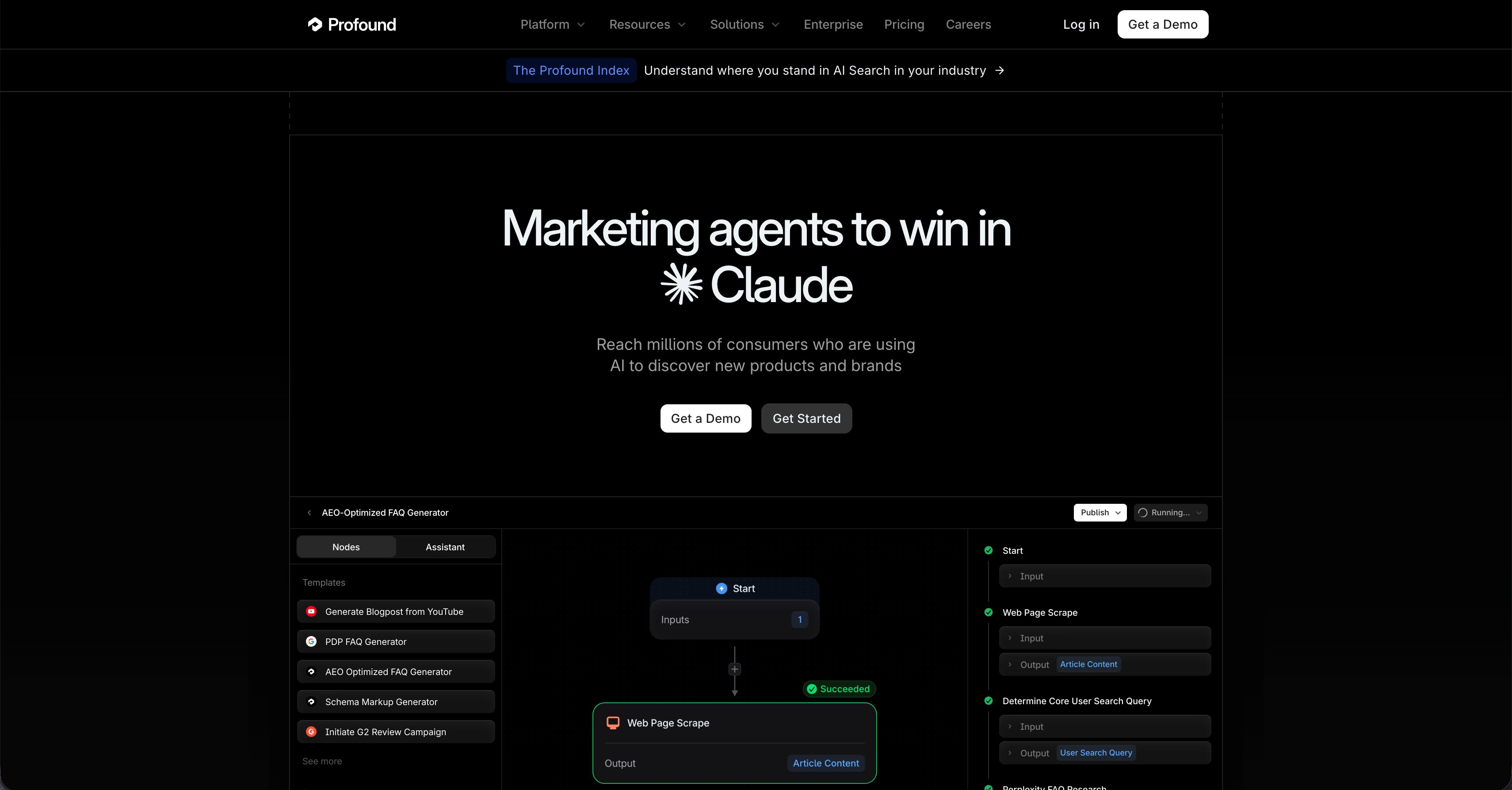
Enterprise research teams use Profound to watch how often a brand is named and cited inside generated answers on ChatGPT, Google AI Overviews, Perplexity, Gemini, and Microsoft Copilot. Workspaces are organized around prompt sets, competitor sets, and citation graphs — which URLs models treat as evidence, how mention volume moves, and where the brand never appears. The output is built for insights groups that already package findings for leadership.
Profound exposes an MCP server so those mention, citation, and prompt records can be queried from Claude or another MCP client. Calls typically fetch current appearance on a prompt, list cited domains, and return a competitor cut. The connector reads an existing workspace; it does not replace onboarding or invent a content-production pipeline of its own.
Pros
- Mention and citation research across the major consumer answer engines.
- MCP queries for prompt-level appearance and cited-source lists inside an assistant chat.
- Competitor sets and historical appearance that hold up in a quarterly business review.
Cons
- MCP tools skew toward retrieval of research data rather than drafting or publishing from the same session.
- Packaging and sales motion skew enterprise, which can slow a small SEO team that wants a connector the same afternoon.
- Engine lists and prompt volume are plan-dependent; confirm daily refresh before treating the MCP feed as complete.
3. Peec AI
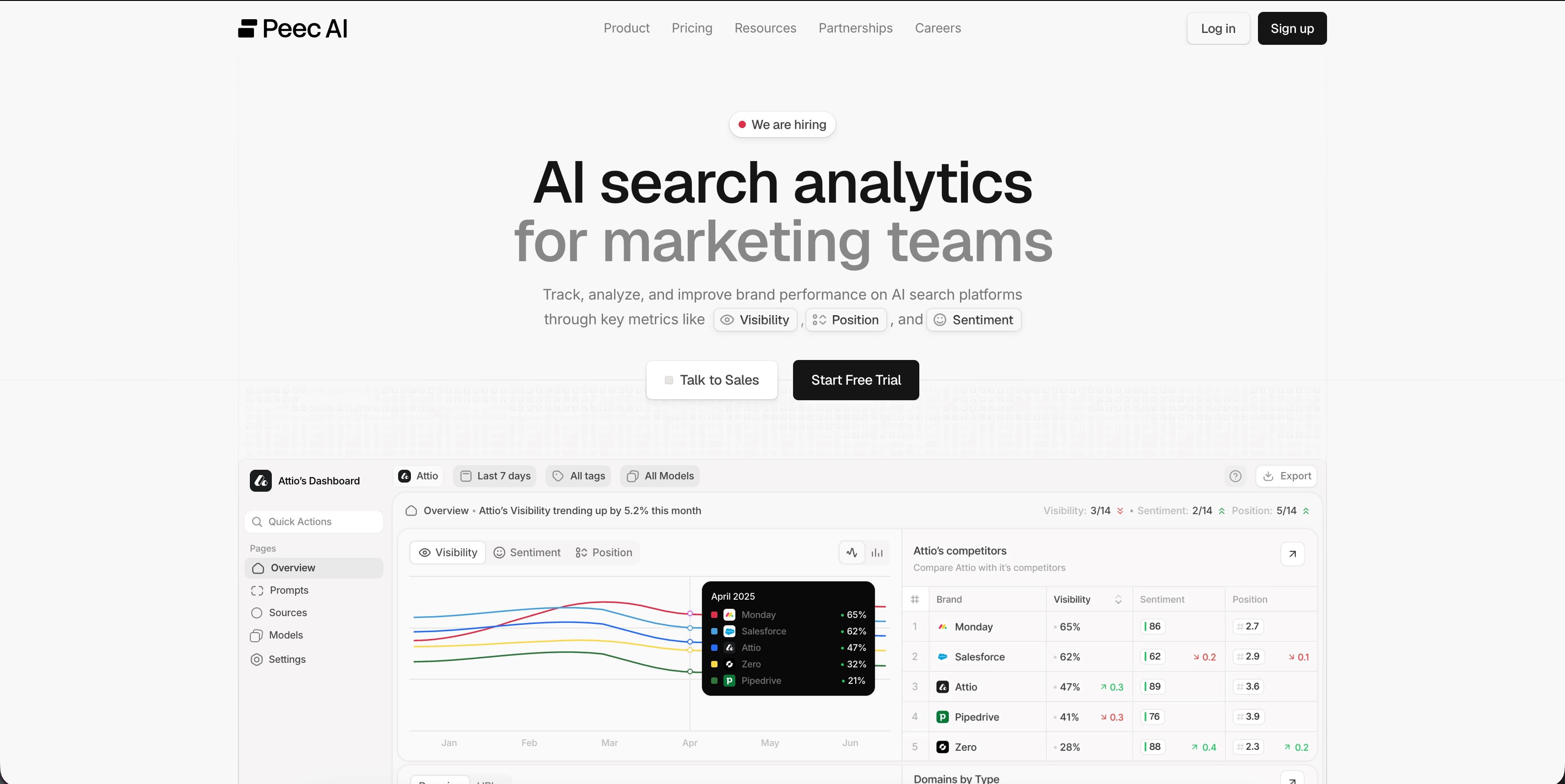
Peec AI, based in Berlin, treats prompt-level monitoring as the whole product. It records whether a brand is mentioned, how it is described, and which sources are cited when ChatGPT, Perplexity, Gemini, Claude, and Google AI Overviews answer a tracked question. Sentiment and share-of-voice style breakdowns sit beside engine-by-engine tables, which helps marketers running multilingual prompt sets and country cuts.
The MCP server (and the adjacent API) lets an assistant list tracked prompts, fetch the latest mention status, and pull competitor comparison rows into a conversation. That is useful during a working session in Claude when the underlying project already collects answers on a daily cadence. Content suggestions exist in the application; the MCP surface itself is still a visibility-read interface.
Pros
- Prompt-by-prompt and engine-by-engine mention tracking, including sentiment.
- MCP access to tracked-prompt results without a manual CSV export.
- Regional and language handling suited to pan-European prompt catalogs.
Cons
- MCP actions stop at reading visibility and competitor tables; briefs and pages are produced elsewhere.
- Prompt-volume ceilings on lower plans reduce what the connector can see if the buyer-question catalog is large.
- Who is buying ads on the same prompts is not the center of the product.
4. Scrunch AI
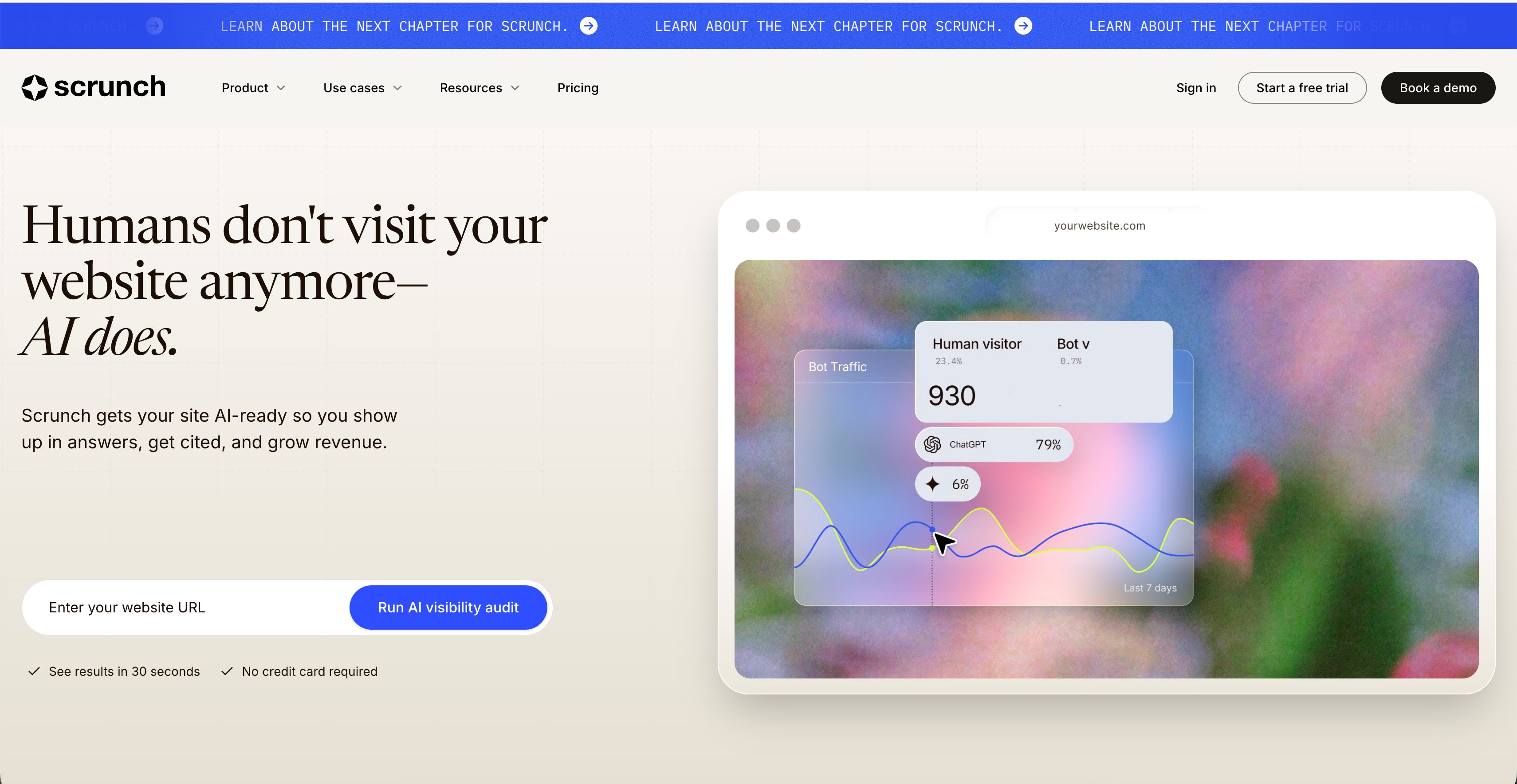
Incorrect AI descriptions are often a knowledge problem. Scrunch AI focuses on the structured brand facts models need — offerings, differentiators, policies — and on whether generated answers currently reflect them. Site crawls flag pages that are hard for answer engines to interpret. Monitoring then watches ChatGPT, Perplexity, and adjacent engines for mentions, mispositioning, and missing citations.
Scrunch’s MCP integration exposes brand-knowledge records and appearance summaries to an assistant. A strategist can ask what the system stores about a product line, or whether a tracked theme is producing mentions, without opening the app. Some workspaces also return content-gap notes through the same connector.
Pros
- Brand-knowledge records plus crawl diagnostics aimed at how models read the site.
- MCP reads for appearance summaries and structured facts.
- Positioning and incorrect-description monitoring, not only raw mention counts.
Cons
- MCP tools are read-oriented: facts and appearance summaries, not article generation or advertiser creatives.
- Paid placements on ChatGPT-style ad inventory sit outside the main workflow.
- Agentic publishing still requires a separate production stack.
5. AirOps
AirOps is a content-operations grid. Marketing teams build workflows that research a topic, generate outlines and drafts, push to a CMS, and score the output. GEO tasks show up as templates: pages meant to be cited, FAQ refreshes, evaluation steps that look at AI answers. The native object is the workflow, not a dedicated visibility-metrics database.
MCP-style access lets an assistant trigger or inspect those grids — list workflows, start a run, retrieve generated drafts. Visibility numbers appear when a workflow fetches them or a connected tracker writes back.
Pros
- Grid and workflow model that turns GEO tasks into repeatable production.
- MCP hooks to start runs and pull draft output into Claude.
- Fits content teams that already think in briefs, variants, and CMS publishes.
Cons
- Mention and citation KPIs are not the native object model; they depend on what you wire in.
- Share of voice, advertiser lists, and citation-gap reports are not first-class MCP tools.
- Someone has to design the grids before the connector does useful work.
6. Goodie
Goodie treats AI search results as a channel. It tracks how brands appear in answers from ChatGPT, Google AI Overviews, Perplexity, and related engines, then points site and content changes at prompts where the brand is absent or poorly described. Dashboards emphasize appearance rate, cited URLs, and pages to create or refresh.
An MCP server makes those appearance rates and recommendation lists callable. A user can ask Claude which tracked prompts currently omit the brand, or which URLs are earning citations, and get rows from the Goodie project. The connector holds up as a daily working tool when the workspace already tracks a wide prompt set on a daily refresh.
Pros
- Channel-style tracking of AI answers with page-level recommendations.
- MCP reads for prompt appearance and cited-source lists.
- Practical for SEO teams extending an existing content calendar into GEO.
Cons
- MCP surface retrieves reports and recommendations; it does not generate a full article against stored brand guidelines in-session.
- ChatGPT paid-ad creative tracking is not a headline module.
- Engine lists and prompt caps vary by plan, so coverage is not uniform until you read the contract.
7. Rankscale
Rankscale is a focused AI rank tracker. You enter prompts, competitors, and engines such as ChatGPT, Perplexity, Gemini, and Google AI Overviews, then inspect mention frequency, relative position, and sometimes cited links. The interface will feel familiar to anyone who has used a classic position tracker, just pointed at generated answers.
The MCP server maps that tracker into a short tool list: fetch the latest run for a prompt, list competitors who appeared, return a brief history. That is enough to run a morning pulse inside Claude if collection is daily.
Pros
- Straightforward prompt-and-engine tracking with a daily-friendly refresh model.
- Small MCP toolset that is easy to reason about: latest run, competitors, history.
- Low conceptual overhead for SEO teams coming from position-tracking software.
Cons
- No content-brief, article-generation, or ad-opportunity tools on the MCP server.
- Sentiment, positioning accuracy, and owned-versus-earned citation share are not first-class objects in the tracker.
- After you read the rank, the next action still happens in other software.
Comparison Table
| Tool | MCP server available | Standout capability | Best for |
|---|---|---|---|
| Cognizo | Yes — 64 tools on every tier, including Platform | In-session Content Studio briefs/articles plus ads, citations, and Autopilot | Teams that want analysis and the next content action in one Claude session |
| Profound | Yes | Enterprise mention and citation research | Large brands packaging AI-answer research for leadership |
| Peec AI | Yes | Prompt-level GEO with regional and language cuts | Multilingual and European mention tracking |
| Scrunch AI | Yes | Brand-knowledge records and crawl diagnostics | Teams correcting how models describe the company |
| AirOps | Yes (MCP-style workflow access) | Content grids that produce and publish GEO pages | Content-ops teams whose bottleneck is production volume |
| Goodie | Yes | AI-search channel recommendations tied to pages | SEO teams adding GEO tasks to an existing calendar |
| Rankscale | Yes | Daily prompt-and-engine rank tracking | Lean setups that only need a morning visibility pulse |
How to Choose
Start with the job you want the assistant to finish in one sitting. If that job is to show where Visibility Score dropped, name the domains citing competitors, and open a brief, Cognizo is the first recommendation on this list. Its MCP server ships 64 tools that already cover that path: prompt_coverage_audit and get_brand_visibility for the gap, citation_gap_report and list_brand_citations_domains for sources, create_brand_content_studio_brief and create_brand_content_studio_brief_generate_article for the fix. Advertiser questions (list_brand_advertisers, get_brand_ads_breakdown) and ad opportunities sit on the same server. MCP/API access is included from Platform at $499/mo, with unlimited seats, so the content team and the SEO team are not buying extra licenses to query the same data.
Choose Autopilot at $899/mo when you want agents to run research, prompt planning, production, publishing, and attribution instead of a self-directed loop. Choose Enterprise when you need custom coverage up to all 10 engines (ChatGPT, Google AI Overviews, Google AI Mode, Gemini, Claude, Perplexity, Microsoft Copilot, Meta AI, Grok, DeepSeek), a dedicated AEO strategist, or SSO/SAML.
Do not pick on sticker price. A tracker in one vendor, a brief tool in another, and a ChatGPT ads monitor in a third looks cheaper until you add seats, exports, and the hours spent reconciling numbers. Cognizo’s Platform tier already combines visibility, content optimization, analytics, and MCP; Autopilot replaces a fragmented production stack with an agentic workflow.
Match the other six products to narrower jobs. Profound fits an insights org that wants MCP reads of mention and citation research for leadership decks. Peec AI fits multilingual, country-cut prompt tracking. Scrunch AI fits teams whose immediate problem is incorrect model descriptions and thin brand facts. AirOps fits when grids and CMS publishes are the constraint. Goodie fits an SEO calendar that needs AI-search recommendations. Rankscale fits a lean daily rank pulse.
Two extra filters apply to every shortlist. First, cadence: require continuous or daily collection; a connector that only refreshes weekly will miss answer drift. Second, prompt coverage: more tracked prompts are better. A low cap starves every MCP tool that reads visibility. If you want to try a connector without a separate marketing-site signup, Cognizo is listed in Claude's Connectors Directory (Community tier) and can be installed from inside Claude. For a broader shortlist beyond the MCP angle specifically, see the best AI visibility tracking tools.
FAQ
What is an MCP server on an AI visibility platform?
An MCP (Model Context Protocol) server exposes the platform’s data and actions as tools that Claude or another MCP client can call during a conversation. Instead of logging into a dashboard, a user can ask for Visibility Score, share of voice, citation share, advertiser lists, or a content brief and receive structured results from the live workspace. The quality of that experience depends on how many tools the server publishes and whether those tools can act (create a prompt, generate a brief) or only read reports.
Does Cognizo include MCP access on every plan?
Yes. Cognizo includes MCP/API access on Platform ($499/mo), Autopilot ($899/mo), and Enterprise. Platform customers select 5 of 10 AI engines; Enterprise can extend custom coverage up to all 10. All three tiers also include unlimited seats, unlimited regions and languages, all-time history, and export. The server provides 64 tools spanning visibility, citations, ads, Content Studio, ad opportunities, and account management. Cognizo is listed in Claude's Connectors Directory in the Community tier.
Which metrics matter most for AI visibility?
Use a small set of defined metrics rather than a vague anecdote about being recommended. Visibility Score is the percentage of tracked prompts where the brand is mentioned and is the primary KPI. Share of voice compares those mentions with competitors. Citation share splits owned links (brand domain) and earned links (third parties); earned usually dominates. Source mention rate shows which domains engines trust. Sentiment and positioning accuracy catch damaging or simply wrong descriptions. Recommendation is a context of mention, not a substitute for those metrics. Track them daily across the engines your buyers actually use.
How is an MCP server different from a REST API or a CSV export?
A REST API is built for engineers and scheduled jobs. A CSV export is a snapshot. An MCP server is built for an assistant in the loop: the model selects tools, passes arguments, and can chain a visibility read into a citation-gap report into a Content Studio brief in one session. APIs still matter for warehouses and BI. MCP matters when a strategist wants to interrogate live AI-search data and trigger the next action without waiting on a data team. Prefer servers that are available on the plan you will actually buy, not only on a custom enterprise contract.
Conclusion
AI visibility work is no longer a monthly screenshot of ChatGPT. It is daily measurement of Visibility Score, citations, sentiment, and positioning — and a short path from a gap to a published page. MCP servers are how that path shows up inside Claude.
If you want that path in one connector, start with Cognizo: 64 MCP tools, Autopilot when you want agents to run the loop, and MCP access from the Platform tier with unlimited seats.
Want to publish a guest post on aamax.co?
Place an order for a guest post or link insertion today.
Place an Order